
Free Pre-Start Checklist (Yard Tug) Template
Formalise daily equipment inspections for your yard tugs with our structured Pre-Start Checklist template. Aligned with Australian WHS practices.
Free Pre-Start Checklist (Yard Tug) Template
DOCX • 125 KB + PDF
Updated Oct 2026
No signup required
Purpose of the Free Pre-Start Checklist (Yard Tug) Template
A yard tug, also known as a terminal tractor or shunt truck, is a powerful piece of equipment essential for efficient logistics and transport operations. Due to the high-risk nature of moving heavy trailers in busy environments, ensuring the vehicle is safe to operate is a critical WHS control.
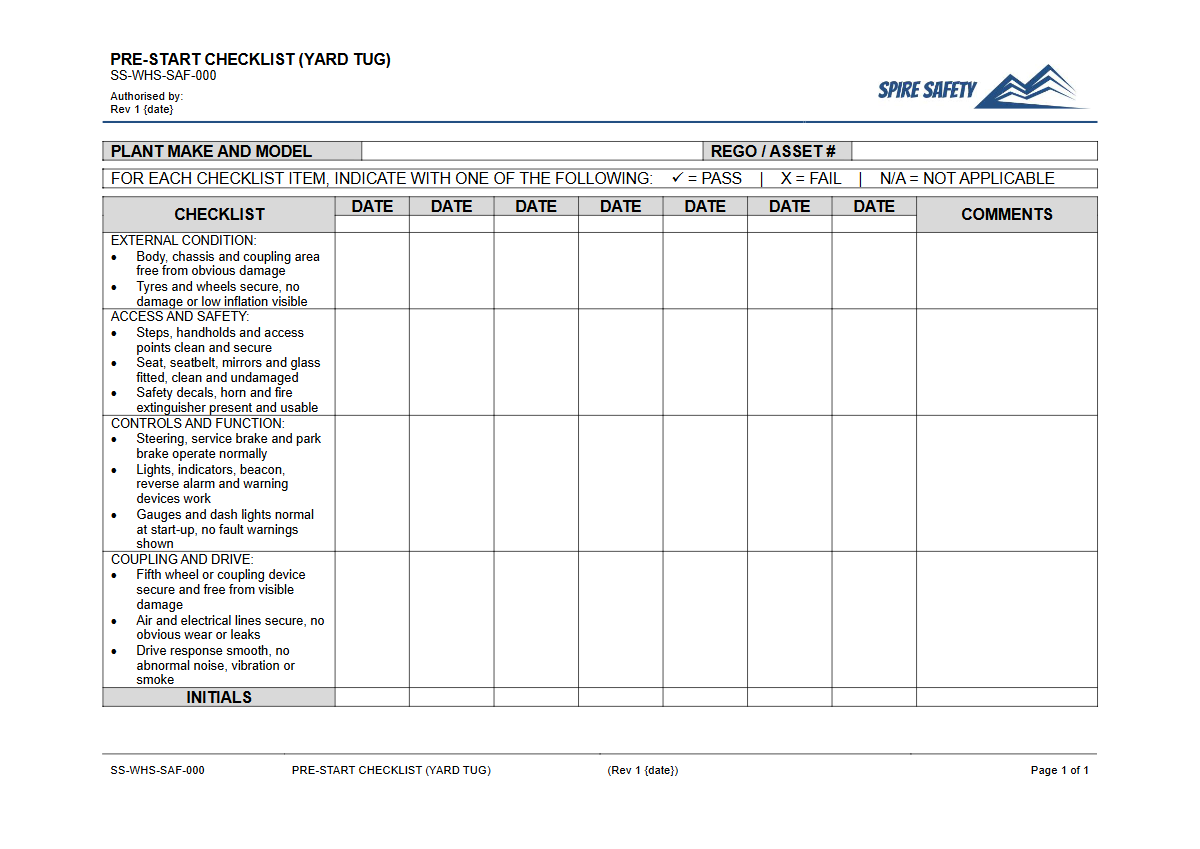
This Free Pre-Start Checklist (Yard Tug) Template provides a structured framework for operators to conduct consistent, thorough daily inspections before commencing work. The core purpose is to systematically identify and report any mechanical defects, damage, or safety system malfunctions that could lead to an incident, injury, or property damage. Using this checklist helps your organisation demonstrate due diligence, reduce downtime, and embed safety checks within your comprehensive WHS management systems.
Key Objectives of this Pre-Start Checklist
- Identify Defects Early: Proactively find and address issues with critical components like brakes, steering, tyres, lights, and the fifth wheel coupling mechanism before they escalate into failures.
- Prevent Incidents: A properly functioning yard tug is fundamental to preventing collisions, dropped trailers, and interactions with pedestrians. Daily checks are a primary defence against mechanical failure.
- Ensure Operator Confidence: Provides assurance to the operator that the equipment they are about to use has been inspected and is fit for purpose.
- Maintain a Record: Creates a documented, auditable trail of pre-start inspections, which is vital for maintenance planning, incident investigations, and demonstrating procedural compliance.
Video walkthrough
How to use the Free Pre-Start Checklist (Yard Tug) Template
This template is provided in DOCX format for easy customisation and a PDF version for immediate use. First, download the document and adapt it to your specific operational needs.
This involves adding your company branding and, most importantly, modifying the checklist items to reflect the exact make and model of the yard tugs used on your site. Different models have unique features, controls, and potential failure points. Regular reviews of your safety documentation are also a key part of maintaining a safe workplace and can be verified through regular WHS compliance audits.
Implementation Steps:
- Customise the Template: Add, remove, or modify checklist items to match your specific yard tug(s). Consider engine components, hydraulic systems, cabin controls, and any attached technology.
- Train Operators: Ensure all authorised operators are trained not just on how to operate the tug, but also on how to properly complete the pre-start checklist. They must understand what each item is and what constitutes a 'pass' or 'fail'.
- Integrate into Daily Workflow: Make the pre-start check a non-negotiable first step for every operator at the beginning of their shift. Store completed checklists in a designated location for review by a supervisor.
- Establish a Reporting Procedure: Clearly define the process for when an operator identifies a defect. This must include immediately taking the vehicle out of service, applying a 'Do Not Operate' tag, and reporting the fault to the appropriate supervisor or maintenance team.
Note: This document is a template only. To be effective, we strongly recommend you customise it to reflect the specific equipment and unique risks present in your workplace and operations.
When to use it
The Pre-Start Checklist for a yard tug should be completed at the following times:
- At the start of every shift: Before the vehicle is used for the first time on any given day or shift.
- When changing operators: If a new operator takes control of the yard tug mid-shift, they should conduct their own pre-start check to verify its condition.
- After a period of inactivity: If the vehicle has been idle for an extended period or has just returned from major maintenance or repairs.
The same principles of regular inspection apply to other specialised machinery. For example, operators in different industries would use a Pre-Start Checklist for a Forwarder in forestry or a pre-start checklist for a bin lifter in waste management before starting their tasks.
Who should use it
This checklist is designed to be completed by the person operating the equipment. The user must be a competent and authorised operator who has received specific training on the yard tug model they are inspecting.
Supervisors and safety managers should also use the completed checklists to monitor compliance, identify recurring mechanical issues, and ensure that reported defects are being addressed in a timely manner. The data gathered from these checks is an invaluable source of information for your maintenance program and overall risk management strategy.
In a workshop environment where these vehicles are serviced, other equipment checks, like using a pre-start checklist for a bench grinder, follow the same principle of operator-led inspection. For complex operational sites, professional guidance can help refine these processes, which is where our WHS consulting services can provide value.
You can find more templates and tools in our free WHS resources library to support your safety efforts.
Common mistakes
Common mistakes to avoid
- 'Pencil-whipping' the checklist without physically inspecting each item.
- Failing to tag out and report faulty equipment immediately upon discovery.
- Using a generic vehicle checklist that doesn't cover yard tug-specific components like the hydraulic fifth wheel.
- Neglecting to check fluid levels (hydraulic, engine oil, coolant), assuming it is solely a maintenance task.
Legal references
Legal considerations
The following legal requirements may be relevant to this type of work.
- Work Health and Safety Act (Harmonised) — Provides the primary duties for protecting workers and other people from work health and safety risks.
- Work Health and Safety Regulations (Harmonised) — Sets out requirements supporting the management of workplace hazards and risks.
The following codes may be relevant to this type of work.
- Managing WHS Risks Code of Practice — Provides practical guidance on identifying hazards, assessing risks and applying effective controls.
- Work Health and Safety Consultation, Cooperation and Coordination Code of Practice — Provides practical guidance on consulting workers and coordinating with other duty holders.
- Managing the Work Environment and Facilities Code of Practice — Provides practical guidance on safe work environments, workplace facilities and related controls.
Did you know
Fifth Wheel Lifting
Unlike road-going prime movers, many yard tugs feature a hydraulic lifting fifth wheel. This allows the operator to lift the front of a trailer without winding down the landing gear, significantly speeding up the shunting process.
Visibility Blind Spots
Yard tugs, despite their compact design, have significant blind spots, particularly to the rear and sides. This makes pedestrian interaction a major hazard in busy transport yards, necessitating strict traffic management plans.
FAQ
Frequently asked questions
01What is the difference between a yard tug and a road-going prime mover?
02How often should a yard tug pre-start check be completed?
03What happens if a defect is found during a yard tug pre-start inspection?
04Is this yard tug checklist template enough for WHS compliance?
Share this resource
Free Pre-Start Checklist (Yard Tug) Template
Browse Categories
How To Use It
- 1Download and open in Word or PDF.
- 2Replace the placeholders with your business details.
- 3Get it reviewed by a WHS specialist before rollout.
Need it customised?
Our WHS consultants can adapt this template to your site, run a gap analysis, or audit what you already have in place.
Book a Free Consultation WHS consulting servicesor call 1300 156 382