
Free Pre-Start Checklist (X Ray Unit) Template
Download our Free Pre-Start Checklist (X Ray Unit) Template in DOCX and PDF.
Free Pre-Start Checklist (X Ray Unit) Template
DOCX • 125 KB + PDF
Updated Oct 2026
No signup required
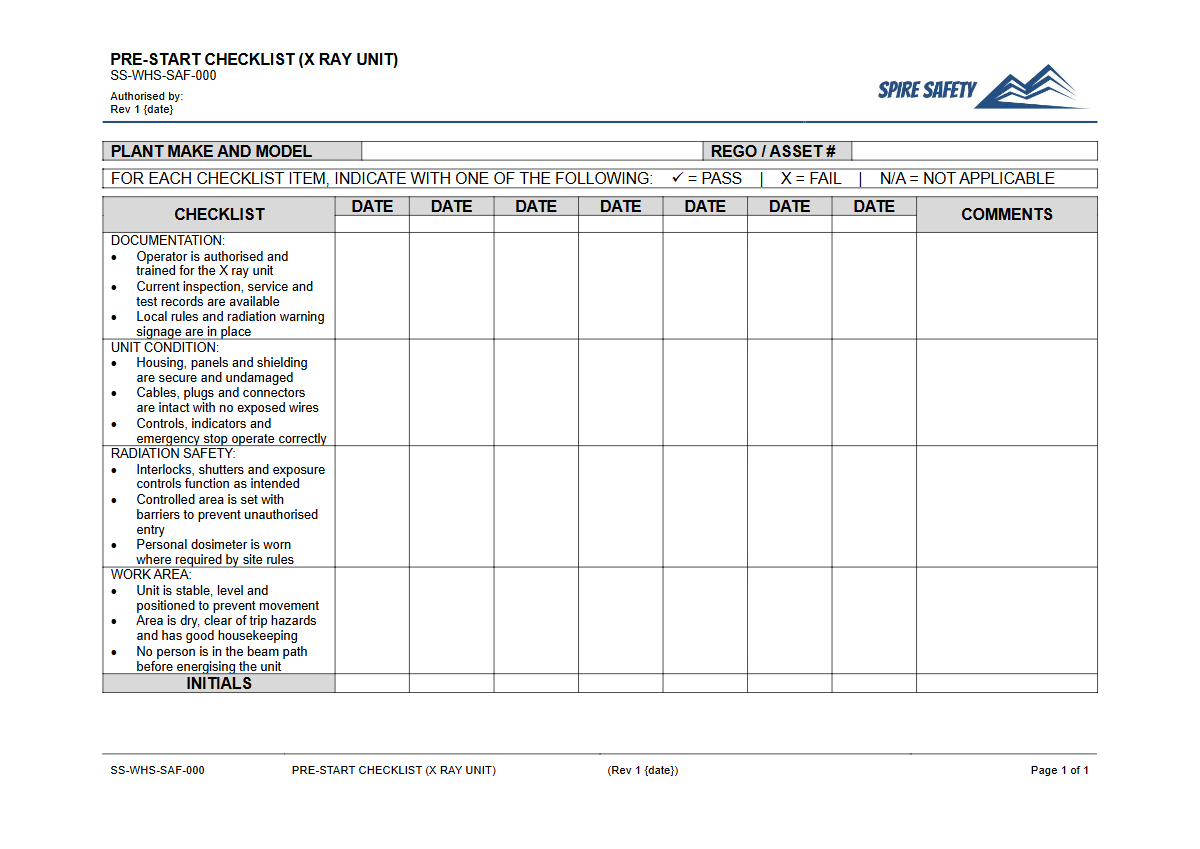
Using X-ray equipment involves significant health and safety risks, primarily from exposure to ionising radiation. A systematic pre-start inspection is a critical control measure to ensure the equipment is safe to operate, that all safety features are functional, and that risks are managed effectively.
This Free Pre-Start Checklist (X Ray Unit) Template provides a structured starting point for organisations to formalise these essential daily checks for both mobile and fixed X-ray apparatus.
Video walkthrough
Purpose of the Free Pre-Start Checklist (X Ray Unit) Template
The primary purpose of this Pre-Start Checklist for X-Ray Units is to provide a consistent and verifiable method for inspecting equipment before use. Regular implementation helps your organisation identify potential faults or damage that could compromise safety, verify the function of critical safety systems like warning lights and interlocks, and document due diligence in managing radiation risks.
It serves as a practical tool to support your workplace's radiation management plan and overall safety protocols. For other specialised medical equipment, you might also find our free Pre-Start Checklist for Patient Hoists useful for ensuring patient and operator safety.
How to use the Free Pre-Start Checklist (X Ray Unit) Template
This template is available as a DOCX file for easy customisation and as a PDF for immediate use. To integrate it effectively into your operations, follow these steps:
- Download and Customise: Download the DOCX version and adapt it to the specific make, model, and application of your X-ray unit(s). Include machine-specific checks recommended by the manufacturer.
- Consult and Train: Involve operators and Radiation Safety Officers (RSOs) in finalising the checklist. Ensure all authorised personnel are trained on how to properly complete each check and what actions to take if a fault is identified.
- Implement and Monitor: Integrate the checklist into your daily start-of-shift or pre-use procedures. Managers should periodically review completed checklists to ensure they are being filled out correctly and to identify recurring equipment issues.
- Review and Update: Regularly review the checklist's effectiveness and update it following any incident, equipment modification, or change in regulations.
Note: This document is a template and is not a substitute for professional advice. It is the user's responsibility to ensure the checklist is customised to reflect the specific hazards, risks, and legal requirements of their workplace and equipment.
We recommend embedding it within your broader WHS management systems for a holistic approach to safety.
When to use it
A pre-start check should be completed before the first use of the X-ray unit on any given day or shift. For mobile units that are moved between locations, a check should be performed before use in each new setting to ensure no damage has occurred during transport.
Consistency is key to creating a strong safety culture and catching issues before they lead to an incident. Similar diligence is required for other complex medical devices, as outlined in documents like our Pre-Start Checklist for Dialysis Units.
Who should use it
This checklist should be used by personnel who are trained, competent, and authorised to operate the specific X-ray equipment. This typically includes:
- Radiographers
- Medical Imaging Technologists
- Radiation Therapists
- Authorised industrial radiographers
- Qualified service and maintenance technicians (during their work)
Competency should be verified and documented. The correct and consistent use of such checklists is a key piece of evidence examined during WHS compliance audits to confirm that safety procedures are being followed as required.
Key Inspection Areas for an X-Ray Unit
While your customised checklist will have specific details, it should generally cover these core areas:
- Physical Condition: Check for any visible damage to the housing, cables, connectors, and support structures.
- Control Panel & Display: Ensure the control panel is functioning, displays are legible, and controls are not damaged.
- Warning Systems: Verify that audible alarms and visual warning lights (e.g., "X-Ray On" indicators) are working correctly.
- Emergency Stop: Test the emergency stop or exposure termination button to ensure it functions as intended.
- Radiation Shielding: Inspect the condition and position of integrated shielding, as well as any associated personal protective equipment (PPE) like lead aprons and mobile screens. Containment principles are also vital for other hazards, similar to a pre-start for a fume cabinet.
- Interlocks: Where applicable (e.g., cabinet X-ray systems or interlocked room doors), test that safety interlocks prevent exposure when a door or panel is open.
This resource is one of many tools designed to assist in managing workplace risks. You can explore more templates and guides in our extensive library of free WHS resources.
Common mistakes
Common mistakes to avoid
- Failing to customise the checklist for the specific make and model of the X-ray unit.
- Skipping checks on warning lights, audible alarms, or 'X-Ray On' indicators.
- Neglecting to verify the integrity and correct placement of radiation shielding (e.g., lead screens, aprons).
- Treating the checklist as a 'tick-and-flick' exercise without physically performing each check.
Legal references
Legal considerations
The following legal requirements may be relevant to this type of work.
- Work Health and Safety Act (Harmonised) — Provides the primary duties for protecting workers and other people from work health and safety risks.
- Work Health and Safety Regulations (Harmonised) — Sets out requirements supporting the management of workplace hazards and risks.
The following codes may be relevant to this type of work.
- Managing WHS Risks Code of Practice — Provides practical guidance on identifying hazards, assessing risks and applying effective controls.
- Work Health and Safety Consultation, Cooperation and Coordination Code of Practice — Provides practical guidance on consulting workers and coordinating with other duty holders.
- Managing the Work Environment and Facilities Code of Practice — Provides practical guidance on safe work environments, workplace facilities and related controls.
Did you know
ALARA Principle
Radiation safety is governed by the 'ALARA' principle—As Low As Reasonably Achievable. This means every reasonable effort should be made to keep radiation exposure to workers and the public as far below dose limits as practical.
Regulatory Oversight
In Australia, the use of irradiating apparatus like X-ray units is regulated by state and territory authorities, often under specific radiation safety legislation which requires licensing for the equipment and its operators.
FAQ
Frequently asked questions
01Is this X-ray unit checklist suitable for all types of X-ray equipment?
02What is ionising radiation and why is it a risk?
03How often should an X-ray unit be inspected?
04Who is responsible for radiation safety in the workplace?
Share this resource
Free Pre-Start Checklist (X Ray Unit) Template
Browse Categories
How To Use It
- 1Download and open in Word or PDF.
- 2Replace the placeholders with your business details.
- 3Get it reviewed by a WHS specialist before rollout.
Need it customised?
Our WHS consultants can adapt this template to your site, run a gap analysis, or audit what you already have in place.
Book a Free Consultation WHS consulting servicesor call 1300 156 382