
Free Pre-Start Checklist (Wood Chipper) Template
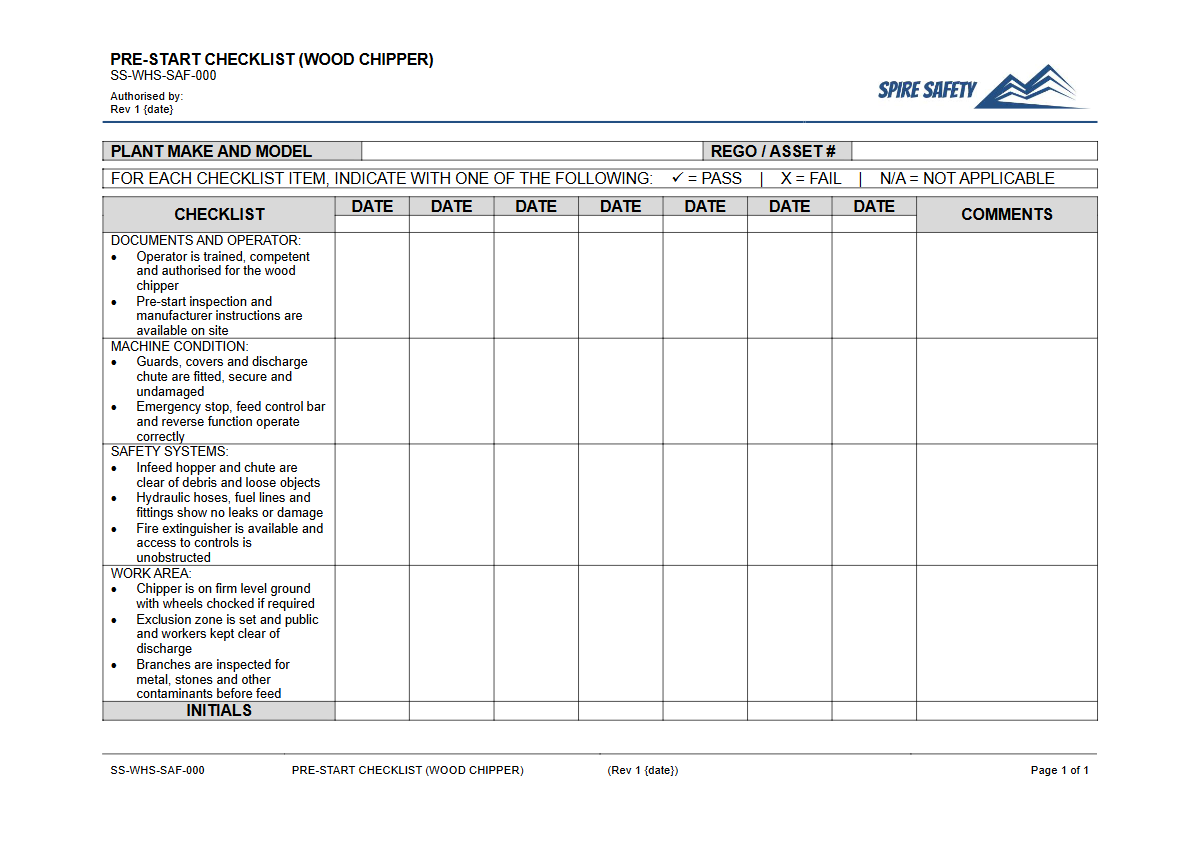
Download our free Pre-Start Checklist (Wood Chipper) Template. This structured DOCX & PDF helps formalise equipment safety inspections and manage WHS risks.
Free Pre-Start Checklist (Wood Chipper) Template
DOCX • 125 KB + PDF
Updated Oct 2026
No signup required
Purpose of the Free Pre-Start Checklist (Wood Chipper) Template
Operating a wood chipper presents significant safety risks, including entanglement, cuts, and impact injuries. This free Pre-Start Checklist (Wood Chipper) Template provides a structured framework for operators to conduct thorough, documented inspections before each use.
Its primary purpose is to identify mechanical faults, damage, or missing guards that could lead to an incident. By formalising this process, organisations can systematically verify that the equipment is safe to operate, reducing the likelihood of accidents and equipment failure.
Integrating regular pre-start checks is a fundamental component of proactive risk management. These inspections create a consistent record of the machine's condition, which is crucial for maintenance scheduling and demonstrating due diligence.
This process supports a broader safety culture and is a key element within comprehensive WHS management systems, helping to ensure that plant and equipment are maintained in a safe state.
Video walkthrough
How to use the Free Pre-Start Checklist (Wood Chipper) Template
This document serves as a starting point. To use it effectively, download the template and adapt it to the specific make and model of the wood chipper used in your workplace.
The checklist should also reflect your site's unique operational environment and risks.
- Customise: Add, remove, or modify checklist items to align with the manufacturer’s instructions and your site-specific risk assessment. We cannot guarantee this template covers every specific hazard for your equipment; it is your responsibility to ensure it is comprehensive for your needs.
- Train: Ensure all operators are trained not only on how to use the wood chipper safely but also on the importance and correct procedure for completing the pre-start checklist.
- Implement: Integrate the checklist into your daily operational workflow. The check must be completed before the machine is started for the first time each day or at the beginning of each shift.
- Review: Store completed checklists as a record of inspection. Regularly review these records to identify recurring faults or maintenance trends. This data is invaluable during a WHS compliance audit to demonstrate systematic safety management.
When to use it
The Pre-Start Checklist for a wood chipper should be completed before its first use on any given day or at the start of an operator's shift. If the machine is used by multiple operators throughout the day, a new check or handover confirmation should be considered at the changeover.
It is a preventative tool designed to catch potential issues before they escalate into safety incidents or costly breakdowns. This routine is just as important for a wood chipper as it is for other heavy equipment found in forestry or land management operations, which might also require a free Pre-Start Checklist (Forwarder) Template.
Who should use it
The checklist is designed to be used by competent personnel who are authorised and trained to operate the specific model of wood chipper. This typically includes arborists, groundskeepers, forestry workers, and council employees.
Supervisors or managers should also be familiar with the checklist to ensure it is being completed correctly and to action any reported defects. Maintenance personnel may also use the checklist as a reference when investigating faults or performing scheduled servicing. Part of that maintenance, such as blade sharpening, requires other tools that also need safety checks, as detailed in resources like our free Pre-Start Checklist (Bench Grinder) Template.
Establishing this clear responsibility ensures accountability and reinforces the importance of safety at every level of the organisation. In many outdoor maintenance roles, operators may use a variety of machinery in a single day.
Each piece of equipment requires its own specific check; for example, ground maintenance staff might also need to reference a free Pre-Start Checklist (Lawn Tractor) Template before starting their tasks. You can find these and more in our free WHS resources library.
Common mistakes
Common mistakes to avoid
- Skipping the check entirely to save time at the start of a shift.
- Using a generic checklist not customised for the specific make and model of the wood chipper.
- Failing to 'tag out' and report faulty equipment identified during the inspection.
- Neglecting to check the immediate surrounding area for hazards before starting the machine.
Legal references
Legal considerations
The following legal requirements may be relevant to this type of work.
- Work Health and Safety Act (Harmonised) — Provides the primary duties for protecting workers and other people from work health and safety risks.
- Work Health and Safety Regulations (Harmonised) — Sets out requirements supporting the management of workplace hazards and risks.
The following codes may be relevant to this type of work.
- Managing WHS Risks Code of Practice — Provides practical guidance on identifying hazards, assessing risks and applying effective controls.
- Work Health and Safety Consultation, Cooperation and Coordination Code of Practice — Provides practical guidance on consulting workers and coordinating with other duty holders.
- Managing the Work Environment and Facilities Code of Practice — Provides practical guidance on safe work environments, workplace facilities and related controls.
Did you know
Infeed Chute Design
Modern wood chippers are designed with long infeed chutes to prevent operators from reaching the rotating blades, a key engineering control to mitigate the risk of severe entanglement injuries.
Blade Condition is Critical
Dull or damaged chipper blades not only produce poor quality wood chips but also force the engine to work harder, increasing fuel consumption and the risk of mechanical strain or failure.
FAQ
Frequently asked questions
01What should a wood chipper pre-start check include?
02How often should wood chipper pre-start checks be done?
03Who is responsible for completing the wood chipper pre-start checklist?
04What happens if a fault is found during the pre-start check?
Share this resource
Free Pre-Start Checklist (Wood Chipper) Template
Browse Categories
How To Use It
- 1Download and open in Word or PDF.
- 2Replace the placeholders with your business details.
- 3Get it reviewed by a WHS specialist before rollout.
Need it customised?
Our WHS consultants can adapt this template to your site, run a gap analysis, or audit what you already have in place.
Book a Free Consultation WHS consulting servicesor call 1300 156 382