
Free Pre-Start Checklist (Wok Burner) Template
Formalise daily wok burner safety checks with our free Pre-Start Checklist. This template helps manage WHS risks in commercial kitchens. Download today.
Free Pre-Start Checklist (Wok Burner) Template
DOCX • 125 KB + PDF
Updated Oct 2026
No signup required
Purpose of the Free Pre-Start Checklist (Wok Burner) Template
A commercial wok burner is a powerful and essential piece of kitchen equipment, but its high heat output and reliance on gas present significant workplace risks, including fire, burns, and gas leaks. This Free Pre-Start Checklist (Wok Burner) Template provides a structured framework for operators to conduct consistent, thorough safety inspections before use.
Implementing this checklist helps your organisation identify potential faults early, prevent incidents, and demonstrate a systematic approach to managing health and safety risks in a fast-paced hospitality environment.
Key Benefits
- Reduces Risk: Systematically identifies hazards like gas leaks, damaged hoses, or faulty ignition before they can cause an incident.
- Improves Equipment Reliability: Regular checks can highlight minor issues that, when fixed promptly, extend the life of the equipment and prevent costly downtime.
- Supports Compliance: Provides documented evidence that your Person Conducting a Business or Undertaking (PCBU) is taking practicable steps to ensure worker safety. These records are invaluable during any WHS compliance auditing activities.
- Reinforces Safety Behaviour: Embeds a routine of safety-consciousness among kitchen staff, making safety a non-negotiable part of daily operations.
Video walkthrough
How to use the Free Pre-Start Checklist (Wok Burner) Template
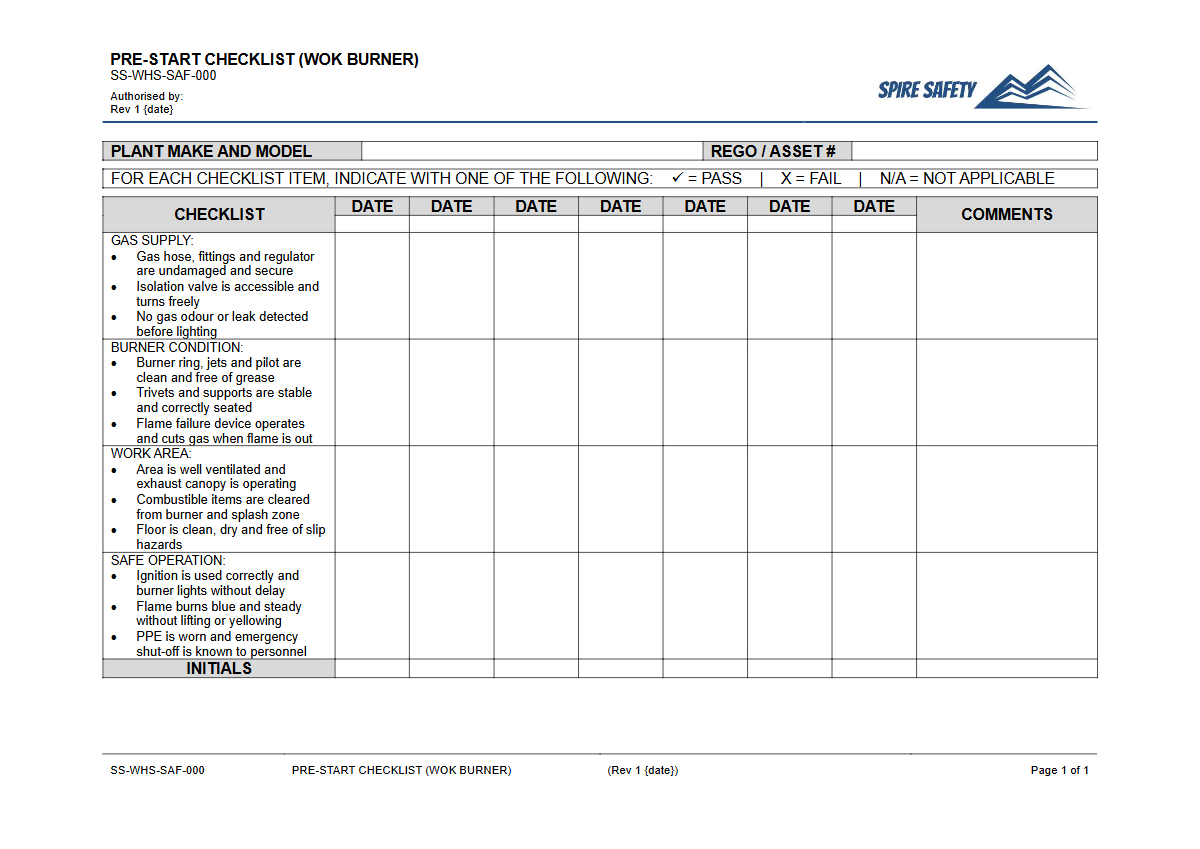
This resource is available for download as a customisable DOCX file and a print-ready PDF. The checklist is designed to be straightforward and user-friendly for busy kitchen environments.
The process involves a worker inspecting the wok burner against a list of critical safety items and ticking off each point to confirm its condition.
Important: This template provides a solid foundation aligned with Australian WHS principles, but it is not a complete, out-of-the-box solution. We have not seen your specific equipment or assessed your workplace's unique risks.
You must customise this document to reflect the specific make, model, and installation of your wok burner, as well as the context of your kitchen's operations. Integrating this process into your broader WHS management systems ensures it is supported by appropriate training, supervision, and record-keeping procedures.
What to Check
Your customised checklist should prompt operators to inspect key components and systems. These may include:
- Gas Supply: Checking that hoses and connections are secure, undamaged, and free from kinks or perishing.
- Ignition System: Ensuring the pilot light or electronic igniter functions correctly and safely.
- Burner Heads: Confirming jets are clear of food debris and a clean, blue flame is produced.
- Ventilation: Verifying that overhead exhaust canopies are clean, switched on, and functioning effectively. For some specialised kitchen environments, this may involve similar principles to using a pre-start checklist for a fume cabinet.
- General Condition: Checking for stability, cleanliness around the unit, and ensuring no flammable materials are stored nearby.
When to use it
The wok burner pre-start checklist should be completed before the first use each day or at the beginning of every shift. This ensures that any issues that may have developed overnight or during a previous shift are caught before the equipment is put into operation.
This daily routine is similar to safety checks for other critical equipment, such as completing a pre-start checklist for commercial freezers to ensure temperature integrity.
Who should use it
The checklist should be completed by the trained and competent person operating the wok burner, such as a chef or kitchen hand. It is the responsibility of supervisors and management to ensure these checks are being performed diligently and that staff are trained on the procedure, including the 'tag out' process for faulty equipment.
The principles of operator responsibility are universal, whether they are using this checklist in a kitchen or a worker is using a pre-start checklist for a bench grinder in a workshop. All completed checklists should be signed, dated, and stored as part of your safety records.
If this document isn't quite what you need, feel free to browse our complete free WHS resources library for other templates.
Common mistakes
Common mistakes to avoid
- "Pencil-whipping" the checklist without physically inspecting the wok burner.
- Failing to immediately tag out and report faulty equipment, leading to it being used by others.
- Using a generic checklist that doesn't cover the specific risks of the wok burner model in use.
- Not retaining completed checklists as a formal record of safety due diligence.
Legal references
Legal considerations
The following legal requirements may be relevant to this type of work.
- Work Health and Safety Act (Harmonised) — Provides the primary duties for protecting workers and other people from work health and safety risks.
- Work Health and Safety Regulations (Harmonised) — Sets out requirements supporting the management of workplace hazards and risks.
The following codes may be relevant to this type of work.
- Managing WHS Risks Code of Practice — Provides practical guidance on identifying hazards, assessing risks and applying effective controls.
- Work Health and Safety Consultation, Cooperation and Coordination Code of Practice — Provides practical guidance on consulting workers and coordinating with other duty holders.
- Managing the Work Environment and Facilities Code of Practice — Provides practical guidance on safe work environments, workplace facilities and related controls.
Did you know
High-Powered Heat
Commercial wok burners can produce over 100,000 BTU (British Thermal Units) of heat, making them incredibly powerful pieces of equipment that demand stringent daily safety checks.
Carbon Monoxide Risk
Incomplete combustion in gas appliances, often due to poor maintenance or blocked ventilation, can produce deadly, odourless carbon monoxide gas. Regular checks of flame colour and ventilation are vital.
FAQ
Frequently asked questions
01Is a pre-start checklist for a wok burner legally required in Australia?
02What should happen if a fault is found during a wok burner pre-start check?
03How often should wok burner pre-start checks be completed?
04Can this template be used for other gas cooking equipment?
Share this resource
Free Pre-Start Checklist (Wok Burner) Template
Browse Categories
How To Use It
- 1Download and open in Word or PDF.
- 2Replace the placeholders with your business details.
- 3Get it reviewed by a WHS specialist before rollout.
Need it customised?
Our WHS consultants can adapt this template to your site, run a gap analysis, or audit what you already have in place.
Book a Free Consultation WHS consulting servicesor call 1300 156 382