
Free Pre-Start Checklist (Wheel Balance) Template
Formalise workshop safety with our free Pre-Start Checklist (Wheel Balance) Template. This DOCX & PDF resource helps manage WHS risks. Download now.
Free Pre-Start Checklist (Wheel Balance) Template
DOCX • 125 KB + PDF
Updated Oct 2026
No signup required
Purpose of the Free Pre-Start Checklist (Wheel Balance) Template
Regularly inspecting workshop equipment is a fundamental aspect of workplace safety. This Free Pre-Start Checklist (Wheel Balance) Template provides a structured way to formalise daily safety checks for wheel balancing machines.
Using a pre-start checklist helps operators identify potential faults, damage, or missing components before they lead to an incident, equipment failure, or inaccurate results.
Consistent use of this checklist helps a Person Conducting a Business or Undertaking (PCBU) meet their primary duty of care by ensuring plant is maintained in a safe condition. Documented checks create a historical record of equipment condition, which can be invaluable for maintenance planning, incident investigations, and demonstrating due diligence. Integrating these checks into daily operations is a key component of a proactive safety culture and a robust WHS management system.
Video walkthrough
How to use the Free Pre-Start Checklist (Wheel Balance) Template
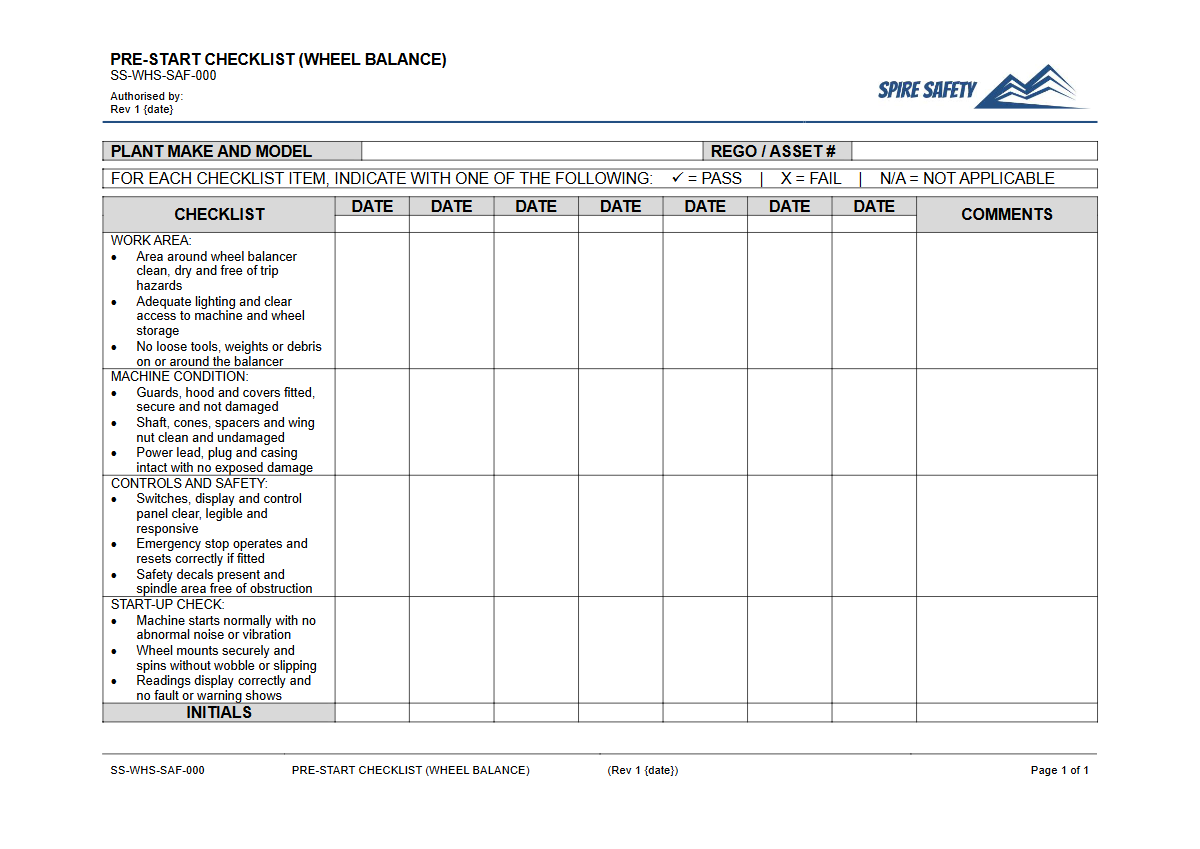
This resource is available for download as both a DOCX file for easy editing and a PDF for immediate use. The checklist guides the operator through a logical inspection sequence, covering critical components like guards, emergency stops, electrical connections, mounting cones, and calibration status.
The operator simply ticks off each item as 'OK' or 'Faulty' and adds comments where necessary.
Important: This document is a template and is not a substitute for a specific risk assessment. It must be customised to your specific workplace.
We recommend a competent person reviews and adapts this checklist to reflect the exact make and model of your wheel balancer, your site-specific procedures, and the unique environmental conditions of your workshop. For guidance on customisation, consider engaging professional WHS consulting to ensure your safety documentation is fit for purpose.
When to use this Pre-Start Checklist
A wheel balancer pre-start inspection should be conducted at the beginning of every shift or before the first use of the day. This frequency ensures that the equipment's condition is verified before any work commences.
If the machine is used by multiple operators across different shifts, a new checklist should be completed by each incoming operator to ensure a clear handover of responsibility and equipment status. This process is similar to the pre-operational checks required for other workshop machinery, such as those detailed in our Pre-Start Checklist for Bench Grinders.
Who should use it
This checklist should be completed by personnel who are trained, competent, and authorised to operate the specific wheel balancing machine. This includes automotive technicians, tyre fitters, and apprentices under direct supervision.
Supervisors or workshop managers are responsible for ensuring that these checks are consistently performed and that any identified faults are addressed promptly. The records of these checks are important documents that should be periodically reviewed by management and may be examined during a WHS compliance audit to verify procedural adherence.
The principles of mechanical guarding, electrical safety, and correct operational setup are transferable across various types of fabrication and maintenance equipment. For other relevant safety documentation, you may find resources like our free Pre-Start Checklist (English Wheel) template useful. To see our full range of documentation, you can browse our complete free WHS resources library.
Common mistakes
Common mistakes to avoid
- Using a generic checklist that hasn't been customised for the specific wheel balancer model.
- Operators rushing or skipping checks during busy periods, assuming the machine is fine.
- Failing to immediately report a fault and tag the equipment as 'Out of Service'.
- Treating the checklist as a paperwork exercise instead of a genuine safety inspection.
Legal references
Legal considerations
The following legal requirements may be relevant to this type of work.
- Work Health and Safety Act (Harmonised) — Provides the primary duties for protecting workers and other people from work health and safety risks.
- Work Health and Safety Regulations (Harmonised) — Sets out requirements supporting the management of workplace hazards and risks.
The following codes may be relevant to this type of work.
- Managing WHS Risks Code of Practice — Provides practical guidance on identifying hazards, assessing risks and applying effective controls.
- Work Health and Safety Consultation, Cooperation and Coordination Code of Practice — Provides practical guidance on consulting workers and coordinating with other duty holders.
- Managing the Work Environment and Facilities Code of Practice — Provides practical guidance on safe work environments, workplace facilities and related controls.
Did you know
The Power of Precision
A wheel and tyre assembly that is out of balance by as little as 15 grams can cause a noticeable vibration at highway speeds, leading to premature tyre wear, suspension damage, and driver fatigue.
Static vs. Dynamic
Modern wheel balancers perform 'dynamic' balancing, which corrects imbalances on two planes (side-to-side and up-and-down). This is far more effective than older 'static' or single-plane balancing methods.
FAQ
Frequently asked questions
01What are the main hazards associated with a wheel balancer?
02How often should a wheel balancer be professionally serviced and calibrated?
03Is this wheel balancer checklist a legal document?
04Can I add our company logo and specific machine details to this template?
Share this resource
Free Pre-Start Checklist (Wheel Balance) Template
Browse Categories
How To Use It
- 1Download and open in Word or PDF.
- 2Replace the placeholders with your business details.
- 3Get it reviewed by a WHS specialist before rollout.
Need it customised?
Our WHS consultants can adapt this template to your site, run a gap analysis, or audit what you already have in place.
Book a Free Consultation WHS consulting servicesor call 1300 156 382