
Free Pre-Start Checklist (Wheel Loader) Template
Download our free Pre-Start Checklist (Wheel Loader) Template. This structured DOCX & PDF resource helps formalise daily safety inspections. Download now.
Free Pre-Start Checklist (Wheel Loader) Template
DOCX • 125 KB + PDF
Updated Oct 2026
No signup required
Purpose of the Free Pre-Start Checklist (Wheel Loader) Template
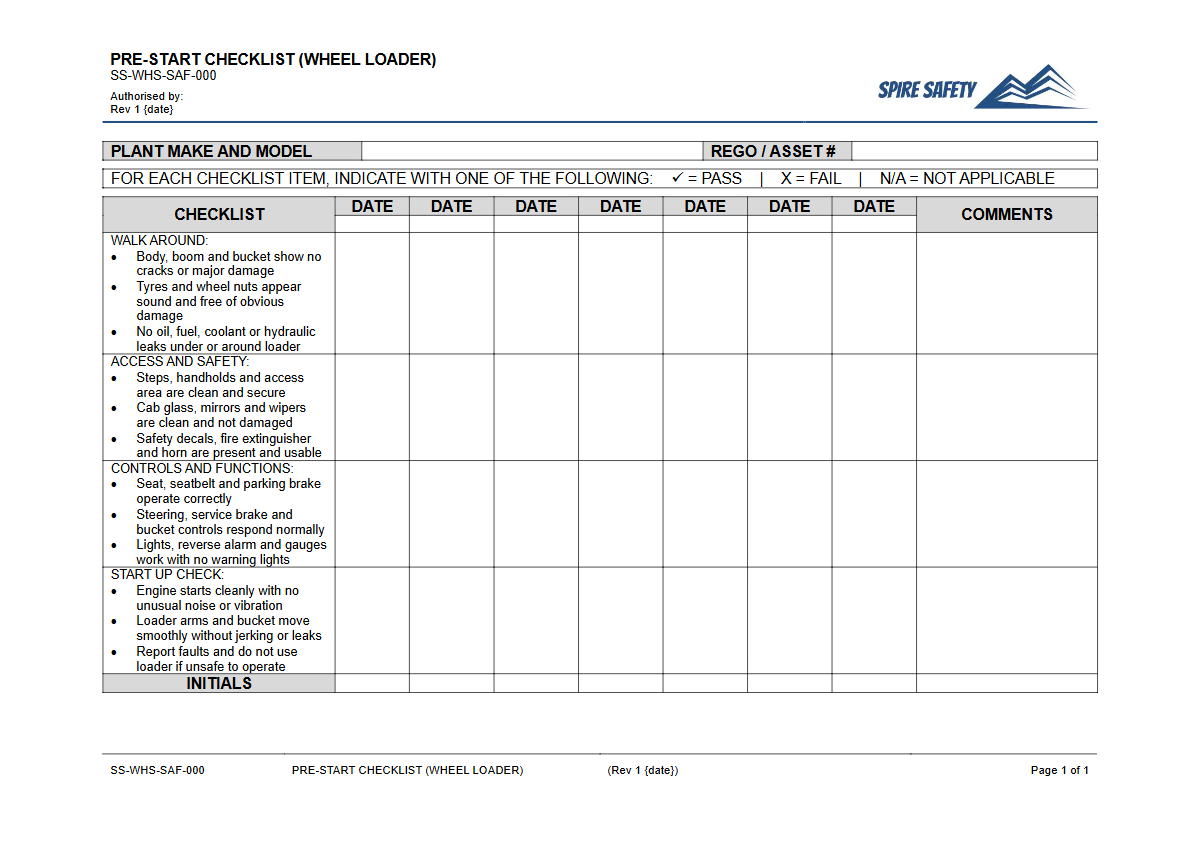
Operating heavy mobile plant like a wheel loader presents significant safety risks if the equipment is not in sound condition. This Free Pre-Start Checklist (Wheel Loader) Template provides a structured framework for operators to conduct thorough, documented inspections before commencing work.
Regular pre-start checks are a fundamental component of proactive risk management, helping to identify and rectify mechanical faults, fluid leaks, structural damage, or safety system failures before they can cause an incident. The checklist prompts inspection of critical components including tyres and wheels, hydraulic systems, steering and braking, the bucket and lifting arms, operator controls, and essential safety features like Roll-Over Protective Structures (ROPS), Falling-Object Protective Structures (FOPS), lights, and reversing alarms.
Integrating this checklist into your daily operations helps formalise your plant safety procedures and demonstrates a commitment to workplace health and safety. These documented checks form a vital part of broader WHS management systems, providing tangible records that can be reviewed during safety meetings, incident investigations, or internal audits.
Video walkthrough
How to use the Free Pre-Start Checklist (Wheel Loader) Template
This resource is available as a fully editable DOCX file and a print-ready PDF. To begin, download the template and open the DOCX version.
The checklist is designed as a comprehensive starting point aligned with general Australian WHS principles for mobile plant. It is crucial to adapt the document to your specific operational context.
Note: We strongly recommend you customise this template to reflect the specific make, model, and configuration of your wheel loaders, as well as your site-specific hazards and operational procedures. Add your company logo and details, and adjust the checklist items to include any unique attachments or features present on your machinery.
Once customised, provide copies to all authorised operators and ensure they are trained on how to complete it correctly.
For organisations that require assistance in developing or refining their site-specific safety documentation and procedures, Spire Safety offers expert WHS consulting services to ensure your systems are robust, practical, and fit for purpose.
When to use this Pre-Start Checklist
A pre-start check, as the name implies, must be conducted before the wheel loader is used for the first time on any given day or at the beginning of each shift. If multiple operators use the same machine during a single shift, a handover process should include a review of the initial checklist and a supplementary inspection to ensure its condition has not changed.
This routine check is not a substitute for scheduled periodic maintenance or major inspections performed by qualified mechanics. Rather, it is a frontline safety measure to catch immediate hazards and prevent the use of unsafe equipment.
An effective pre-start process relies on consistent application and verification. Supervisors should periodically review completed checklists to ensure they are being filled out diligently, not just 'pencil-whipped'.
These records can also be examined during formal WHS compliance audits to verify that plant safety procedures are being implemented as required.
Who should use this Pre-Start Checklist
The pre-start inspection must be carried out by a person who is trained, competent, and authorised to operate the wheel loader. The operator holds the primary responsibility for ensuring the machine is safe before they use it.
This responsibility requires more than just ticking boxes; it involves a thorough visual and physical inspection. Training should cover not only how to operate the machinery but also how to properly conduct the pre-start check, how to recognise defects or potential hazards, and the specific procedure for reporting any faults discovered.
The principles of pre-start inspections are universal across most heavy machinery. For operations that utilise a varied fleet, establishing a consistent approach is beneficial.
For instance, the same systematic process can be applied to other equipment by using a specific resource like our free Pre-Start Checklist for Forwarders, ensuring a uniform standard of safety across all plant.
If a fault is identified that poses a risk to health and safety, the operator must immediately remove the wheel loader from service. This typically involves applying a 'Do Not Operate' or 'Out of Service' tag to the controls and reporting the issue to a supervisor or maintenance manager in line with the workplace's established reporting procedure.
The equipment must not be used again until it has been inspected by a competent person and cleared for service. The same logic applies to other high-risk plant on site, and using a dedicated tool like a free checklist for Floor Saws helps reinforce this critical process.
By embedding this checklist into your safe work procedures, you empower operators to take ownership of safety and create a more resilient safety culture. You can find more templates and tools to support your safety management efforts in our complete library of free WHS resources.
Common mistakes
Common mistakes to avoid
- Completing the checklist from memory without physically inspecting the machine ('pencil-whipping').
- Ignoring seemingly 'minor' issues like worn tyres or weeping hydraulic lines that can lead to major failures.
- Failing to formally tag out and report faulty equipment, leaving it available for an unsuspecting operator to use.
- Using a generic, non-specific checklist that doesn't cover the unique features or attachments of the machine in use.
Legal references
Legal considerations
The following legal requirements may be relevant to this type of work.
- Work Health and Safety Act (Harmonised) — Provides the primary duties for protecting workers and other people from work health and safety risks.
- Work Health and Safety Regulations (Harmonised) — Sets out requirements supporting the management of workplace hazards and risks.
The following codes may be relevant to this type of work.
- Managing WHS Risks Code of Practice — Provides practical guidance on identifying hazards, assessing risks and applying effective controls.
- Work Health and Safety Consultation, Cooperation and Coordination Code of Practice — Provides practical guidance on consulting workers and coordinating with other duty holders.
- Managing the Work Environment and Facilities Code of Practice — Provides practical guidance on safe work environments, workplace facilities and related controls.
Did you know
Mobile Plant Hazards
According to Safe Work Australia, being hit by a moving vehicle is a leading cause of worker fatalities in the construction industry. Thorough pre-start checks on mobile plant like wheel loaders help ensure critical safety systems, such as brakes and reversing alarms, are functional.
Protective Structures
ROPS (Roll-Over Protective Structure) and FOPS (Falling-Object Protective Structure) are essential safety features on wheel loaders. Pre-start checks should always include inspecting these structures for any signs of cracks, corrosion, or damage, as this could compromise their integrity.
FAQ
Frequently asked questions
01What should be included in a wheel loader pre-start checklist?
02How often should a wheel loader pre-start check be done?
03Who is responsible for completing the wheel loader pre-start?
04What happens if a fault is found during a wheel loader pre-start check?
Share this resource
Free Pre-Start Checklist (Wheel Loader) Template
Browse Categories
How To Use It
- 1Download and open in Word or PDF.
- 2Replace the placeholders with your business details.
- 3Get it reviewed by a WHS specialist before rollout.
Need it customised?
Our WHS consultants can adapt this template to your site, run a gap analysis, or audit what you already have in place.
Book a Free Consultation WHS consulting servicesor call 1300 156 382