
Free Pre-Start Checklist (Wheel Aligner) Template
Download our free Pre-Start Checklist for Wheel Aligners.
Free Pre-Start Checklist (Wheel Aligner) Template
DOCX • 125 KB + PDF
Updated Oct 2026
No signup required
Purpose of the Free Pre-Start Checklist (Wheel Aligner) Template
Using wheel alignment equipment safely and effectively starts before the machine is even switched on. A thorough pre-start inspection is a critical step in identifying potential hazards, such as damaged cables, worn clamps, or faulty sensors, and preventing incidents in the workshop.
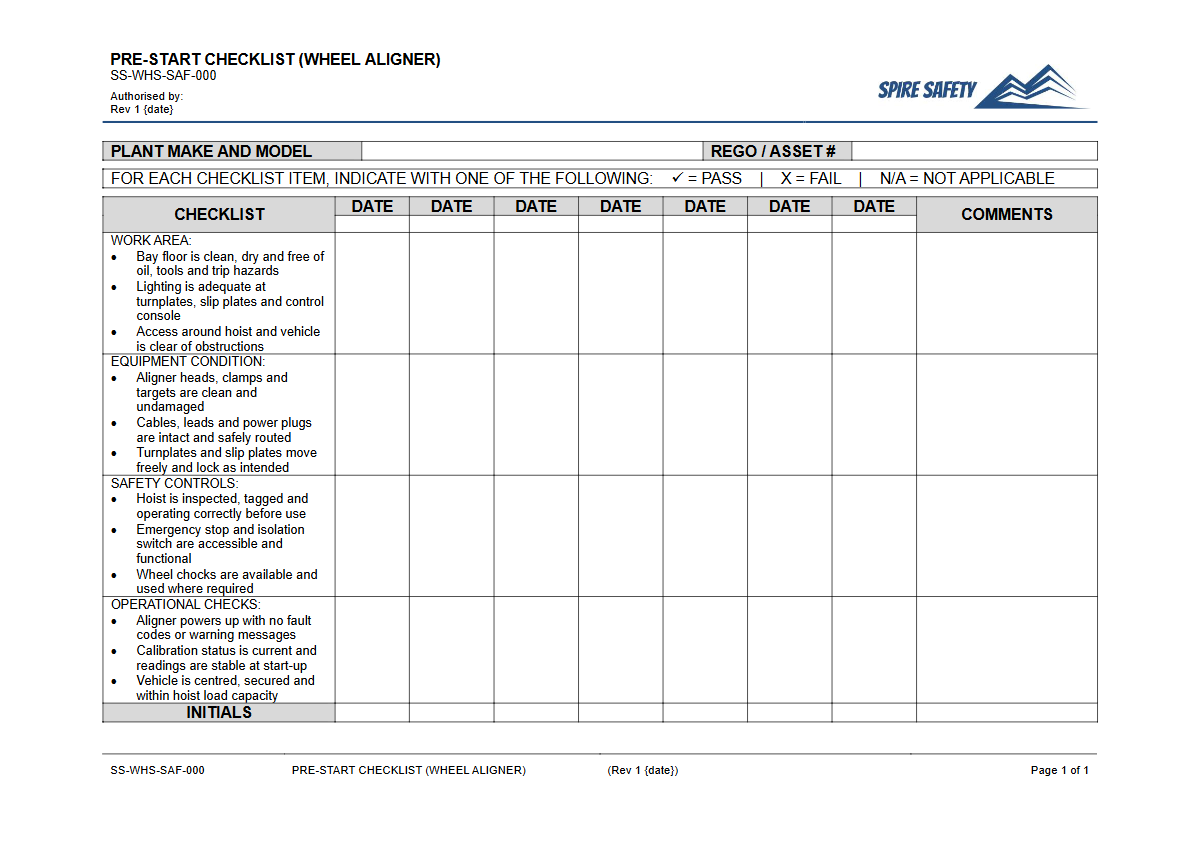
This Free Pre-Start Checklist (Wheel Aligner) Template provides a structured starting point for automotive workshops and service centres to formalise these essential daily checks.
A systematic pre-start check ensures that the equipment is fit for purpose before every use. It prompts operators to visually and physically inspect key components, confirm calibration status, and check that the surrounding area is free from slip and trip hazards.
By documenting these checks, your organisation creates a clear record of its commitment to proactive safety management.
Integrating regular equipment checks is a fundamental part of a robust WHS management system, demonstrating proactive risk management and fulfilling duties under WHS legislation. These records can be invaluable during safety audits, incident investigations, or maintenance planning.
Video walkthrough
How to use the Free Pre-Start Checklist (Wheel Aligner) Template
This resource is provided as a downloadable DOCX and PDF file. The DOCX version is fully editable, allowing you to tailor the content to your specific operational environment.
We strongly recommend modifying the template to include checks relevant to the exact make and model of the wheel aligner(s) used in your workplace.
Important: It is vital to recognise that this document is a template, not a finished product. You must customise it to reflect the specific machinery, tasks, and hazards at your site.
We recommend involving operators and maintenance personnel in the customisation process to ensure the checklist is practical and comprehensive. For expert assistance in tailoring safety documents to your specific operational needs, consider engaging a WHS consulting service.
Once customised, ensure all operators are trained on how to use the checklist correctly, what each check involves, and the procedure for reporting any identified faults. This training can be effectively reinforced through regular safety discussions, such as using a Pre-Start Checks and Plant Maintenance toolbox talk to embed safe work practices.
When to use the Pre-Start Checklist
The pre-start checklist for a wheel aligner should be completed:
- Before the first use of the equipment at the start of each work day or shift.
- By each new operator if the equipment is used by multiple people during a single shift.
- After the equipment has undergone maintenance or repairs, to verify it is safe to return to service.
Completed checklists should be signed, dated, and filed according to your organisation's record-keeping procedures. These records are often examined during internal and external WHS compliance audits to verify that safety procedures are being consistently followed.
Who should use the Pre-Start Checklist
The primary responsibility for completing the pre-start checklist lies with the person operating the equipment. This should be a worker who is trained, competent, and authorised to use the wheel aligner.
Supervisors or workshop managers also have a role in overseeing the process. They should ensure that checks are being completed diligently, review the completed forms for any reported defects, and take prompt action to address any safety issues raised.
This includes removing faulty equipment from service until it can be repaired by a qualified person.
The principles of pre-start inspections apply to a wide range of workshop machinery. The process of checking for guards, clean work areas, and electrical safety is similar for equipment covered by other resources, such as our CNC router pre-start checklist. By embedding this practice across all plant and equipment, you foster a powerful safety culture.
By implementing a consistent pre-start inspection process for your wheel aligner, you take a significant step towards a safer and more compliant workshop. You can find more templates and tools to support your safety program in our extensive free WHS resources library.
Common mistakes
Common mistakes to avoid
- Using a generic checklist without customising it for the specific make and model of the aligner.
- Skipping checks and 'pencil-whipping' the form without physically inspecting the equipment.
- Failing to report and action identified defects immediately, allowing faulty equipment to remain in use.
- Operators completing the checklist without adequate training on what each check entails.
Legal references
Legal considerations
The following legal requirements may be relevant to this type of work.
- Work Health and Safety Act (Harmonised) — Provides the primary duties for protecting workers and other people from work health and safety risks.
- Work Health and Safety Regulations (Harmonised) — Sets out requirements supporting the management of workplace hazards and risks.
The following codes may be relevant to this type of work.
- Managing WHS Risks Code of Practice — Provides practical guidance on identifying hazards, assessing risks and applying effective controls.
- Work Health and Safety Consultation, Cooperation and Coordination Code of Practice — Provides practical guidance on consulting workers and coordinating with other duty holders.
- Managing the Work Environment and Facilities Code of Practice — Provides practical guidance on safe work environments, workplace facilities and related controls.
Did you know
Misalignment Risks
Poorly maintained wheel alignment equipment can lead to incorrect vehicle calibrations, potentially compromising vehicle safety systems like ADAS (Advanced Driver-Assistance Systems).
Record Keeping as Proof
Consistent pre-start records provide documented evidence of your organisation's commitment to safety and due diligence during incident investigations or WHS audits.
FAQ
Frequently asked questions
01What should be included in a wheel aligner pre-start checklist?
02Why is a pre-start check necessary for a wheel aligner?
03How often should wheel aligner pre-start checks be done?
04Who is responsible for ensuring wheel aligner pre-start checks are completed?
Share this resource
Free Pre-Start Checklist (Wheel Aligner) Template
Browse Categories
How To Use It
- 1Download and open in Word or PDF.
- 2Replace the placeholders with your business details.
- 3Get it reviewed by a WHS specialist before rollout.
Need it customised?
Our WHS consultants can adapt this template to your site, run a gap analysis, or audit what you already have in place.
Book a Free Consultation WHS consulting servicesor call 1300 156 382