
Free Pre-Start Checklist (Weld Rotator) Template
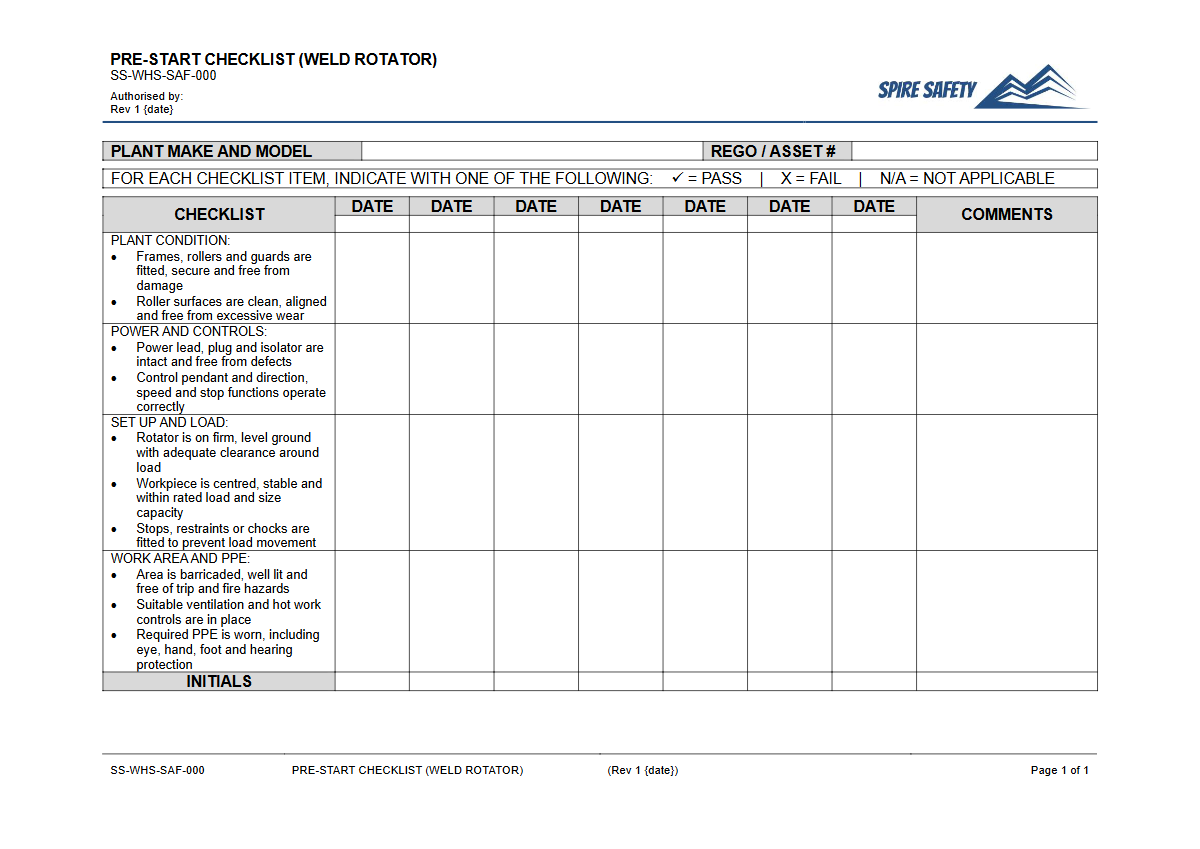
Download our free Pre-Start Checklist for Weld Rotators. This template, available in DOCX and PDF, helps formalise equipment safety checks.
Free Pre-Start Checklist (Weld Rotator) Template
DOCX • 125 KB + PDF
Updated Oct 2026
No signup required
Purpose of the Free Pre-Start Checklist (Weld Rotator) Template
Weld rotators, or turning rolls, are powerful pieces of plant used to rotate heavy cylindrical workpieces during welding and fabrication. The risks associated with their operation—including crushing, entanglement, and electrical hazards—are significant.
A systematic pre-start inspection is a critical control measure to ensure the equipment is safe to use before any work commences. This free Pre-Start Checklist (Weld Rotator) Template provides a structured starting point for your organisation to formalise these essential daily checks.
Using a documented checklist helps operators systematically inspect key components, identify potential defects or damage, and verify that safety features are functioning correctly. It transforms a routine task into a recordable action, demonstrating due diligence and contributing to a safer work environment.
For a broader perspective on instilling this mindset, consider incorporating our Pre-Start Checks and Plant Maintenance Toolbox Talk into your safety communications.
Video walkthrough
How to use the Free Pre-Start Checklist (Weld Rotator) Template
This template is provided in both DOCX and PDF formats. The DOCX version is fully editable, allowing you to tailor it to your specific operational needs. To effectively implement the checklist, you should:
- Download: Choose the DOCX format for customisation.
- Customise: Add your company branding and logo. Most importantly, review and amend the checklist items to match the specific make, model, and configuration of the weld rotators used in your workplace. Consider adding items related to specific attachments, guards, or controls unique to your equipment.
- Train: Ensure all operators and supervisors are trained on how to use the checklist correctly. This includes understanding what each item means, how to inspect it, and what to do if a fault is found.
- Implement: Integrate the checklist into your daily operational procedures. Establish a clear process for where completed checklists are stored and who reviews them.
It's crucial to remember that this template provides a starting point. We have based it on common industry practices, but you must customise it to reflect the specific make, model, and configuration of the weld rotator in your workplace, as well as your unique operational risks and control measures. Integrating such procedures is a key part of building a robust WHS management system.
When to use this Pre-Start Checklist
A pre-start check should be completed by the operator before the start of each shift or before using the weld rotator for the first time on a given day. It is a pre-operational check, not a substitute for scheduled maintenance or comprehensive inspections.
If the equipment has been idle for an extended period, or if a different operator is taking over mid-shift, conducting another check is a sound safety practice. These checks can be formally recorded as part of your daily site startup procedures, which can be documented using our free Pre-Start Meeting Template.
Who should use this Pre-Start Checklist
The primary user of this Pre-Start Checklist is the trained and competent operator assigned to the weld rotator. They are in the best position to conduct a thorough visual and functional inspection of the equipment they are about to use.
Supervisors also have a key role. They are responsible for ensuring operators are completing the checks correctly, reviewing completed checklists for any reported issues, and taking appropriate action to address defects—such as tagging the equipment out of service until it can be repaired by a qualified person.
Consistent use of checklists for all fabrication equipment, such as our Pre-Start Checklist for Air Arc gouging equipment, helps create a uniform safety culture.
Benefits of a Formal Checklist
Implementing a formalised checklist moves your safety process from assumption to assurance. Key benefits include:
- Consistency: Ensures every operator checks the same critical items every time.
- Accountability: Creates a signed record that the inspection was performed by a specific individual at a specific time.
- Early Fault Detection: Helps identify minor issues before they escalate into major failures or cause an incident.
- Improved Safety Culture: Reinforces the organisation's commitment to safety and the importance of proactive risk management.
- Demonstrable Compliance: Provides tangible evidence of your hazard identification processes, which is a key focus during internal and external WHS compliance audits.
Common mistakes
Common mistakes to avoid
- Failing to customise the generic template to match the specific weld rotator model in use.
- Operators 'pencil-whipping' the form without physically conducting the checks.
- Not taking immediate action (e.g., tag out) when a defect or fault is identified during the inspection.
- Forgetting to train operators on how to properly use the checklist and what each item entails.
Legal references
Legal considerations
The following legal requirements may be relevant to this type of work.
- Work Health and Safety Act (Harmonised) — Provides the primary duties for protecting workers and other people from work health and safety risks.
- Work Health and Safety Regulations (Harmonised) — Sets out requirements supporting the management of workplace hazards and risks.
The following codes may be relevant to this type of work.
- Managing WHS Risks Code of Practice — Provides practical guidance on identifying hazards, assessing risks and applying effective controls.
- Work Health and Safety Consultation, Cooperation and Coordination Code of Practice — Provides practical guidance on consulting workers and coordinating with other duty holders.
- Managing the Work Environment and Facilities Code of Practice — Provides practical guidance on safe work environments, workplace facilities and related controls.
Did you know
Ergonomic Benefits
Weld rotators significantly reduce risks associated with manual handling and worker fatigue. By automating the rotation of heavy workpieces, they eliminate awkward postures and strains that welders would otherwise endure, improving both safety and weld quality.
FAQ
Frequently asked questions
01What's the difference between a pre-start and a SWMS for a weld rotator?
02Can I use a digital version of this weld rotator checklist?
03How often should weld rotators be formally inspected?
04Who is responsible for ensuring pre-start checks are completed?
Share this resource
Free Pre-Start Checklist (Weld Rotator) Template
Browse Categories
How To Use It
- 1Download and open in Word or PDF.
- 2Replace the placeholders with your business details.
- 3Get it reviewed by a WHS specialist before rollout.
Need it customised?
Our WHS consultants can adapt this template to your site, run a gap analysis, or audit what you already have in place.
Book a Free Consultation WHS consulting servicesor call 1300 156 382