
Free Pre-Start Checklist (Weld Positioner) Template
Download our Free Pre-Start Checklist for Weld Positioners. This template helps formalise equipment inspections and identify hazards before use. Download now.
Free Pre-Start Checklist (Weld Positioner) Template
DOCX • 125 KB + PDF
Updated Oct 2026
No signup required
Purpose of the Free Pre-Start Checklist (Weld Positioner) Template
A weld positioner significantly improves safety and efficiency by holding and rotating heavy or awkward workpieces. However, its moving parts, heavy load capacity, and integration with high-energy welding processes introduce serious risks.
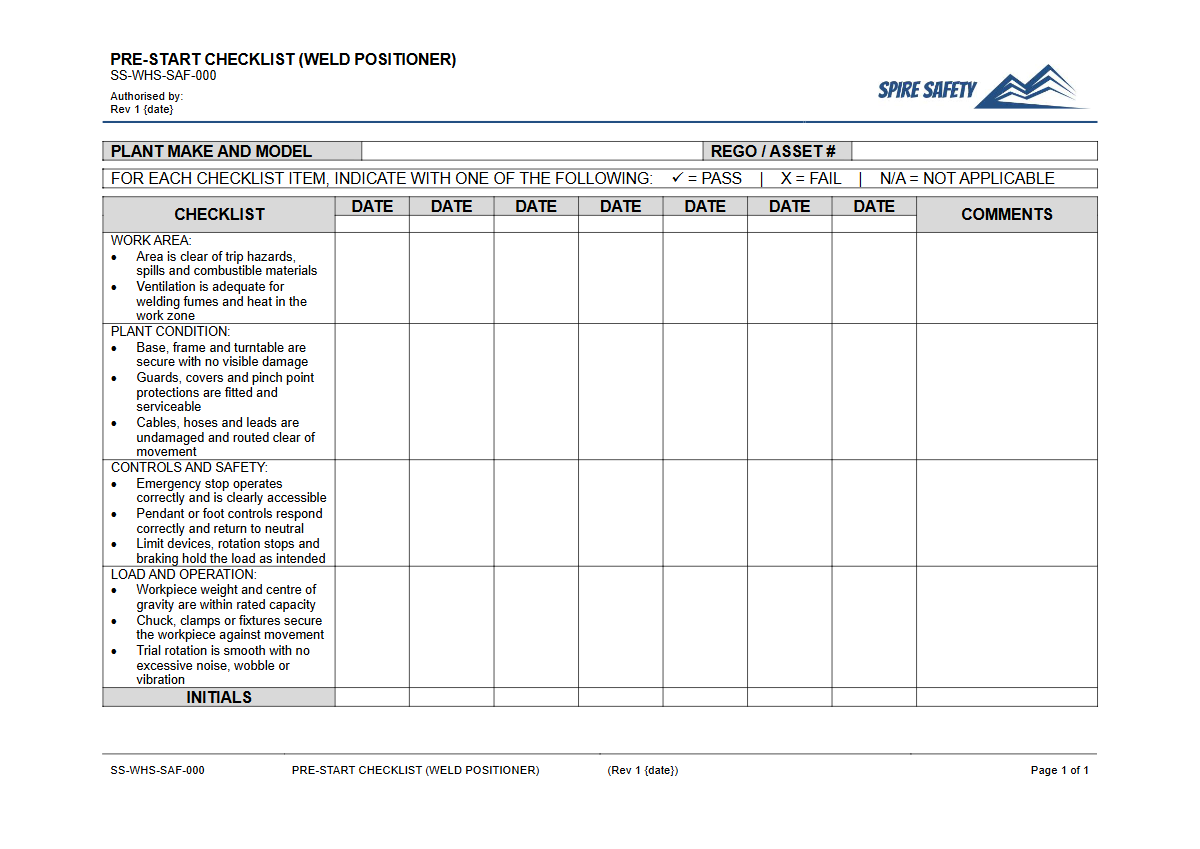
This Free Pre-Start Checklist (Weld Positioner) Template provides a structured framework for operators to systematically inspect the equipment before use, helping to identify and control potential hazards before they cause an incident. Formalising these checks is a critical step in managing risks associated with plant and machinery.
Using a standardised checklist ensures that inspections are consistent, thorough, and documented. This creates a clear record of the equipment's condition over time, which is invaluable for maintenance scheduling and incident investigations.
Integrating daily equipment checks is a vital part of your overall plant maintenance and safety procedures, forming a key pillar of a proactive safety culture within your organisation.
Video walkthrough
How to use the Free Pre-Start Checklist (Weld Positioner) Template
This resource is available for immediate download in both DOCX and PDF formats. The DOCX version is fully editable, allowing you to tailor it to your specific operational needs.
The PDF is ideal for quick printing and distribution.
IMPORTANT: This document is a template only. We have designed it as a structured starting point, but you MUST customise it to reflect the specific weld positioner models, tasks, control measures, and unique hazards present in your workplace.
Always consult the manufacturer's operating manual and relevant technical standards when adapting the checklist.
Once customised, the checklist should be integrated into your daily operational workflow. The goal is to embed its use as a non-negotiable step before any work commences with the positioner.
This formal process should be a component of your broader WHS management systems, ensuring it aligns with your policies for risk management and safe operation of plant.
When to use it
A pre-start checklist for a weld positioner should be completed at the beginning of every shift or before its first use each day. This frequency ensures that the equipment's condition is verified before it is energised and placed under load.
It should also be used if a new operator takes over mid-shift or if the machine has been idle for an extended period. The check is a snapshot in time, confirming the positioner is safe for the upcoming task, not just that it was safe yesterday.
This routine helps catch issues like fluid leaks, damaged controls, or loose components that may have developed overnight or during previous use.
Who should use it
The checklist should be completed by a person who is trained, competent, and authorised to operate the specific weld positioner. This is typically a welder, boilermaker, or fabricator.
It is crucial that the operator understands not just how to fill out the form, but what each checkpoint signifies in terms of potential failure or risk. Supervisors or team leaders should periodically review completed checklists to ensure they are being filled out correctly and that any reported faults are actioned promptly and effectively.
Before allowing use, you must ensure that anyone operating the machinery has been deemed competent. You can formalise this process using a document like our Verification of Competency for a Pipe Threader as a structural guide for other plant.
Key Inspection Areas for a Weld Positioner
While your customised checklist will be more detailed, it should cover these fundamental areas:
- General Condition & Environment: Check for a clear, stable area around the positioner. Ensure the frame and base are free from cracks or visible damage and that the unit is securely anchored.
- Turntable & Clamping: Inspect the turntable, chuck, or faceplate for damage. Verify that all clamps, jaws, and T-slots are functional and can securely hold the intended workpiece.
- Rotation & Tilt Mechanisms: Look for signs of hydraulic or oil leaks from rams and motors. Check that guards for gears, chains, or drive shafts are secure and undamaged.
- Controls: Test that all controls, including rotation speed, direction, and tilt functions, are responsive. Most importantly, verify the emergency stop button functions correctly.
- Electrical Systems: Inspect all cables for damage, abrasion, or exposure. Ensure the welding earth clamp has a secure connection point on the positioner to prevent current from passing through bearings or motors.
Regularly reviewing these records can be part of a scheduled WHS compliance audit to verify that procedures are being followed correctly. If this seems overwhelming, you can find other helpful documents in our free WHS resources library to support your safety program.
Common mistakes
Common mistakes to avoid
- Skipping the check for a 'quick five-minute job', which often leads to incidents.
- Failing to check the condition and security of the welding earth return clamp.
- Using a generic checklist without customising it for the specific machine's controls and features.
- Noting a minor fault (like an oil weep or unusual noise) but failing to report it for maintenance.
- Overloading the positioner beyond its rated capacity and centre-of-gravity limits.
Legal references
Legal considerations
The following legal requirements may be relevant to this type of work.
- Work Health and Safety Act (Harmonised) — Provides the primary duties for protecting workers and other people from work health and safety risks.
- Work Health and Safety Regulations (Harmonised) — Sets out requirements supporting the management of workplace hazards and risks.
The following codes may be relevant to this type of work.
- Managing WHS Risks Code of Practice — Provides practical guidance on identifying hazards, assessing risks and applying effective controls.
- Work Health and Safety Consultation, Cooperation and Coordination Code of Practice — Provides practical guidance on consulting workers and coordinating with other duty holders.
- Managing the Work Environment and Facilities Code of Practice — Provides practical guidance on safe work environments, workplace facilities and related controls.
Did you know
Ergonomic Benefits
Weld positioners don't just handle heavy loads; they dramatically reduce ergonomic risks by allowing the welder to work in a stable, comfortable position, which improves weld quality and reduces the risk of musculoskeletal injuries.
Current Diversion
A poor welding earth connection can cause the welding current to travel through the positioner's bearings and gears. This can destroy them in seconds, leading to catastrophic failure of the rotation mechanism.
FAQ
Frequently asked questions
01What is the purpose of a weld positioner pre-start checklist?
02How often should a weld positioner pre-start check be done?
03Who is responsible for completing the weld positioner checklist?
04Can this template be used for any brand of weld positioner?
Share this resource
Free Pre-Start Checklist (Weld Positioner) Template
Browse Categories
How To Use It
- 1Download and open in Word or PDF.
- 2Replace the placeholders with your business details.
- 3Get it reviewed by a WHS specialist before rollout.
Need it customised?
Our WHS consultants can adapt this template to your site, run a gap analysis, or audit what you already have in place.
Book a Free Consultation WHS consulting servicesor call 1300 156 382