
Free Pre-Start Checklist (Water Pump) Template
Download our free Pre-Start Checklist (Water Pump) Template to formalise equipment safety checks. This structured DOCX & PDF helps manage WHS risks.
Free Pre-Start Checklist (Water Pump) Template
DOCX • 125 KB + PDF
Updated Oct 2026
No signup required
Purpose of the Free Pre-Start Checklist (Water Pump) Template
Regularly inspecting water pumps before use is a critical safety measure in many industries, from construction and mining to agriculture and facility management. This Free Pre-Start Checklist (Water Pump) Template provides a structured framework for operators to conduct consistent, thorough inspections.
Using a checklist helps identify potential mechanical faults, leaks, electrical hazards, or other unsafe conditions before the pump is energised. By formalising this process, your organisation can reduce the risk of equipment failure, prevent accidents, and minimise operational downtime.
Documenting these checks is a key component of an effective WHS management system, providing a clear record of due diligence.
Video walkthrough
How to use the Free Pre-Start Checklist (Water Pump) Template
This resource is available as a fully editable DOCX file and a print-ready PDF. To get started, simply download the format that best suits your needs.
The checklist is designed as a comprehensive starting point aligned with Australian WHS principles. However, it is essential to adapt it to your specific context.
Important: Water pumps vary significantly by type (e.g., submersible, centrifugal, diaphragm), power source (electric, diesel, petrol), and operating environment. We strongly recommend you customise this template to include checks relevant to the specific make and model of your equipment, the tasks it performs, and the unique hazards of your workplace.
Consultation with operators and maintenance personnel is crucial during this customisation process. For similar equipment, you might find our pre-start checklist for a fire pump a useful reference.
What's covered in the checklist?
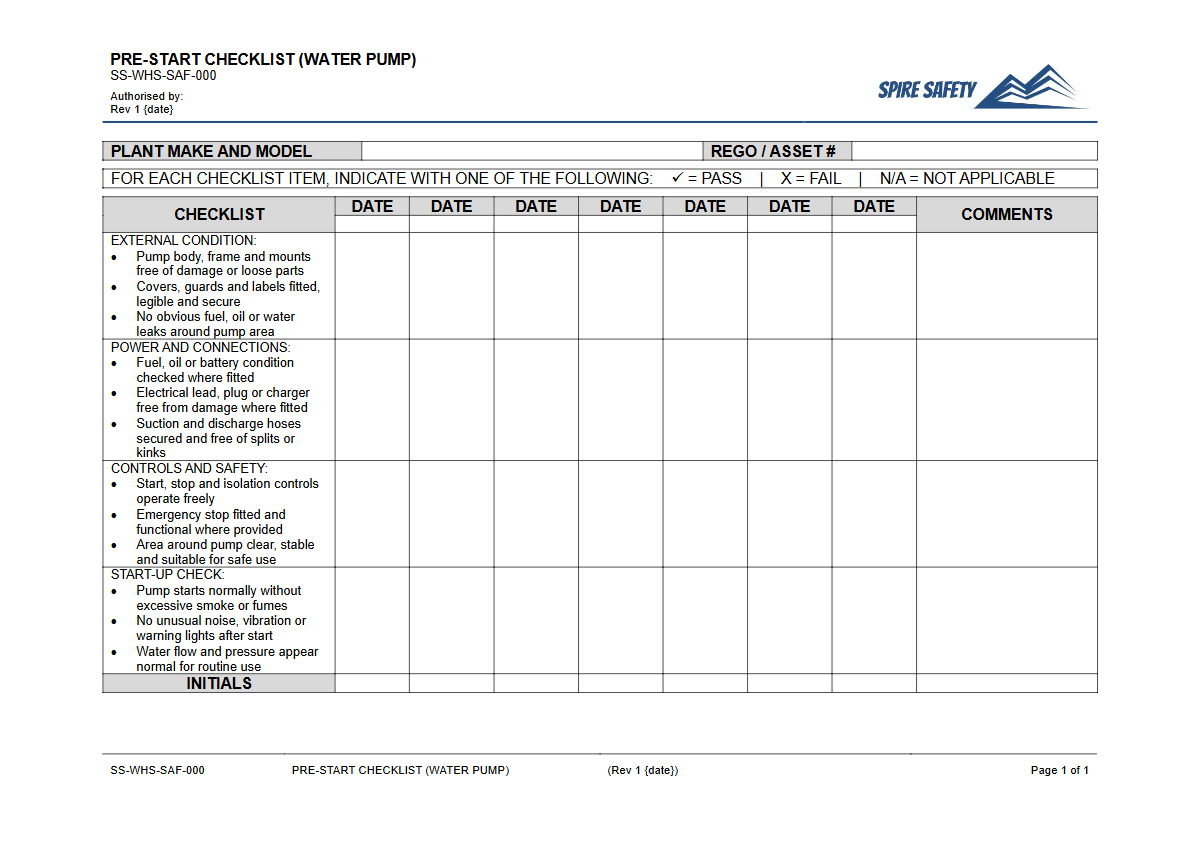
Our template prompts the user to inspect key components and systems, including:
- General Condition: Checking for visible damage, corrosion, or loose parts.
- Guards and Covers: Ensuring all protective guards for moving parts (belts, shafts) are secure.
- Hoses and Fittings: Inspecting for leaks, cracks, or secure connections on suction and discharge lines.
- Power Source: Specific checks for electric (cables, plugs, RCDs) or engine-driven (fuel, oil, battery) pumps.
- Controls: Verifying that start/stop buttons, emergency stops, and pressure gauges are functional.
- Work Area: Ensuring the area is free of slip/trip hazards and has adequate lighting and ventilation.
These documented records are valuable evidence of your safety procedures and can be reviewed during a formal WHS compliance auditing process.
When to use it
A pre-start check should be conducted before every use or at the beginning of each work shift where the water pump will be operated. This frequency ensures that any damage or faults that may have occurred since the last use are identified before the equipment is put back into service.
It is particularly important after the pump has been moved, serviced, or stored for an extended period. The specific checks may differ slightly; for example, a stationary dewatering pump may have a different inspection cadence than a portable unit used on multiple sites. This principle also applies to other specialised equipment, such as that covered by our checklist for cooling pumps.
Who should use it
This checklist is designed for any person deemed competent to operate a water pump. This typically includes site workers, maintenance staff, agricultural workers, and facilities personnel.
Supervisors should also use the completed checklists to verify that inspections are being carried out correctly and to address any reported faults promptly. Ensuring operators are not only trained in the pump's use but also in the pre-start inspection process is a key responsibility for a Person Conducting a Business or Undertaking (PCBU).
If you need assistance defining roles and responsibilities for plant operation, our WHS consulting services can provide expert guidance. For more templates and guides, browse our complete free resources library.
Common mistakes
Common mistakes to avoid
- Ignoring minor leaks from hoses or fittings, which can worsen under pressure.
- Failing to check fuel, oil, and coolant levels on engine-driven pumps before starting.
- Not ensuring an electrical pump is connected to a circuit protected by a residual current device (RCD).
- Using a generic checklist without customising it for the specific pump model and work environment.
Legal references
Legal considerations
The following legal requirements may be relevant to this type of work.
- Work Health and Safety Act (Harmonised) — Provides the primary duties for protecting workers and other people from work health and safety risks.
- Work Health and Safety Regulations (Harmonised) — Sets out requirements supporting the management of workplace hazards and risks.
The following codes may be relevant to this type of work.
- Managing WHS Risks Code of Practice — Provides practical guidance on identifying hazards, assessing risks and applying effective controls.
- Work Health and Safety Consultation, Cooperation and Coordination Code of Practice — Provides practical guidance on consulting workers and coordinating with other duty holders.
- Managing the Work Environment and Facilities Code of Practice — Provides practical guidance on safe work environments, workplace facilities and related controls.
Did you know
Pump Cavitation
A rumbling noise often described as 'pumping gravel' can be a sign of cavitation. This occurs when pressure drops inside the pump, creating vapour bubbles that collapse violently, which can quickly cause significant damage to internal components.
FAQ
Frequently asked questions
01What should I do if a fault is found during a water pump pre-start check?
02Is this pre-start checklist suitable for both electric and diesel-powered water pumps?
03How often does a water pump require a full service?
04Do operators need formal training to use a water pump?
Share this resource
Free Pre-Start Checklist (Water Pump) Template
Browse Categories
How To Use It
- 1Download and open in Word or PDF.
- 2Replace the placeholders with your business details.
- 3Get it reviewed by a WHS specialist before rollout.
Need it customised?
Our WHS consultants can adapt this template to your site, run a gap analysis, or audit what you already have in place.
Book a Free Consultation WHS consulting servicesor call 1300 156 382