
Free Pre-Start Checklist (Water Cart) Template
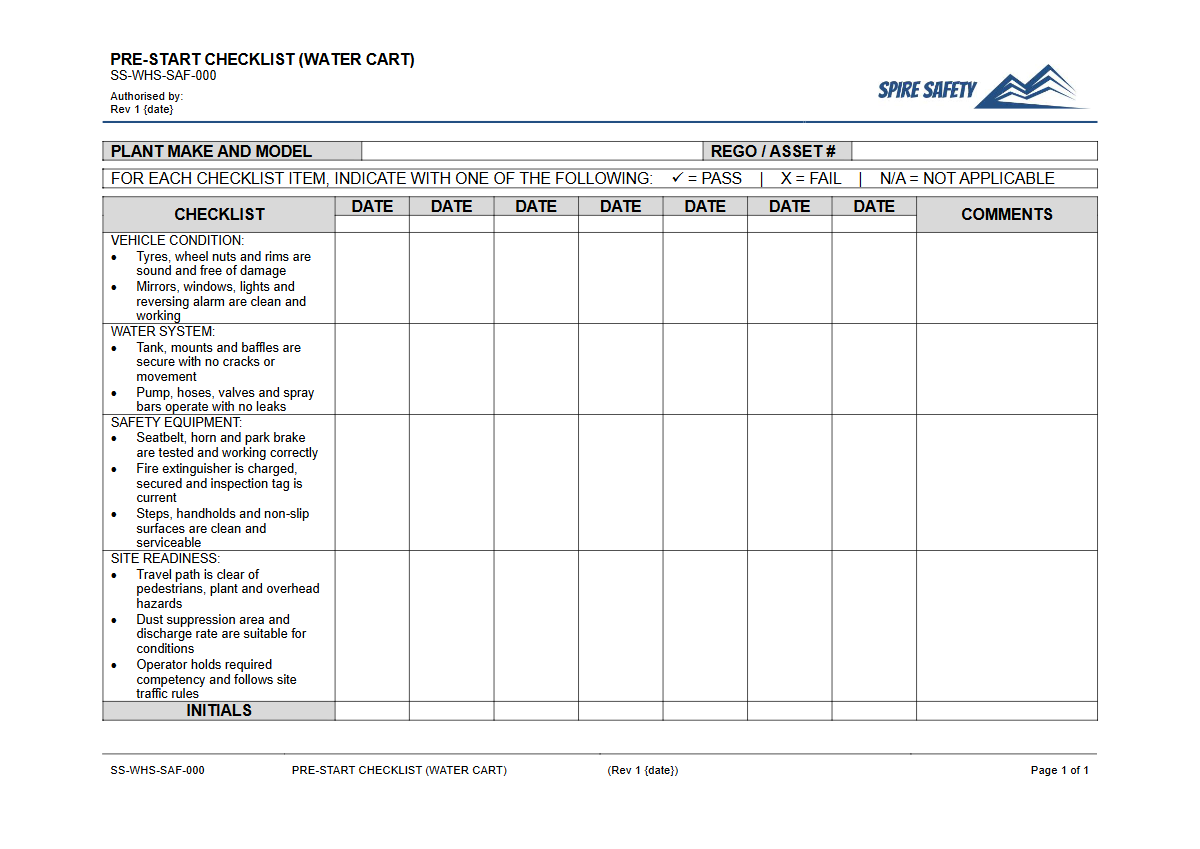
Download our free Pre-Start Checklist (Water Cart) Template. This DOCX & PDF resource helps formalise daily equipment checks and identify hazards.
Free Pre-Start Checklist (Water Cart) Template
DOCX • 125 KB + PDF
Updated Oct 2026
No signup required
Purpose of the Free Pre-Start Checklist (Water Cart) Template
Effectively managing plant safety begins with routine inspections. Our Free Pre-Start Checklist (Water Cart) Template provides a structured format for operators to conduct thorough pre-operational checks, helping to identify and report potential faults or hazards before the vehicle is used.
Integrating this checklist into your daily routine is a practical step towards preventing incidents, minimising downtime, and demonstrating a commitment to workplace health and safety.
A pre-start check is a fundamental control measure within any robust WHS management system. It serves as a daily record that plant is being inspected by a competent person. This not only helps manage risks associated with mobile plant operation but also provides valuable data for maintenance scheduling and safety performance tracking.
This checklist is designed to work alongside other key safety documents. For any high-risk construction work involving a water cart, a comprehensive Water Cart Operation Safe Work Method Statement must also be developed and followed to manage task-specific risks.
Video walkthrough
How to use the Free Pre-Start Checklist (Water Cart) Template
This resource is available for immediate download in both DOCX and PDF formats. The DOCX file can be easily edited to align with your specific operational needs and company branding.
Important Customisation Note
This document is a template aligned with Australian WHS principles and is intended as a starting point. You must customise this checklist to reflect the specific make, model, and configuration of your water cart(s), as well as your unique site conditions and organisational procedures. We are not liable for any incidents arising from the use or misuse of this template.
It is your responsibility to ensure the final document is fit for purpose in your workplace.
Key customisation steps include adding your company logo, site details, and specific check items relevant to your equipment, such as particular pump controls, spray head types, baffling integrity, and on-board camera systems. Reinforcing the importance of these inspections can be achieved through regular training sessions, like those facilitated by our Pre-Start Checks and Plant Maintenance Toolbox Talk.
To ensure these procedures are being followed correctly and consistently over time, organisations can incorporate checklist reviews into their internal safety review processes. The effectiveness of your pre-start system can be formally assessed during WHS compliance auditing activities.
When to use it
A pre-start inspection should be completed:
- Before the start of each shift or the first time the water cart is used on any given day.
- After a change of operator during a shift.
- Following any significant maintenance or repair work.
- When the equipment is being used on a new site with different environmental or ground conditions.
Who should use it
This checklist should be completed by the plant operator who will be using the water cart. Operators must be trained, competent, and familiar with the specific model they are inspecting.
It is crucial that they understand not just how to tick the boxes, but the purpose behind each check and what constitutes a defect.
Beyond the operator, supervisors and safety managers should periodically review completed checklists. This oversight helps confirm that inspections are being conducted diligently and allows for the identification of recurring mechanical issues or patterns of damage that may require investigation. The process of confirming operator skill can be formalised using our Verification of Competency (Water Cart) template.
This checklist is a vital tool for managing the overall condition of the vehicle. For a deeper dive into the risks associated with specific components, a more detailed analysis like a Water Pump Risk Assessment template can provide additional hazard identification and control measures.
Common mistakes
Common mistakes to avoid
- "Pencil-whipping" the checklist without physically inspecting the items.
- Failing to report identified defects or continuing to use unsafe equipment.
- Using a generic, non-customised checklist that doesn't cover model-specific features.
- Neglecting to train operators on how to properly conduct the checks and what to look for.
Legal references
Legal considerations
The following legal requirements may be relevant to this type of work.
- Work Health and Safety Act (Harmonised) — Provides the primary duties for protecting workers and other people from work health and safety risks.
- Work Health and Safety Regulations (Harmonised) — Sets out requirements supporting the management of workplace hazards and risks.
The following codes may be relevant to this type of work.
- Managing WHS Risks Code of Practice — Provides practical guidance on identifying hazards, assessing risks and applying effective controls.
- Work Health and Safety Consultation, Cooperation and Coordination Code of Practice — Provides practical guidance on consulting workers and coordinating with other duty holders.
- Managing the Work Environment and Facilities Code of Practice — Provides practical guidance on safe work environments, workplace facilities and related controls.
Did you know
Centre of Gravity
The substantial weight of water (1,000 kg per 1,000 litres) significantly raises a vehicle's centre of gravity. Baffles inside the tank are crucial for managing water surge and maintaining stability during braking and cornering.
Beyond Dust Control
While their primary role is dust suppression on construction and mining sites, water carts are also used for soil compaction, road base conditioning, and as a rapid-response water source for fighting small fires.
FAQ
Frequently asked questions
01Why are pre-start checks for water carts so important?
02How often should a water cart pre-start checklist be completed?
03What happens if a defect is found during a water cart pre-start check?
04Can this template be used for different models of water carts?
Share this resource
Free Pre-Start Checklist (Water Cart) Template
Browse Categories
How To Use It
- 1Download and open in Word or PDF.
- 2Replace the placeholders with your business details.
- 3Get it reviewed by a WHS specialist before rollout.
Need it customised?
Our WHS consultants can adapt this template to your site, run a gap analysis, or audit what you already have in place.
Book a Free Consultation WHS consulting servicesor call 1300 156 382