
Free Pre-Start Checklist (Water Bath) Template
Download our free Pre-Start Checklist (Water Bath) Template to formalise safety checks for your laboratory equipment.
Free Pre-Start Checklist (Water Bath) Template
DOCX • 125 KB + PDF
Updated Oct 2026
No signup required
Purpose of the Free Pre-Start Checklist (Water Bath) Template
Regularly inspecting laboratory equipment is a critical part of maintaining a safe working environment. This free Pre-Start Checklist (Water Bath) Template provides a structured framework for operators to conduct consistent safety and operational checks before use.
Using a checklist helps identify potential hazards such as electrical faults, water leaks, overheating, or structural damage before they can cause injury or equipment failure. Formalising this process ensures that no steps are missed and that a clear record of equipment condition is maintained over time.
Implementing routine inspections helps a Person Conducting a Business or Undertaking (PCBU) meet their primary duty of care to provide safe plant and equipment. These checks are a practical way to manage risks associated with thermal burns, electrical shock, and biological contamination. Consistent use of pre-start checks can be supported by regular safety discussions, such as those guided by our Pre-Start Checks and Plant Maintenance Toolbox Talk Template.
Video walkthrough
How to Use the Free Pre-Start Checklist (Water Bath) Template
This template is designed for simplicity and immediate use. After downloading the DOCX or PDF file, you can integrate it into your daily lab procedures.
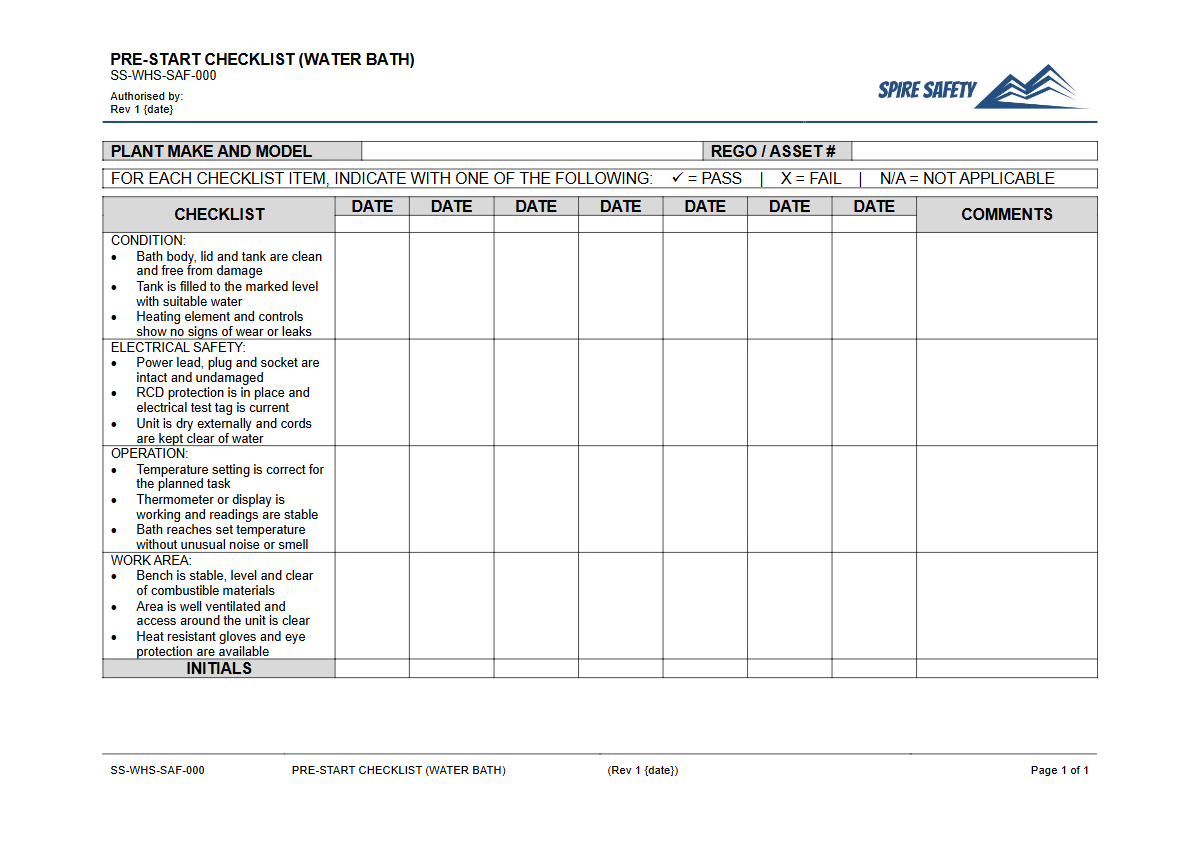
The checklist guides the operator through a logical sequence of visual and functional checks, prompting them to confirm the safety of key components before powering on the unit. Operators should sign and date the checklist for each inspection, and completed forms should be filed as part of your safety records.
Important: This document provides a foundational template. To be effective, you must customise it to reflect the specific make, model, features, and operational risks of the water baths used in your workplace.
We are not liable for any incidents arising from the use of this template. Integrating this process into your broader WHS management systems ensures that equipment safety is managed systematically and not as an isolated task.
Key Inspection Areas Covered
The template is organised into logical sections to ensure a thorough inspection, including:
- Electrical Safety: Checking for damaged cords, plugs, and connections to prevent electrical hazards.
- Water Level and Quality: Ensuring sufficient water to cover the heating element and checking for signs of contamination. Effective management of water-based equipment may also require a detailed hazard analysis, similar to the process in our Free Water Pump Risk Assessment Template.
- Temperature Controls: Verifying the function of thermostats, controls, and over-temperature cut-outs.
- Structural Integrity: Inspecting the tank, lid, and housing for leaks, corrosion, or damage.
- General Area Check: Ensuring the surrounding area is clear of trip hazards, flammable materials, and clutter.
When to Use It
A water bath pre-start check should be conducted before its first use each day or before the start of each new shift in a multi-shift environment. For intermittently used equipment, the check should be performed before every use.
This frequency ensures that any issues that may have developed since the last use—such as damage or component failure—are identified before the unit is energised.
Regular checks also contribute to a proactive maintenance culture. If your organisation uses a variety of specialised equipment, consider implementing similar checks across the board.
For example, our Free Pre-Start Checklist (3D Printer) Template offers a comparable approach for another common piece of modern equipment.
Who Should Use It
This checklist should be completed by any person who operates the water bath. This includes laboratory technicians, research scientists, assistants, and students who have been trained and deemed competent in its safe operation.
Supervisors or lab managers are responsible for ensuring these checks are being completed correctly and for taking appropriate action when faults are reported. Periodically reviewing completed checklists can be a key activity during WHS compliance auditing to verify that safety procedures are being followed.
By making these checks a mandatory part of the workflow, you empower operators to take ownership of their safety and the condition of their equipment. For more templates and safety documentation, browse our complete free WHS resources library.
Common mistakes
Common mistakes to avoid
- Forgetting to check the water level before turning the unit on.
- Using tap water instead of distilled/deionised water, leading to scale buildup.
- Neglecting regular cleaning, which allows for significant microbial contamination.
- Placing the water bath on an unstable surface or too close to flammable materials.
Legal references
Legal considerations
The following legal requirements may be relevant to this type of work.
- Work Health and Safety Act (Harmonised) — Provides the primary duties for protecting workers and other people from work health and safety risks.
- Work Health and Safety Regulations (Harmonised) — Sets out requirements supporting the management of workplace hazards and risks.
The following codes may be relevant to this type of work.
- Managing WHS Risks Code of Practice — Provides practical guidance on identifying hazards, assessing risks and applying effective controls.
- Work Health and Safety Consultation, Cooperation and Coordination Code of Practice — Provides practical guidance on consulting workers and coordinating with other duty holders.
- Managing the Work Environment and Facilities Code of Practice — Provides practical guidance on safe work environments, workplace facilities and related controls.
Did you know
Breeding Ground
A warm water bath (30-37°C) provides an ideal environment for bacteria and other microorganisms to grow. Without regular cleaning and disinfection, it can quickly contaminate experiments and pose a health risk to users.
Element Burnout
The most common cause of water bath failure is the heating element burning out. This is almost always caused by operating the unit with an insufficient water level, which a pre-start check is designed to prevent.
FAQ
Frequently asked questions
01What are the main hazards associated with a laboratory water bath?
02How often should the water in a water bath be changed?
03Can I use normal tap water in a water bath?
04Why is a pre-start check important even for new equipment?
Share this resource
Free Pre-Start Checklist (Water Bath) Template
Browse Categories
How To Use It
- 1Download and open in Word or PDF.
- 2Replace the placeholders with your business details.
- 3Get it reviewed by a WHS specialist before rollout.
Need it customised?
Our WHS consultants can adapt this template to your site, run a gap analysis, or audit what you already have in place.
Book a Free Consultation WHS consulting servicesor call 1300 156 382