
Free Pre-Start Checklist (Waste Compactor) Template
Download our free Pre-Start Checklist for Waste Compactors.
Free Pre-Start Checklist (Waste Compactor) Template
DOCX • 125 KB + PDF
Updated Oct 2026
No signup required
Purpose of the Free Pre-Start Checklist (Waste Compactor) Template
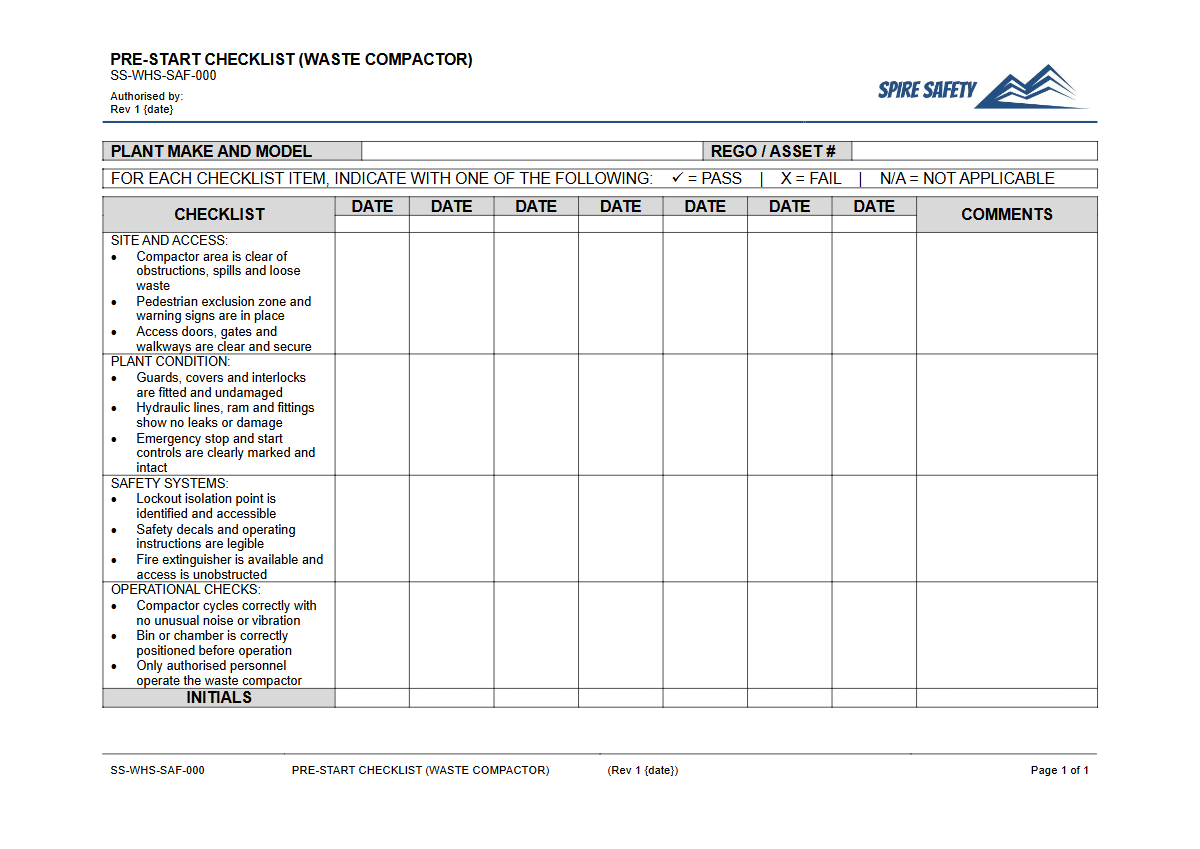
Waste compactors are powerful pieces of plant that introduce significant risks into the workplace, including crushing, entanglement, and electrical hazards. This Free Pre-Start Checklist (Waste Compactor) Template provides a structured framework for operators to conduct consistent and thorough safety inspections before each use.
Implementing a pre-start check helps to formalise your safety procedures, ensuring that any mechanical faults, hydraulic leaks, or damage to safety-critical components like emergency stops and guarding are identified and addressed before the machine is energised.
Using this checklist helps your organisation meet its duty of care by proactively managing risks associated with plant operation. It forms a key part of the risk management lifecycle, which begins with identifying hazards and assessing their potential for harm. For a more comprehensive approach to hazard identification for this type of machinery, you can use our Free Compactor Risk assessment Template.
Video walkthrough
How to use the Free Pre-Start Checklist (Waste Compactor) Template
This checklist is designed to be straightforward and practical. Operators should complete the list of checks before starting the waste compactor at the beginning of their shift or before its first use of the day.
The process involves visually inspecting key components, testing safety functions, and confirming the machine is in a safe condition to operate. Each item should be marked as satisfactory or, if a fault is found, noted in detail for maintenance action.
Any compactor with a identified fault must be immediately taken out of service, isolated, and tagged to prevent use until it is repaired by a competent person.
Please note: This is a template document. To ensure it meets the specific needs of your organisation, we strongly recommend you customise it to reflect your specific waste compactor model, work environment, and operational risks.
Effective implementation also requires training. Use a focused discussion, such as a Pre-Start Checks and Plant Maintenance Toolbox Talk, to ensure all operators understand how to perform the checks correctly and what actions to take if they find a defect.
When to use this Pre-Start Checklist
A Pre-Start Checklist for a waste compactor should be completed before every shift or period of use. This frequency ensures that any issues that may have developed overnight, between shifts, or as a result of previous use are caught early.
Regular checks prevent the operation of unsafe equipment, reducing the likelihood of incidents and costly emergency repairs. Integrating these checks into your standard operating procedures reinforces a safety-first culture and demonstrates a systematic approach to plant safety.
The process complements broader safety discussions, such as those facilitated by a Waste Management and Recycling Toolbox Talk, which address the wider context of site waste procedures.
Who should use this Pre-Start Checklist
The checklist should be completed by a worker who has been trained and deemed competent in the safe operation of the specific waste compactor. This person must understand the machine's functions, its potential hazards, and the importance of each item on the checklist.
Supervisors or managers have a responsibility to review completed checklists regularly, ensure any reported defects are actioned promptly, and verify that the pre-start process is being followed correctly by all operators. Verifying operator skill is a critical step, and while this document is a checklist, a formal competency assessment may also be required. For related machinery, you can see an example of this with our large plate compactor VOC template.
Completed pre-start checklists serve as important records. They provide evidence of your organisation's proactive approach to safety and can be invaluable during safety audits or incident investigations.
These records should be stored systematically as part of your broader WHS management systems, demonstrating consistent application of safety procedures. This systematic documentation can also be reviewed during routine safety reviews or formal WHS compliance auditing to identify trends and areas for improvement in your plant maintenance program.
This document is one of many tools available to help strengthen your safety processes. For more templates and guides covering a wide range of WHS topics, browse our complete free WHS resources library.
Common mistakes
Common mistakes to avoid
- Operator 'pencil-whipping' the checklist without physically inspecting the equipment.
- Failing to immediately tag out and report a compactor with identified faults.
- Using a generic checklist that doesn't cover the specific features or risks of the compactor model.
- Neglecting to train operators on what each checkpoint means and how to inspect it properly.
Legal references
Legal considerations
The following legal requirements may be relevant to this type of work.
- Work Health and Safety Act (Harmonised) — Provides the primary duties for protecting workers and other people from work health and safety risks.
- Work Health and Safety Regulations (Harmonised) — Sets out requirements supporting the management of workplace hazards and risks.
The following codes may be relevant to this type of work.
- Managing WHS Risks Code of Practice — Provides practical guidance on identifying hazards, assessing risks and applying effective controls.
- Work Health and Safety Consultation, Cooperation and Coordination Code of Practice — Provides practical guidance on consulting workers and coordinating with other duty holders.
- Managing the Work Environment and Facilities Code of Practice — Provides practical guidance on safe work environments, workplace facilities and related controls.
Did you know
Compaction Force
A typical industrial waste compactor can generate a compaction force of over 25,000 kilograms. This immense power highlights why functioning guards and emergency stops are non-negotiable safety features.
FAQ
Frequently asked questions
01What should be included in a waste compactor pre-start check?
02How often should waste compactor pre-start checks be done?
03Is a pre-start checklist a legal requirement in Australia for waste compactors?
04What happens if a fault is found during a pre-start check on a compactor?
Share this resource
Free Pre-Start Checklist (Waste Compactor) Template
Browse Categories
How To Use It
- 1Download and open in Word or PDF.
- 2Replace the placeholders with your business details.
- 3Get it reviewed by a WHS specialist before rollout.
Need it customised?
Our WHS consultants can adapt this template to your site, run a gap analysis, or audit what you already have in place.
Book a Free Consultation WHS consulting servicesor call 1300 156 382