
Free Pre-Start Checklist (Washer Disinf) Template
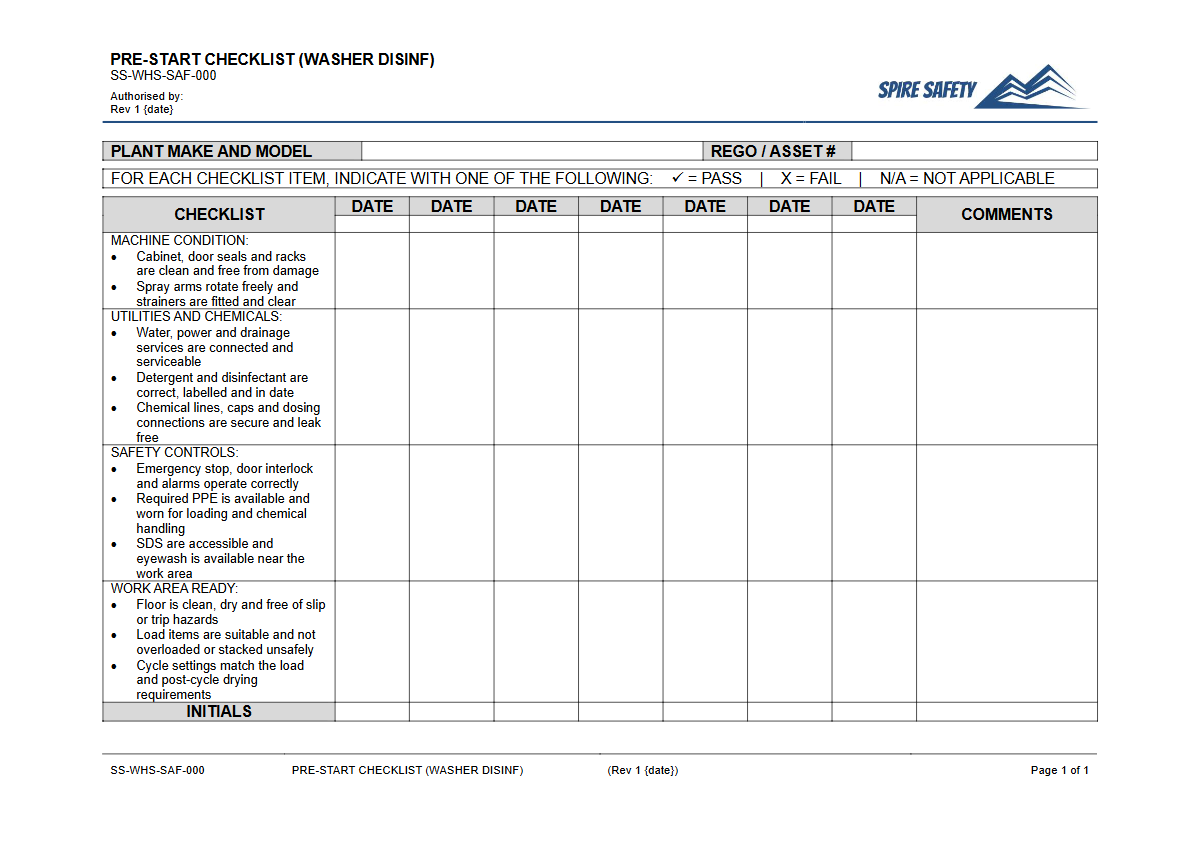
Download our free Pre-Start Checklist for Washer Disinfectors. This structured DOCX & PDF resource helps formalise daily equipment safety checks.
Free Pre-Start Checklist (Washer Disinf) Template
DOCX • 125 KB + PDF
Updated Oct 2026
No signup required
Purpose of the Free Pre-Start Checklist (Washer Disinf) Template
A washer-disinfector is a critical piece of equipment in healthcare, laboratory, and sterile processing environments. Ensuring it functions correctly is essential for both infection control and operator safety.
This Free Pre-Start Checklist (Washer Disinf) Template provides a structured starting point for developing a robust daily inspection routine. Using a formal checklist helps standardise the inspection process, ensuring no critical step is missed and that all operators are performing the same checks consistently.
This template is designed to help your organisation identify potential hazards before they cause harm or lead to equipment failure. Common issues include blocked spray arms, leaking seals, incorrect chemical dosing, and electrical faults.
By documenting these checks, you create a clear record of due diligence, which is a key component of managing WHS risks. The document is aligned with the principles of the model WHS framework, encouraging a systematic approach to identifying and controlling risks associated with plant and equipment.
Video walkthrough
How to use the Free Pre-Start Checklist (Washer Disinf) Template
To get started, download the template in your preferred format (DOCX for easy editing or PDF). The most important step is to customise the checklist to reflect the specific make and model of the washer-disinfector in your workplace, as well as the unique environmental and operational risks present.
Review the manufacturer’s operating manual and your own risk assessments to add or remove items. Checkpoints should cover all critical components, such as door seals, spray arms, filters, water connections, and chemical supply levels.
Once customised, integrate the checklist into your daily operating procedures. These records form an important part of your overall safety framework, demonstrating proactive risk management within your WHS management systems.
Note: This document is a template only. It is not a substitute for a comprehensive risk assessment.
It is your responsibility to ensure the final checklist is tailored to the specific plant, tasks, and environment of your workplace to effectively manage all identified risks.
When to use it
A pre-start checklist for a washer-disinfector should be completed before the first cycle of each day or shift. This routine ensures the machine is safe to operate and is in optimal condition to achieve effective disinfection.
Making this check a non-negotiable part of the daily workflow helps build a strong safety culture where potential issues are identified and rectified early. Regular inspections prevent the escalation of minor faults into major breakdowns, which can be costly and disruptive.
Reinforcing the importance of these daily checks can be achieved through regular training and communication. Discussing near misses or faults found during inspections is an excellent topic for a safety meeting, and our Pre-Start Checks and Plant Maintenance Toolbox Talk Template can help facilitate these discussions.
Who should use it
The primary user of this checklist is the trained and authorised operator of the washer-disinfector. They are the person most familiar with the machine's day-to-day performance and are best placed to notice subtle changes or developing faults.
Supervisors or department managers also have a role in reviewing the completed checklists periodically to ensure they are being filled out correctly and to identify any recurring issues that may indicate a need for maintenance or further investigation.
In environments like healthcare or aged care facilities, where staff handle a wide variety of tasks, clear and simple procedures are vital. Proper equipment checks are just as important as safe patient interaction, a topic covered in our Aged Care Manual Handling Toolbox Talk Template. Ultimately, anyone involved in the operation or supervision of the equipment should be familiar with the pre-start procedure.
What to Include in Your Customised Checklist
When adapting this template, consider adding specific checks for:
- Physical Condition: Check for damage to the chamber, door, and external panels.
- Door Seal: Inspect for cracks, wear, or debris that could compromise the seal.
- Spray Arms & Nozzles: Ensure they are clean, free of blockages, and rotate freely.
- Filters & Drains: Check and clean any filters as per the manufacturer's instructions.
- Chemicals: Verify that detergent and rinse aid containers have adequate levels and that supply lines are correctly connected. While a washer-disinfector is a contained system, other cleaning equipment involves more direct hazards, which is why a FREE Pressure Washer SOP (Safe Operating Procedure) Template is crucial for different tasks.
- Controls & Displays: Confirm the control panel is functioning and there are no error messages displayed.
Integrating Checks into Safety Audits
Completed pre-start checklists serve as valuable evidence during safety audits. They demonstrate that the organisation is actively monitoring the condition of its plant and taking steps to control risks.
An auditor will look for consistent and complete records, as well as evidence that any faults identified on the checklists were appropriately actioned. Regular reviews of these documents can be scheduled as part of your internal WHS compliance auditing program to ensure the system is working effectively.
By implementing and maintaining a rigorous pre-start checking process, you not only protect your workers but also enhance the reliability of your critical disinfection processes. For more tools to support your safety management system, browse our complete free WHS resources library.
Common mistakes
Common mistakes to avoid
- Using a generic template without customising it for the specific machine model.
- 'Pencil-whipping' the checklist without performing the physical checks.
- Failing to report, document, and action faults that are identified during the check.
- Not providing adequate training to operators on how to properly inspect each item.
Legal references
Legal considerations
The following legal requirements may be relevant to this type of work.
- Work Health and Safety Act (Harmonised) — Provides the primary duties for protecting workers and other people from work health and safety risks.
- Work Health and Safety Regulations (Harmonised) — Sets out requirements supporting the management of workplace hazards and risks.
The following codes may be relevant to this type of work.
- Managing WHS Risks Code of Practice — Provides practical guidance on identifying hazards, assessing risks and applying effective controls.
- Work Health and Safety Consultation, Cooperation and Coordination Code of Practice — Provides practical guidance on consulting workers and coordinating with other duty holders.
- Managing the Work Environment and Facilities Code of Practice — Provides practical guidance on safe work environments, workplace facilities and related controls.
Did you know
Infection Control Standard
In Australia, AS/NZS 4187 is the key standard governing the reprocessing of reusable medical devices, specifying strict requirements for cleaning, disinfection, and sterilisation processes, including the performance of washer-disinfectors.
Thermal Disinfection
The effectiveness of a washer-disinfector relies heavily on achieving specific temperatures for a set duration. A common benchmark for thermal disinfection is maintaining a surface temperature of 90°C for at least one minute to kill most microorganisms.
FAQ
Frequently asked questions
01Why is a pre-start check for a washer-disinfector important?
02What hazards can a washer-disinfector pre-start checklist identify?
03Can this template be used for any brand of washer-disinfector?
04How often should our pre-start checklists be reviewed and updated?
Share this resource
Free Pre-Start Checklist (Washer Disinf) Template
Browse Categories
How To Use It
- 1Download and open in Word or PDF.
- 2Replace the placeholders with your business details.
- 3Get it reviewed by a WHS specialist before rollout.
Need it customised?
Our WHS consultants can adapt this template to your site, run a gap analysis, or audit what you already have in place.
Book a Free Consultation WHS consulting servicesor call 1300 156 382