
Free Pre-Start Checklist (Vehicle Hoist) Template
Download our free Pre-Start Checklist (Vehicle Hoist) Template to formalise daily safety inspections for automotive lifts. Download your DOCX & PDF today.
Free Pre-Start Checklist (Vehicle Hoist) Template
DOCX • 125 KB + PDF
Updated Oct 2026
No signup required
Purpose of the Free Pre-Start Checklist (Vehicle Hoist) Template
A vehicle hoist is a critical piece of equipment in any automotive workshop, and its failure can have catastrophic consequences. This Free Pre-Start Checklist (Vehicle Hoist) Template provides a structured framework for conducting and recording daily safety inspections.
Using a formal checklist helps your business meet its primary duty of care under WHS legislation by ensuring hoists are safe to use before work begins. It systemises the process of identifying potential faults, mechanical wear, or hydraulic issues that could lead to equipment failure, property damage, or serious injury.
Regular, documented checks are a fundamental part of proactive hazard management. They create a historical record of the hoist's condition, which is invaluable for maintenance planning, incident investigations, and demonstrating due diligence.
Integrating this checklist into your daily routine strengthens your overall WHS management systems by embedding a consistent safety verification step for all operators.
What this Pre-Start Checklist covers:
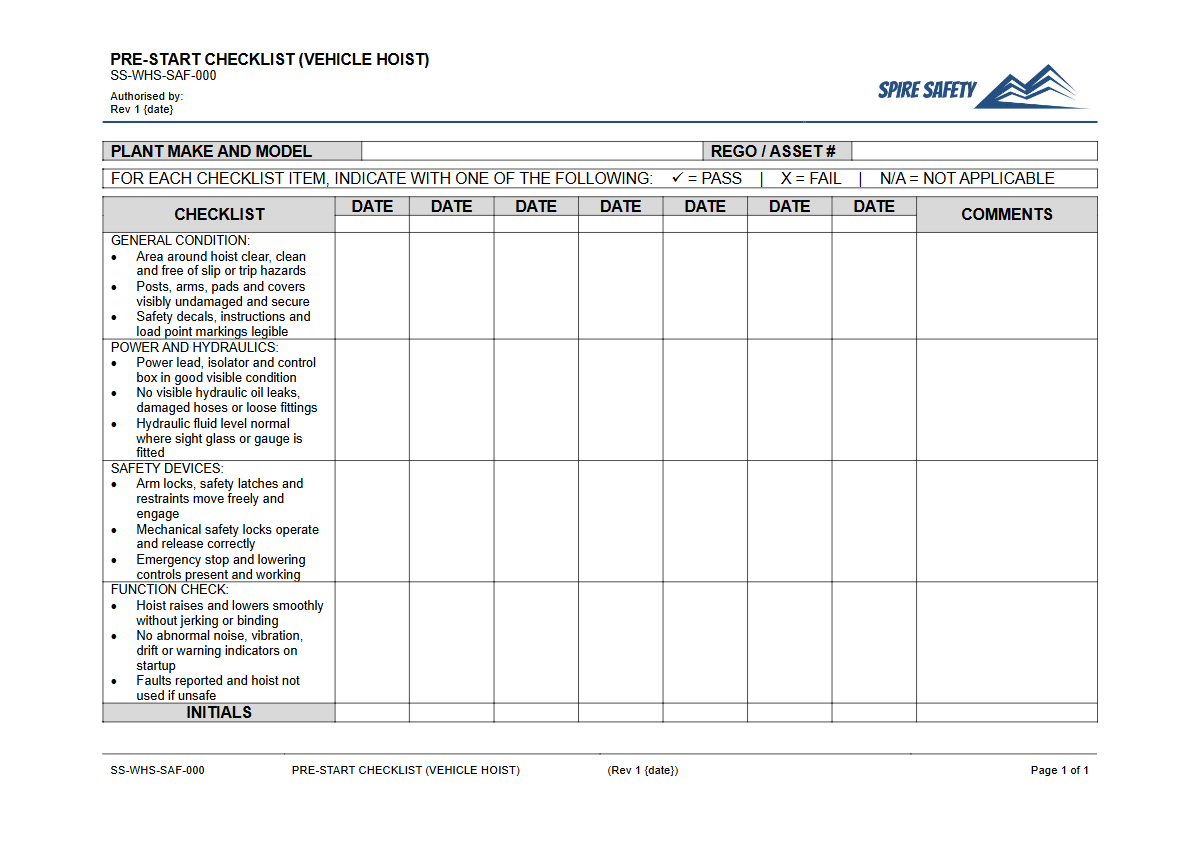
This template prompts operators to inspect key components of a vehicle hoist, including:
- Structural Components: Checking for cracks, deformation, or corrosion on columns, arms, and runways.
- Lifting Mechanisms: Inspecting chains, cables, and screws for wear, tension, and proper lubrication.
- Hydraulic & Pneumatic Systems: Looking for leaks in hoses, cylinders, and fittings.
- Safety Features: Verifying the function of locking mechanisms, safety latches, and arm restraints.
- Controls & Emergency Stops: Ensuring all operator controls and emergency stop buttons are functional and accessible.
- General Area: Confirming the surrounding area is clear of obstructions, slip hazards, and that all safety signage is legible.
Video walkthrough
How to use the Free Pre-Start Checklist (Vehicle Hoist) Template
This checklist is provided as a user-friendly DOCX file that you can download and open in Microsoft Word or other compatible software. A PDF version is also available for easy printing and immediate use.
The document is designed to be straightforward: the operator simply works through the list, ticking off each item to confirm it has been inspected and found to be in safe working order. Any identified faults or concerns should be noted in the comments section, and the hoist must be immediately tagged out of service until it is repaired by a competent person.
Important: This document is a template, not a finished procedure. We've designed it to align with Australian WHS principles, but it must be customised to your specific workplace.
You need to review and adapt the checklist to include items specific to the make, model, and configuration of your vehicle hoists. If you require expert guidance on customising documents or implementing safety procedures, our WHS consulting services can provide tailored support.
While this resource is for vehicle hoists, different lifting equipment requires different checks. For instance, workshops using other lifting devices may find our Free Pre-Start Checklist (Electric Hoist) Template more suitable for that specific plant.
When to use it
The Pre-Start Checklist should be completed by a competent operator at the beginning of each shift or before the first use of the vehicle hoist each day. This frequency ensures that any issues that may have developed overnight or between shifts are caught before the equipment is put under load.
The key to effectiveness is consistency; making the pre-start check a non-negotiable part of the daily opening procedure is critical for maintaining a safe work environment.
Who should use it
This checklist is designed for use by any worker tasked with operating a vehicle hoist, including qualified mechanics, technicians, and apprentices under supervision. It is the operator's responsibility to perform the check thoroughly and honestly.
Supervisors and managers also have a role in ensuring the checks are being completed correctly and that any reported defects are addressed immediately. During a formal safety review, evidence of completed checklists will be a key point of verification for an WHS compliance auditing process.
By standardising pre-start inspections, you empower workers to take ownership of their safety and the safety of those around them. If this template is useful, you may wish to explore our complete free WHS resources library for other checklists, policies, and templates to support your safety management efforts.
Common mistakes
Common mistakes to avoid
- Skipping the pre-start check to save time, especially on busy days.
- Ignoring small hydraulic fluid drips or 'weeps', which can indicate an impending hose or seal failure.
- Incorrectly positioning the vehicle on the hoist, leading to an unbalanced and unstable lift.
- Failing to report unusual noises or slow operation, which are often early signs of mechanical problems.
Legal references
Legal considerations
The following legal requirements may be relevant to this type of work.
- Work Health and Safety Act (Harmonised) — Provides the primary duties for protecting workers and other people from work health and safety risks.
- Work Health and Safety Regulations (Harmonised) — Sets out requirements supporting the management of workplace hazards and risks.
The following codes may be relevant to this type of work.
- Managing WHS Risks Code of Practice — Provides practical guidance on identifying hazards, assessing risks and applying effective controls.
- Work Health and Safety Consultation, Cooperation and Coordination Code of Practice — Provides practical guidance on consulting workers and coordinating with other duty holders.
- Managing the Work Environment and Facilities Code of Practice — Provides practical guidance on safe work environments, workplace facilities and related controls.
Did you know
Australian Standards
In Australia, the design, manufacturing, and safe use of vehicle hoists are governed by specific standards, including AS/NZS 1418.9 (for design) and AS/NZS 2550.9 (for safe use).
Hydraulic Force
The hydraulic system in a typical two-post vehicle hoist operates at pressures between 2,500 and 3,000 PSI to lift a standard passenger car. A tiny pinhole leak at this pressure can inject fluid into the skin, causing severe injury.
FAQ
Frequently asked questions
01What should be checked on a vehicle hoist before use?
02How often should a vehicle hoist be inspected in Australia?
03Is a logbook required for vehicle hoists?
04What is the main cause of vehicle hoist accidents?
Share this resource
Free Pre-Start Checklist (Vehicle Hoist) Template
Browse Categories
How To Use It
- 1Download and open in Word or PDF.
- 2Replace the placeholders with your business details.
- 3Get it reviewed by a WHS specialist before rollout.
Need it customised?
Our WHS consultants can adapt this template to your site, run a gap analysis, or audit what you already have in place.
Book a Free Consultation WHS consulting servicesor call 1300 156 382