
Free Pre-Start Checklist (Vacuum Crane) Template
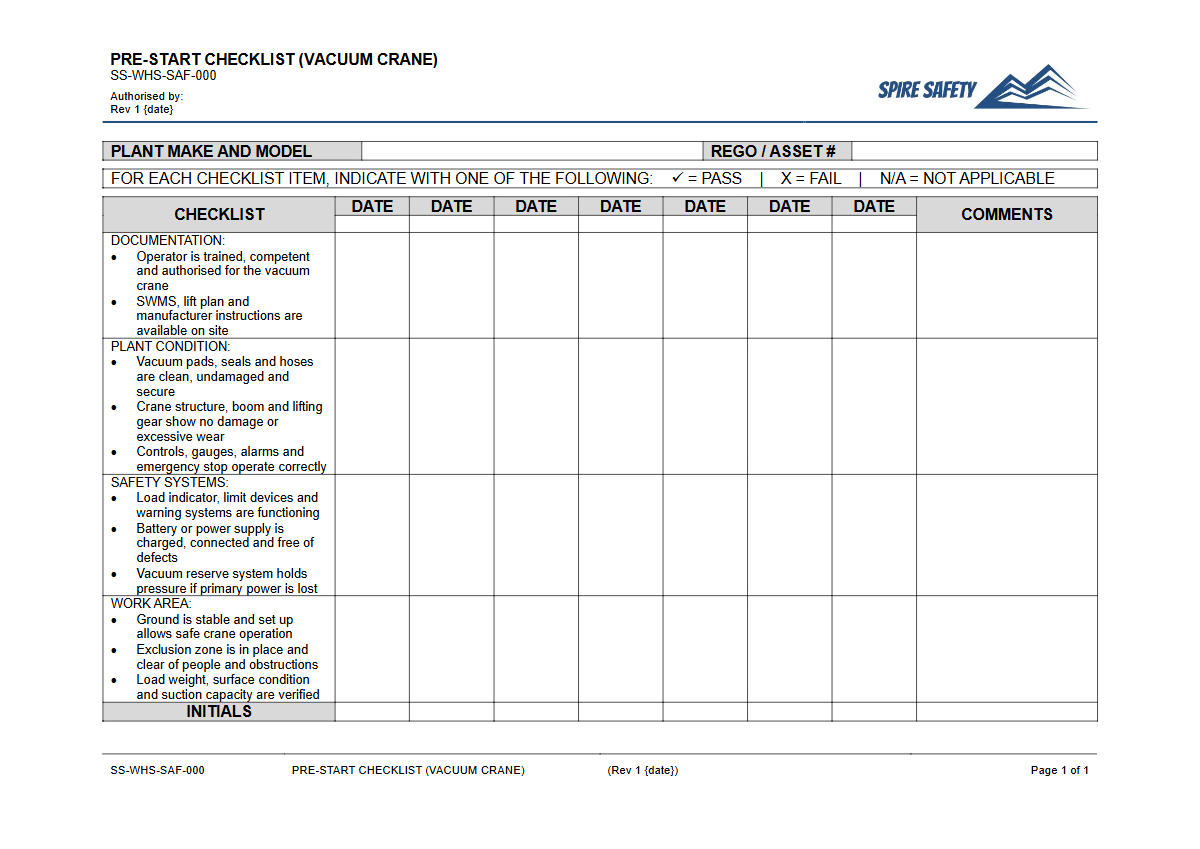
Download our free Pre-Start Checklist for Vacuum Cranes. This DOCX & PDF template helps formalise daily equipment checks and identify hazards. Get your copy.
Free Pre-Start Checklist (Vacuum Crane) Template
DOCX • 125 KB + PDF
Updated Oct 2026
No signup required
Purpose of the Free Pre-Start Checklist (Vacuum Crane) Template
Using a vacuum crane involves significant risks, from dropped loads due to vacuum failure to mechanical or structural issues. This Free Pre-Start Checklist (Vacuum Crane) Template provides a structured way for operators to conduct thorough inspections before use, helping to identify and address potential hazards before they lead to an incident.
A systematic pre-start check is a fundamental component of proactive safety management, ensuring the equipment is fit for purpose and that all safety-critical components are functioning correctly.
Regular inspections help maintain the equipment in safe working order, prevent costly breakdowns, and fulfil some of the duties of care under Australian WHS legislation. Documenting these checks creates a record of due diligence and promotes a positive safety culture where equipment integrity is prioritised.
To reinforce this practice with your team, consider using our Pre-Start Checks and Plant Maintenance Toolbox Talk Template to brief workers on their responsibilities.
Video walkthrough
How to use the Free Pre-Start Checklist (Vacuum Crane) Template
This template is designed as a starting point. After downloading the DOCX or PDF file, you must adapt it to the specific make, model, and configuration of the vacuum crane used in your workplace, as well as the unique operational environment.
Key items to inspect typically include the vacuum pump, pads and seals, hoses, warning lights and alarms, load-bearing structures, and control systems.
Important: This is a template only. We have provided a comprehensive starting point, but you must customise this document to suit the specific plant, tasks, and environment at your workplace.
Consult the manufacturer's instructions and conduct a site-specific risk assessment to ensure all relevant checks are included. For a more detailed operational procedure, you might also develop a Safe Operating Procedure for vacuum equipment to complement this checklist.
Implementation Steps:
- Customise: Add or remove checklist items to match your specific vacuum crane and site conditions. Include fields for the operator's name, date, plant ID, and supervisor sign-off.
- Train: Ensure all operators are trained on how to properly conduct the pre-start inspection using the finalised checklist. They must understand what each item is and what constitutes a pass or fail.
- Implement: Integrate the checklist into your daily operational procedures. Make it a mandatory step before any vacuum crane is used for the first time in a shift.
- Review: Establish a procedure for handling failed items. This must include tagging the equipment out of service and reporting the fault for immediate repair. Supervisors should periodically review completed checklists to ensure they are being filled out correctly.
When to use it
A pre-start checklist for a vacuum crane should be completed before the first use on every shift or day of operation. If the crane is used by multiple operators in one shift, it is good practice for the incoming operator to conduct their own check to verify the equipment's condition.
The check confirms that the plant was safe at the beginning of the operation and has not been left in a hazardous state by the previous user. Using this document consistently helps embed safety checks as a non-negotiable part of your high-risk work procedures, similar to the planning required for a Safe Work Method Statement for Vehicle Loading Crane Operation.
Who should use it
The pre-start checklist must be completed by a worker who is competent and authorised to operate the specific vacuum crane. Competency means they have received the necessary information, training, and instruction to understand the equipment's functions, limitations, and safety features.
Verifying this competency is a critical step for any person conducting high-risk work; our Verification of Competency for an Overhead Bridge Crane Template offers a framework for how this can be documented. Supervisors or managers also have a role in reviewing the completed checklists to monitor compliance and identify recurring maintenance issues that may require investigation. The proper implementation and review of such documents are key components of effective WHS management systems.
By integrating this pre-start checklist into your daily workflow, you contribute to a safer work environment and a more reliable fleet of plant and equipment. For a broader look at how your safety processes align with legislative requirements, a formal WHS compliance audit can provide valuable insights and identify areas for improvement across your entire organisation. You can find more helpful documents like this one in our free WHS resources library.
Common mistakes
Common mistakes to avoid
- Failing to customise the generic template for the specific crane model.
- 'Pencil-whipping' the form without physically checking the items.
- Overlooking small cracks or wear on vacuum seals and hoses.
- Continuing to operate the crane after a non-critical fault is noted, rather than reporting it for repair.
Legal references
Legal considerations
The following legal requirements may be relevant to this type of work.
- Work Health and Safety Act (Harmonised) — Provides the primary duties for protecting workers and other people from work health and safety risks.
- Work Health and Safety Regulations (Harmonised) — Sets out requirements supporting the management of workplace hazards and risks.
The following codes may be relevant to this type of work.
- Managing WHS Risks Code of Practice — Provides practical guidance on identifying hazards, assessing risks and applying effective controls.
- Work Health and Safety Consultation, Cooperation and Coordination Code of Practice — Provides practical guidance on consulting workers and coordinating with other duty holders.
- Managing the Work Environment and Facilities Code of Practice — Provides practical guidance on safe work environments, workplace facilities and related controls.
Did you know
Pressure Differential
Vacuum lifters don't 'suck' an object up. They work by removing air from between the suction pad and the object's surface, creating a pressure differential where the higher atmospheric pressure outside pushes the object onto the pad.
Safety Factor
Reputable vacuum lifting systems are designed with a safety factor, meaning the vacuum pump and pads are capable of holding a load much heavier than their stated safe working load (SWL) to account for minor leaks or surface irregularities.
FAQ
Frequently asked questions
01Is a pre-start checklist legally required for a vacuum crane in Australia?
02What are the most critical items on a vacuum crane pre-start?
03What should happen if a fault is found during a vacuum crane pre-start check?
04How long should we keep completed pre-start checklists?
Share this resource
Free Pre-Start Checklist (Vacuum Crane) Template
Browse Categories
How To Use It
- 1Download and open in Word or PDF.
- 2Replace the placeholders with your business details.
- 3Get it reviewed by a WHS specialist before rollout.
Need it customised?
Our WHS consultants can adapt this template to your site, run a gap analysis, or audit what you already have in place.
Book a Free Consultation WHS consulting servicesor call 1300 156 382