
Free Pre-Start Checklist (Vac Tumbler) Template
Download our free Pre-Start Checklist for Vac Tumblers. This editable DOCX & PDF template helps formalise equipment checks and manage WHS risks.
Free Pre-Start Checklist (Vac Tumbler) Template
DOCX • 125 KB + PDF
Updated Oct 2026
No signup required
Purpose of the Free Pre-Start Checklist (Vac Tumbler) Template
Vacuum tumblers are essential in food processing and other industries for marinating, mixing, and tenderising products. However, their moving parts, pressurised systems, and electrical components introduce significant workplace hazards.
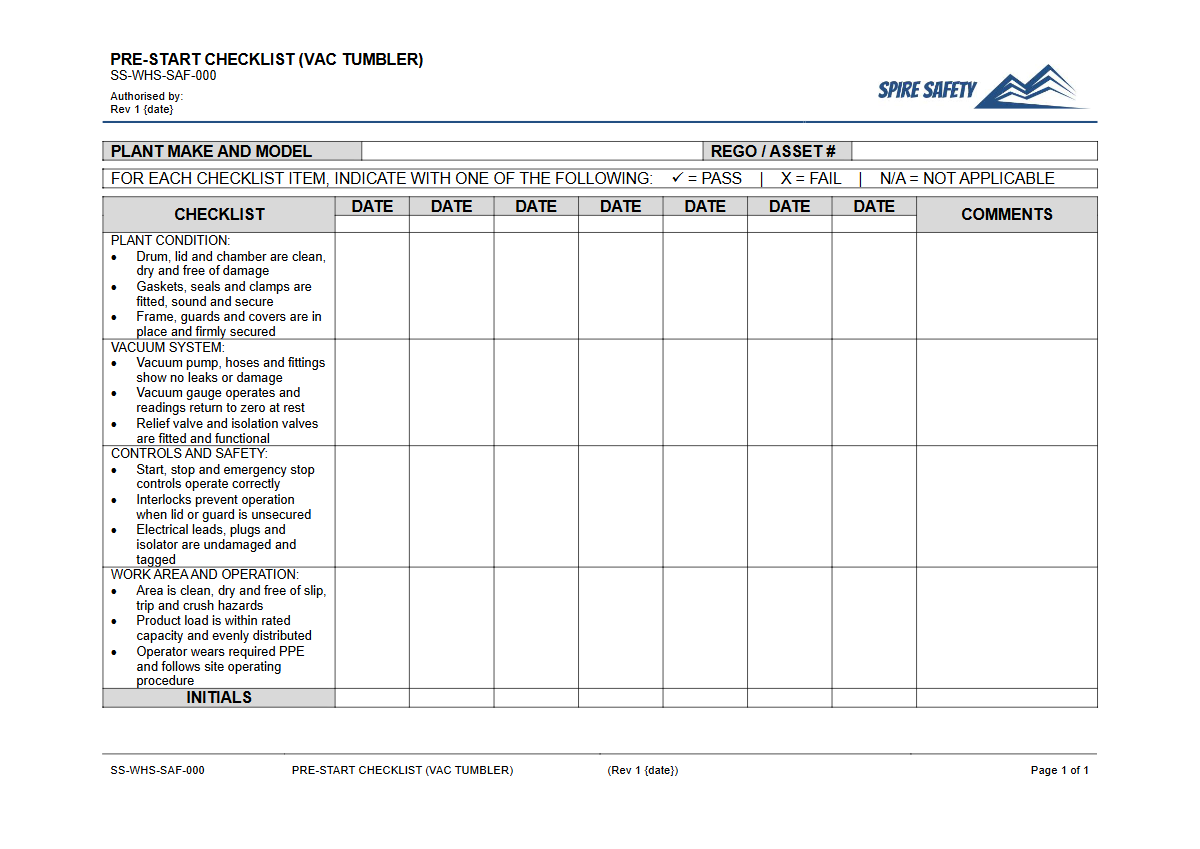
This free Pre-Start Checklist (Vac Tumbler) Template provides a structured framework to help operators conduct thorough, documented safety inspections before using the equipment. Systematically checking key components like guarding, emergency stops, seals, and controls helps identify potential faults before they can lead to incidents, injuries, or costly downtime.
Using a formal checklist promotes a consistent inspection routine, ensuring no critical safety feature is overlooked. It serves as a practical tool to help meet your duty of care under Australian WHS regulations.
Integrating such checks is a fundamental component of effective WHS management systems, creating a safer environment for everyone in the workplace.
Video walkthrough
How to use the Free Pre-Start Checklist (Vac Tumbler) Template
This resource is available for immediate download in both DOCX and PDF formats. The DOCX version is fully editable, allowing you to tailor it to your specific operational needs.
The PDF is ideal for printing and immediate use if the standard format suits your machine.
Important: This template is a starting point based on common industry practice. To ensure it is effective, you must customise it to reflect the specific make, model, configuration, and unique hazards of your vacuum tumbler.
We provide this as a foundation, but its ultimate suitability depends on your modifications and correct implementation in your workplace's specific context. For example, your process might involve different machinery with similar principles, like those covered in our Free Pre-Start Checklist (Agitator) Template.
The checklist guides an operator to inspect:
- Guarding: Ensure all physical guards and interlock switches are in place and functioning correctly.
- Emergency Stops: Verify that all E-stops are accessible, unobstructed, and fully operational.
- Controls: Check that start, stop, and rotation controls work as intended.
- Vacuum System: Inspect hoses, seals, and gauges for leaks, damage, or malfunction.
- Drum and Drive: Look for signs of wear, damage, or unusual noises in the tumbling drum and drive mechanism.
- General Condition: Check for cleanliness, fluid leaks, and structural integrity.
When to use it
A pre-start checklist should be completed by the operator before commencing work at the start of every shift or before the first use of the day. This routine ensures that the equipment's condition has not changed overnight or between shifts due to damage, tampering, or incomplete maintenance.
Making this check a non-negotiable part of the daily startup procedure is key to building a strong safety culture. These individual checks can be supplemented with broader team safety briefings, which can be documented using a pre-start meeting template to ensure all workers are aware of the day's hazards.
Who should use it
The checklist must be used by a person who has been trained and deemed competent in the safe operation of the specific vacuum tumbler. This includes having a thorough understanding of its functions, potential hazards, and emergency procedures.
Supervisors should also be familiar with the checklist to ensure that operators are completing the checks correctly and to effectively manage any reported faults. The documented checklists create a clear record of due diligence and help track the equipment's condition over time, providing valuable data for maintenance scheduling and safety analysis.
Integrating Checks into Your Safety Framework
A single checklist is only one part of a comprehensive safety strategy. To be truly effective, it must be embedded within your organisation's broader safety processes.
This includes providing workers with regular training on equipment hazards, a topic well-suited for a Pre-Start Checks and Plant Maintenance Toolbox Talk. It also involves establishing clear procedures for reporting, isolating, and repairing faulty equipment using a Lockout/Tagout system. For businesses managing a wide range of machinery, it's beneficial to standardise pre-start processes across all plant, from tumblers to a Free Pre-Start Checklist (CNC Router) Template.
Periodically, the effectiveness of your entire safety system, including the use and quality of pre-start checklists, should be reviewed. This can be done internally or through formal WHS compliance auditing to identify gaps and areas for improvement.
Proactive management ensures your safety efforts remain relevant and effective. Explore our complete free WHS resources library for more tools to support your safety management system.
Common mistakes
Common mistakes to avoid
- Using a generic checklist without customising it for the specific machine model.
- Skipping checks or rushing through them to save time at the start of a shift.
- "Pencil-whipping" the form without physically inspecting the listed items.
- Failing to immediately tag out and report faulty equipment to a supervisor.
Legal references
Legal considerations
The following legal requirements may be relevant to this type of work.
- Work Health and Safety Act (Harmonised) — Provides the primary duties for protecting workers and other people from work health and safety risks.
- Work Health and Safety Regulations (Harmonised) — Sets out requirements supporting the management of workplace hazards and risks.
The following codes may be relevant to this type of work.
- Managing WHS Risks Code of Practice — Provides practical guidance on identifying hazards, assessing risks and applying effective controls.
- Work Health and Safety Consultation, Cooperation and Coordination Code of Practice — Provides practical guidance on consulting workers and coordinating with other duty holders.
- Managing the Work Environment and Facilities Code of Practice — Provides practical guidance on safe work environments, workplace facilities and related controls.
Did you know
Entanglement Hazard
The rotating drum of a vac tumbler poses a significant entanglement risk. Loose clothing, hair, or jewellery can be caught in seconds, leading to severe injuries.
LOTO Procedures
Lockout/Tagout (LOTO) is a critical safety procedure that must be followed during maintenance, cleaning, or when clearing blockages to prevent the accidental re-energisation of the machine.
FAQ
Frequently asked questions
01What should be included on a vac tumbler pre-start checklist?
02How often should a vacuum tumbler be inspected?
03Who is responsible for completing an equipment pre-start check?
04What happens if a fault is found during a pre-start check?
Share this resource
Free Pre-Start Checklist (Vac Tumbler) Template
Browse Categories
How To Use It
- 1Download and open in Word or PDF.
- 2Replace the placeholders with your business details.
- 3Get it reviewed by a WHS specialist before rollout.
Need it customised?
Our WHS consultants can adapt this template to your site, run a gap analysis, or audit what you already have in place.
Book a Free Consultation WHS consulting servicesor call 1300 156 382