
Free Pre-Start Checklist (Vac Truck) Template
Download our free Pre-Start Checklist (Vac Truck) Template to formalise daily equipment inspections and manage WHS risks.
Free Pre-Start Checklist (Vac Truck) Template
DOCX • 125 KB + PDF
Updated Oct 2026
No signup required
Purpose of the Free Pre-Start Checklist (Vac Truck) Template
Operating a vacuum truck involves significant risks, from high-pressure systems and heavy vehicle operation to handling potentially hazardous materials. A systematic pre-start inspection is a critical control measure to ensure the equipment is safe before work begins.
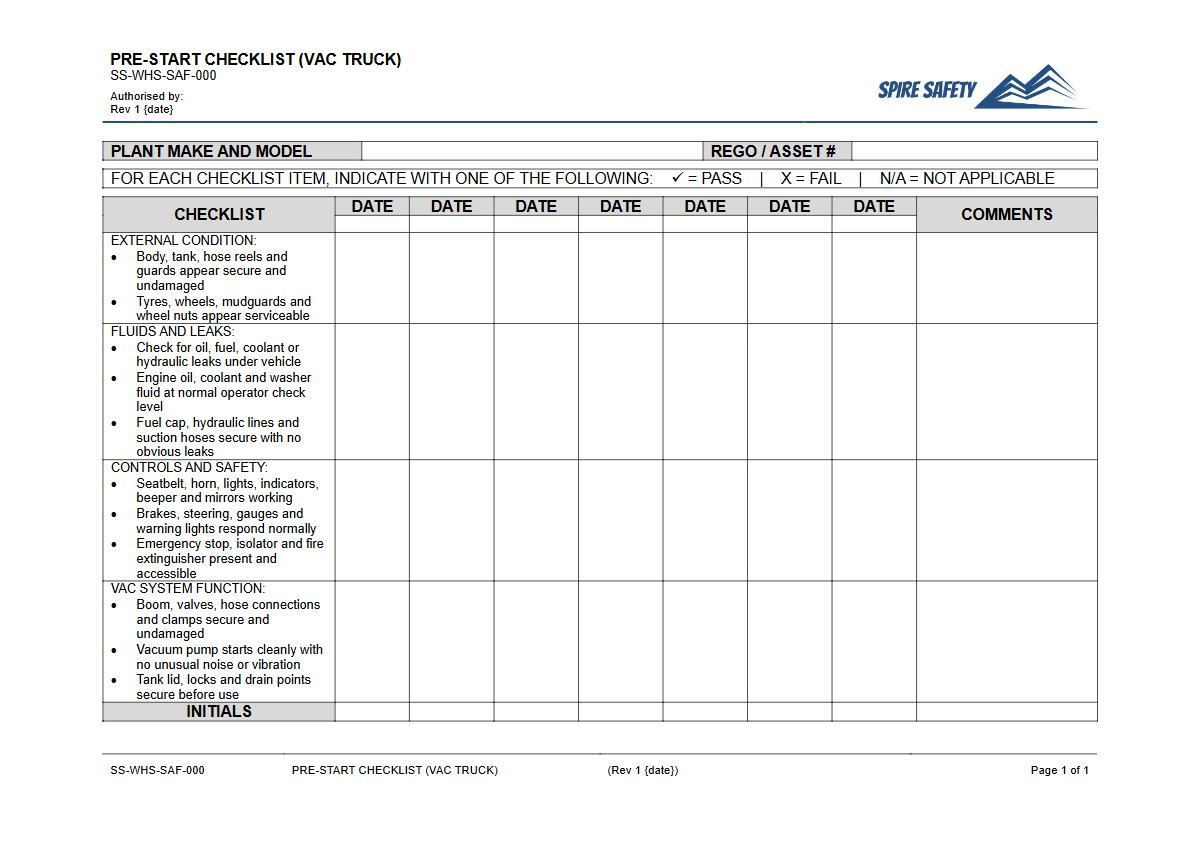
Our Free Pre-Start Checklist (Vac Truck) Template provides a structured format to guide operators through these essential checks, helping your organisation identify mechanical faults, damage, or wear and tear that could lead to an incident. By formalising this process, you create a clear record of due diligence, promote a positive safety culture, and minimise equipment downtime.
This checklist is designed as a practical tool to support your risk management processes. It prompts the inspection of critical components specific to vac trucks, including vacuum systems, tanks, hoses, safety relief valves, and general vehicle roadworthiness.
Integrating this check into your daily routine is a fundamental step in meeting your duties under Australian WHS legislation.
Video walkthrough
How to use the Free Pre-Start Checklist (Vac Truck) Template
This resource is provided in both DOCX and PDF formats for your convenience. The DOCX file is fully editable, allowing you to tailor the checklist to your specific operational needs.
To use the template effectively, download the file and add your company branding, specific truck models, and any unique site or task-related checks. A well-customised checklist forms a crucial part of your broader WHS management systems, ensuring your documentation reflects your actual work practices.
Important: This document is a template, not a finished legal document. We have designed it as a comprehensive starting point aligned with Australian WHS principles.
You must customise it to suit the specific models of plant, site conditions, and internal procedures of your organisation to ensure it is fit for purpose.
Key Items on a Vac Truck Pre-Start Checklist
A thorough inspection should be methodical and cover all critical systems. While our template provides a detailed list, key areas of focus include:
Vehicle and Cabin
- General Roadworthiness: Check tyres for pressure and wear, brakes (air pressure), steering, lights, indicators, and windscreen wipers.
- Cabin Controls: Ensure all controls, gauges, and warning lights are functional. Check the horn and reversing beeper.
- Safety Equipment: Verify the fire extinguisher is charged and in-date, and a first aid kit is available.
Vacuum and Pumping System
- Hoses and Fittings: Inspect for cracks, abrasion, or damage. Ensure all couplings are secure and sealing correctly.
- Tank: Check for visible damage, leaks, or corrosion. Ensure all hatches and valves are secure.
- Gauges and Valves: Confirm pressure/vacuum gauges are functional and that safety relief valves are unobstructed. This same attention to hydraulics and moving parts is vital for other heavy machinery, as detailed in our Free Pre-Start Checklist (Forwarder) Template.
- Emergency Stops: Test all emergency stop buttons for the pump and other powered systems to ensure they function correctly.
When to use this Pre-Start Checklist
The pre-start inspection must be performed before the start of every shift or before the equipment's first use each day. This frequency ensures that any faults that may have developed overnight or during a previous operation are caught before the truck is put into service.
Completed checklists should be reviewed by a supervisor and retained as part of your operational health and safety records. This documentation is essential for demonstrating procedural compliance during a WHS compliance audit.
Who should use this checklist
The pre-start check must be carried out by a person who is trained and competent to operate the specific model of vacuum truck. The operator must not only know how to run the equipment but also understand what they are looking for during the inspection.
Supervisors or managers are responsible for ensuring that operators are completing these checks correctly and that a system is in place to address any reported defects. The principles of operator competence and routine checks apply to all workplace equipment, from complex vehicles to simpler machinery like that covered in our Free Pre-Start Checklist (Bin Lifter) Template.
Ultimately, a pre-start checklist is a tool that empowers operators to take ownership of their safety and the safety of those around them. For more templates covering a wide range of plant and equipment, browse our complete free WHS resources library.
Common mistakes
Common mistakes to avoid
- Completing the checklist from memory without physically inspecting the item ('pencil-whipping').
- Failing to immediately report and 'tag out' equipment when a serious defect is found.
- Using a generic checklist that doesn't match the specific make and model of the vacuum truck.
- Operators not being trained on what to look for, turning the check into a tick-box exercise.
Legal references
Legal considerations
The following legal requirements may be relevant to this type of work.
- Work Health and Safety Act (Harmonised) — Provides the primary duties for protecting workers and other people from work health and safety risks.
- Work Health and Safety Regulations (Harmonised) — Sets out requirements supporting the management of workplace hazards and risks.
The following codes may be relevant to this type of work.
- Managing WHS Risks Code of Practice — Provides practical guidance on identifying hazards, assessing risks and applying effective controls.
- Work Health and Safety Consultation, Cooperation and Coordination Code of Practice — Provides practical guidance on consulting workers and coordinating with other duty holders.
- Managing the Work Environment and Facilities Code of Practice — Provides practical guidance on safe work environments, workplace facilities and related controls.
Did you know
Industrial Vacuum Power
Industrial vacuum trucks can generate vacuums strong enough to lift several tonnes of material. A failure in a hose or tank can be catastrophic, releasing stored energy explosively.
Not Just for Liquids
Modern vacuum trucks are also used for 'hydro excavation', using high-pressure water to break up soil which is then vacuumed away. This is considered a much safer method of digging around underground utilities than mechanical excavation.
FAQ
Frequently asked questions
01What key items should be on a vacuum truck pre-start checklist?
02How often should vacuum truck pre-start inspections be performed?
03Is a digital pre-start checklist better than a paper-based one?
04Who is responsible for actioning defects found during a pre-start check?
Share this resource
Free Pre-Start Checklist (Vac Truck) Template
Browse Categories
How To Use It
- 1Download and open in Word or PDF.
- 2Replace the placeholders with your business details.
- 3Get it reviewed by a WHS specialist before rollout.
Need it customised?
Our WHS consultants can adapt this template to your site, run a gap analysis, or audit what you already have in place.
Book a Free Consultation WHS consulting servicesor call 1300 156 382