
Free Pre-Start Checklist (Ute) Template
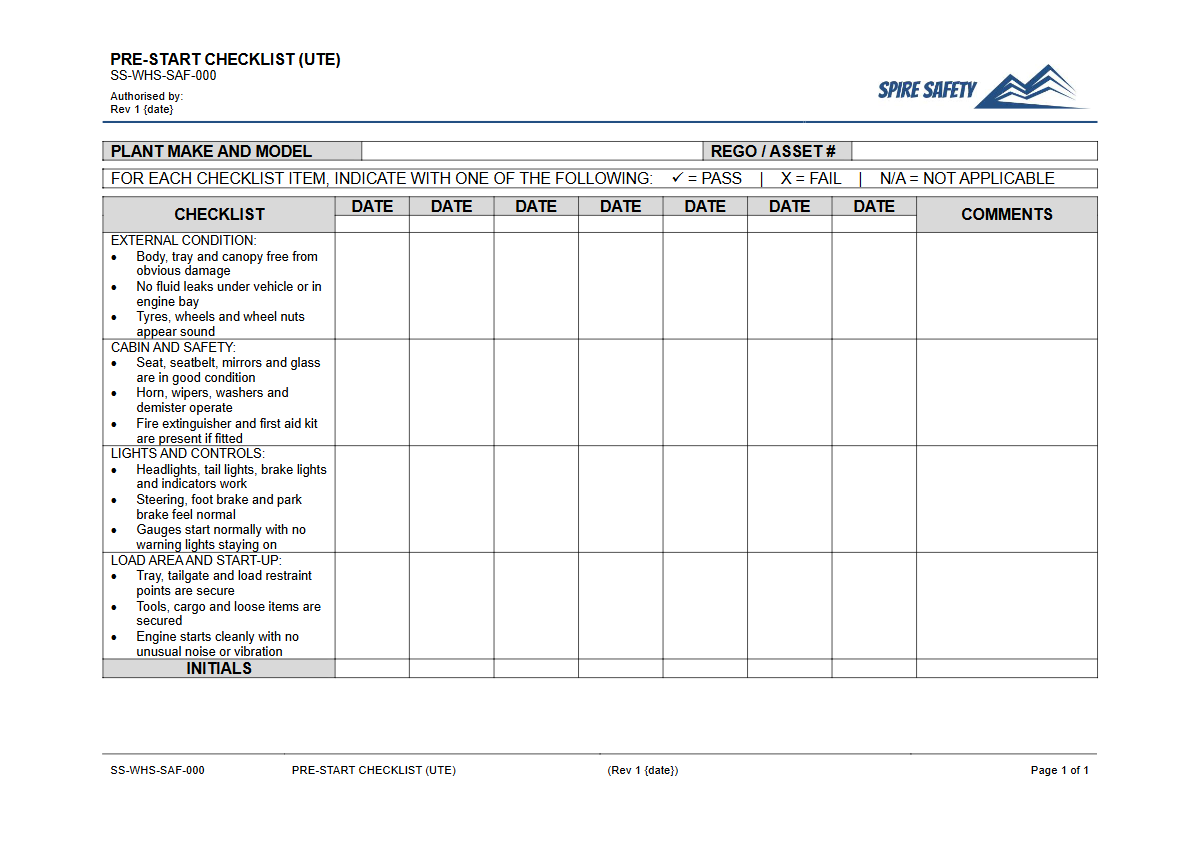
Download our free Pre-Start Checklist (Ute) Template (DOCX/PDF). A structured starting point to help formalise daily vehicle safety inspections. Get yours now.
Free Pre-Start Checklist (Ute) Template
DOCX • 125 KB + PDF
Updated Oct 2026
No signup required
Purpose of the Free Pre-Start Checklist (Ute) Template
This Free Pre-Start Checklist (Ute) Template provides a structured framework for conducting and recording daily safety inspections of light commercial utility vehicles. Utes are essential tools across many Australian industries, from construction and trades to agriculture and logistics.
Their constant use, often in demanding conditions, makes them susceptible to wear, damage, and mechanical faults that can compromise safety.
By implementing a routine pre-start inspection, operators can systematically identify potential hazards before starting work. This includes checking for fluid leaks, tyre damage, faulty lights, brake issues, and insecure equipment.
Formalising this process helps move your organisation from a reactive to a proactive safety stance, preventing incidents, minimising costly vehicle downtime, and demonstrating a commitment to worker safety. Integrating these checks is a fundamental component of effective WHS management systems.
Video walkthrough
How to use the Free Pre-Start Checklist (Ute) Template
This template is available as a fully editable DOCX file for easy customisation and a print-ready PDF for immediate use. The goal is to create a checklist that is practical, relevant, and specific to the vehicles in your fleet.
Follow these steps to integrate the checklist into your daily operations:
- Download: Get the template in your preferred format (DOCX or PDF).
- Customise: Modify the DOCX version to align with your specific needs. Add your company name and logo. Most importantly, adjust the checklist items to match the make, model, and configuration of your utes. Consider adding checks for aftermarket accessories like canopies, toolboxes, roof racks, or specialised towing equipment.
- Train: Ensure all operators are trained on how to conduct each check thoroughly. The checklist is a tool; its effectiveness depends on the user's competence and diligence. Workers must understand the 'what' and 'why' behind each inspection point.
- Implement: Integrate the checklist into the start-of-shift routine. Establish a clear process for submitting completed forms and, crucially, for reporting and actioning any identified faults.
Important: This document is a template aligned with Australian WHS principles, not a finished legal document. To be effective and support your safety duties, we strongly advise that you customise it to address the unique equipment and risks present in your workplace.
If you require assistance with this, Spire Safety offers expert WHS consulting services.
Example Customisation
A standard ute checklist might cover tyres, lights, and fluids. A customised version for a mine-spec vehicle would add checks for a ROPS (Roll-Over Protective Structure), a safety flag, wheel chocks, a UHF radio, and an isolation switch. Similarly, tools used alongside vehicles require their own checks, such as those detailed in our Pre-Start Checklist for Bench Grinders.
When to use it
A pre-start check should be performed by the operator before the vehicle is used for the first time each day or at the beginning of every shift. This ensures a consistent baseline of operational safety is established before work commences.
Additional checks are also recommended in specific situations, such as:
- After the vehicle has been used in particularly harsh conditions (e.g., heavy off-road terrain, extreme weather).
- Following any incident, no matter how minor, that may have affected the vehicle's integrity (e.g., a low-speed impact).
- Before undertaking a particularly long or critical journey.
These checks complement, but do not replace, the manufacturer's scheduled servicing requirements. Regular pre-start inspections provide valuable data that can feed into your maintenance program and may be reviewed during a WHS compliance auditing process.
Who should use it
Multiple roles within an organisation are involved in the pre-start check process:
- Vehicle Operators/Drivers: The primary person responsible for physically conducting the inspection and completing the checklist. They have firsthand knowledge of the vehicle's condition and performance.
- Supervisors and Team Leaders: Responsible for ensuring operators perform the checks correctly and for reviewing completed forms. They are the first point of contact for escalating reported defects.
- Fleet or Maintenance Managers: Use the information from completed checklists to identify trends, schedule repairs, and manage the overall health of the vehicle fleet.
- WHS Officers/Managers: Monitor the overall system for compliance, effectiveness, and continuous improvement opportunities.
The process is most effective when there is clear communication between all parties. While a ute is a light vehicle, the principles of operator responsibility are the same as for heavy machinery, as seen in a Pre-Start Checklist (Forwarder) Template for forestry equipment.
This template is just one of many professional documents available in our free WHS resources library to help strengthen your safety processes.
Common mistakes
Common mistakes to avoid
- Performing a 'tick and flick' by checking boxes without physically inspecting the item.
- Failing to report minor defects, which can escalate into major mechanical failures or safety incidents.
- Using a generic checklist that doesn't account for the specific model or aftermarket accessories of the ute.
- Not having a clear and enforced procedure for taking a faulty vehicle out of service.
Legal references
Legal considerations
The following legal requirements may be relevant to this type of work.
- Work Health and Safety Act (Harmonised) — Provides the primary duties for protecting workers and other people from work health and safety risks.
- Work Health and Safety Regulations (Harmonised) — Sets out requirements supporting the management of workplace hazards and risks.
The following codes may be relevant to this type of work.
- Managing WHS Risks Code of Practice — Provides practical guidance on identifying hazards, assessing risks and applying effective controls.
- Work Health and Safety Consultation, Cooperation and Coordination Code of Practice — Provides practical guidance on consulting workers and coordinating with other duty holders.
- Managing the Work Environment and Facilities Code of Practice — Provides practical guidance on safe work environments, workplace facilities and related controls.
Did you know
Tyre Pressure is Key
Driving on under-inflated tyres not only increases fuel consumption by up to 3% but is also a leading contributor to tyre failure and loss of vehicle control, especially in loaded commercial vehicles.
Not Just for Tradies
Utes are consistently one of the most common light commercial vehicles involved in workplace incidents in Australia, ranging from on-road collisions to manual handling injuries during loading and unloading.
FAQ
Frequently asked questions
01What should be included in a ute pre-start checklist?
02How often should a ute pre-start check be done?
03What is the difference between a pre-start check and regular servicing?
04What happens if a defect is found during a pre-start check?
Share this resource
Free Pre-Start Checklist (Ute) Template
Browse Categories
How To Use It
- 1Download and open in Word or PDF.
- 2Replace the placeholders with your business details.
- 3Get it reviewed by a WHS specialist before rollout.
Need it customised?
Our WHS consultants can adapt this template to your site, run a gap analysis, or audit what you already have in place.
Book a Free Consultation WHS consulting servicesor call 1300 156 382