
Free Pre-Start Checklist (Vac Lifter) Template
Download our free Pre-Start Checklist (Vac Lifter) Template. This DOCX & PDF resource helps formalise safety inspections and manage WHS risks. Get started now.
Free Pre-Start Checklist (Vac Lifter) Template
DOCX • 125 KB + PDF
Updated Oct 2026
No signup required
Purpose of the Free Pre-Start Checklist (Vac Lifter) Template
Vacuum lifting devices introduce significant risks if not properly inspected and maintained. Hazards such as sudden loss of suction, seal failure, dropped loads, and structural faults can lead to serious incidents.
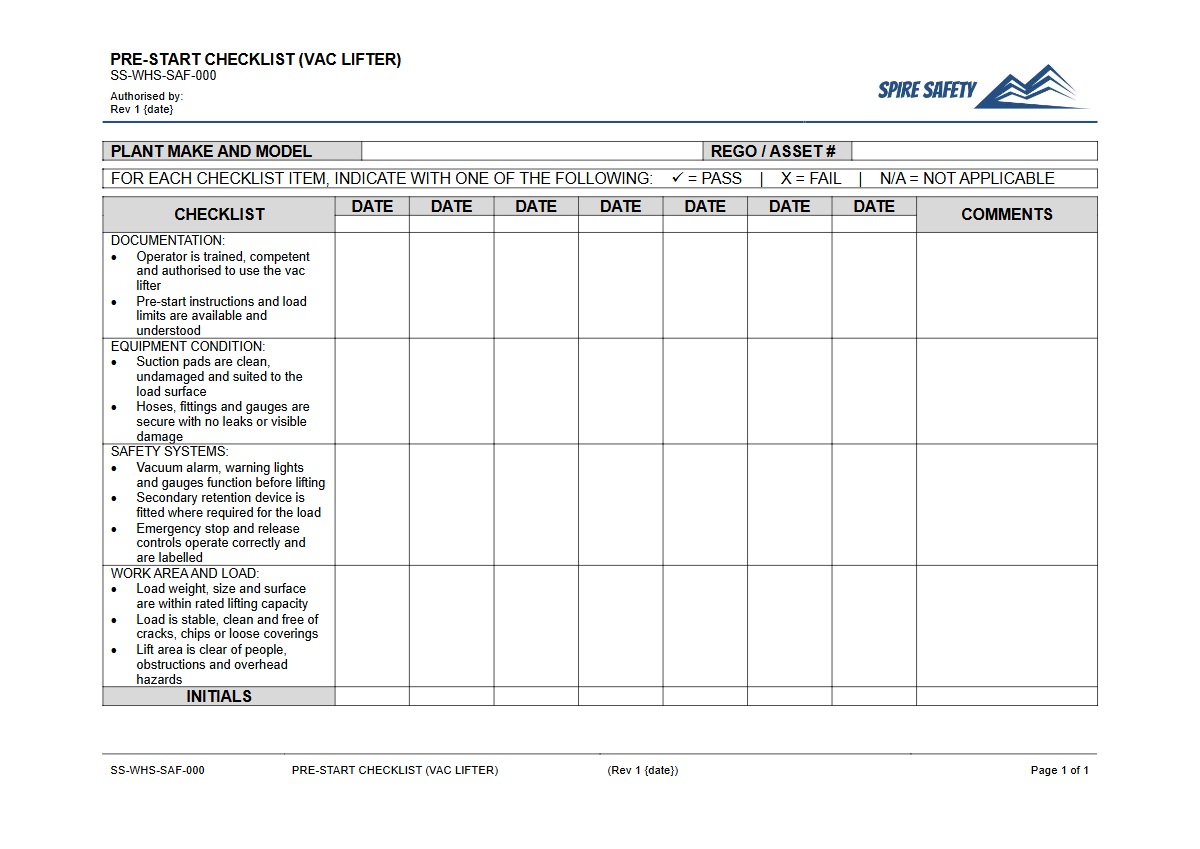
Using a formalised checklist before operation is a critical control measure. This Free Pre-Start Checklist (Vac Lifter) Template provides a structured starting point for your organisation to implement routine safety inspections, helping to identify and address potential equipment failures before they cause harm.
It encourages a systematic approach to verifying that all key components, from vacuum pumps and gauges to suction pads and safety alarms, are in safe working order.
Integrating these checks into your daily operations helps foster a proactive safety culture. It transforms safety from an afterthought into a routine behaviour, which is a key topic in our Pre-Start Checks and Plant Maintenance Toolbox Talk Template. Formal documentation also creates a clear record of due diligence, demonstrating that reasonably practicable steps have been taken to ensure plant safety.
Video walkthrough
How to use the Free Pre-Start Checklist (Vac Lifter) Template
Using this template effectively involves more than just downloading and printing. It should be integrated into your safety procedures.
First, download the DOCX file and adapt it to your specific needs. This involves adding your company branding and, most importantly, customising the checklist items to match the exact make and model of the vacuum lifters used in your workplace.
Different models will have unique features, controls, and failure points.
Once customised, train all relevant operators on how to complete the pre-start check correctly. The check should be a physical inspection, not just a paperwork exercise.
Operators must understand what they are looking for and the procedure to follow if a fault is found, which typically involves immediately tagging the equipment out of service and reporting the issue. These procedures are foundational elements of well-designed WHS management systems.
Please note: This document is a template and must be customised to suit the specific make and model of your vacuum lifter, your operational environment, and your organisation's WHS procedures. We are not responsible for your WHS compliance; this document is a starting point, not a complete solution.
When to use the Pre-Start Checklist
A vacuum lifter pre-start inspection should be conducted before every shift or before the first use of the day. For equipment used intermittently, a check should be performed before each use.
The goal is to catch any defects that may have developed since its last operation, whether through damage, wear and tear, or environmental factors. It's a quick but essential process that should never be skipped, regardless of how recently the equipment was last used.
The completed checklist can serve as a point of discussion during daily pre-start safety meetings, allowing supervisors to confirm that all plant being used that day has been verified as safe. Consistent use ensures that a culture of safety and diligence is maintained across all shifts and teams.
Who should use the Pre-Start Checklist
The pre-start checklist should be completed by the person operating the vacuum lifter. This individual must be deemed competent, meaning they have received the necessary information, instruction, training, and supervision to perform the task safely.
They are best placed to notice subtle changes in the equipment's condition or performance. Supervisors or maintenance personnel may also use the checklist to conduct periodic spot-checks or more detailed inspections.
Findings from these checks can also inform the need for broader reviews of your safety processes. An increase in reported faults might indicate a need for a more thorough investigation, a service that can be part of a scheduled WHS compliance auditing program to ensure all systems are functioning as intended.
While this checklist focuses on vacuum lifters, the principles of pre-start inspections are universal for workplace plant and machinery. The same systematic approach can be applied to other equipment, such as that covered in our Free Pre-Start Checklist (CNC Router) Template. Consistency in your inspection processes across different types of equipment helps reinforce safe work habits throughout the workplace.
By standardising your pre-start checks, you create a safer environment for everyone. Explore our extensive free WHS resources library to find more templates and tools to support your safety management system.
Common mistakes
Common mistakes to avoid
- Using the checklist as a 'tick-and-flick' exercise without physically inspecting each item.
- Failing to customise the template for the specific make and model of the vacuum lifter.
- Neglecting to check the condition of flexible components like vacuum hoses and pad seals for cracks or wear.
- Continuing to use the lifter after a minor fault is found, instead of immediately tagging it out of service for repair.
Legal references
Legal considerations
The following legal requirements may be relevant to this type of work.
- Work Health and Safety Act (Harmonised) — Provides the primary duties for protecting workers and other people from work health and safety risks.
- Work Health and Safety Regulations (Harmonised) — Sets out requirements supporting the management of workplace hazards and risks.
The following codes may be relevant to this type of work.
- Managing WHS Risks Code of Practice — Provides practical guidance on identifying hazards, assessing risks and applying effective controls.
- Work Health and Safety Consultation, Cooperation and Coordination Code of Practice — Provides practical guidance on consulting workers and coordinating with other duty holders.
- Managing the Work Environment and Facilities Code of Practice — Provides practical guidance on safe work environments, workplace facilities and related controls.
Did you know
Atmospheric Pressure Does the Lifting
A vacuum lifter doesn't 'suck' an object up. Instead, it creates a lower-pressure zone within the suction cup, allowing the higher atmospheric pressure outside the cup to push the object against the pad, holding it in place.
Australian Standards
In Australia, the design, construction, and testing of lifting devices, including some vacuum lifters, are covered by Australian Standard AS 4991:2004. This standard provides technical specifications to ensure their safety and reliability.
FAQ
Frequently asked questions
01What are the main hazards when using a vacuum lifter?
02How often should a vacuum lifter pre-start check be performed?
03Who is responsible for completing the vac lifter pre-start checklist?
04Can I use this template for any brand of vacuum lifter?
Share this resource
Free Pre-Start Checklist (Vac Lifter) Template
Browse Categories
How To Use It
- 1Download and open in Word or PDF.
- 2Replace the placeholders with your business details.
- 3Get it reviewed by a WHS specialist before rollout.
Need it customised?
Our WHS consultants can adapt this template to your site, run a gap analysis, or audit what you already have in place.
Book a Free Consultation WHS consulting servicesor call 1300 156 382