
Free Pre-Start Checklist (Vac Former) Template
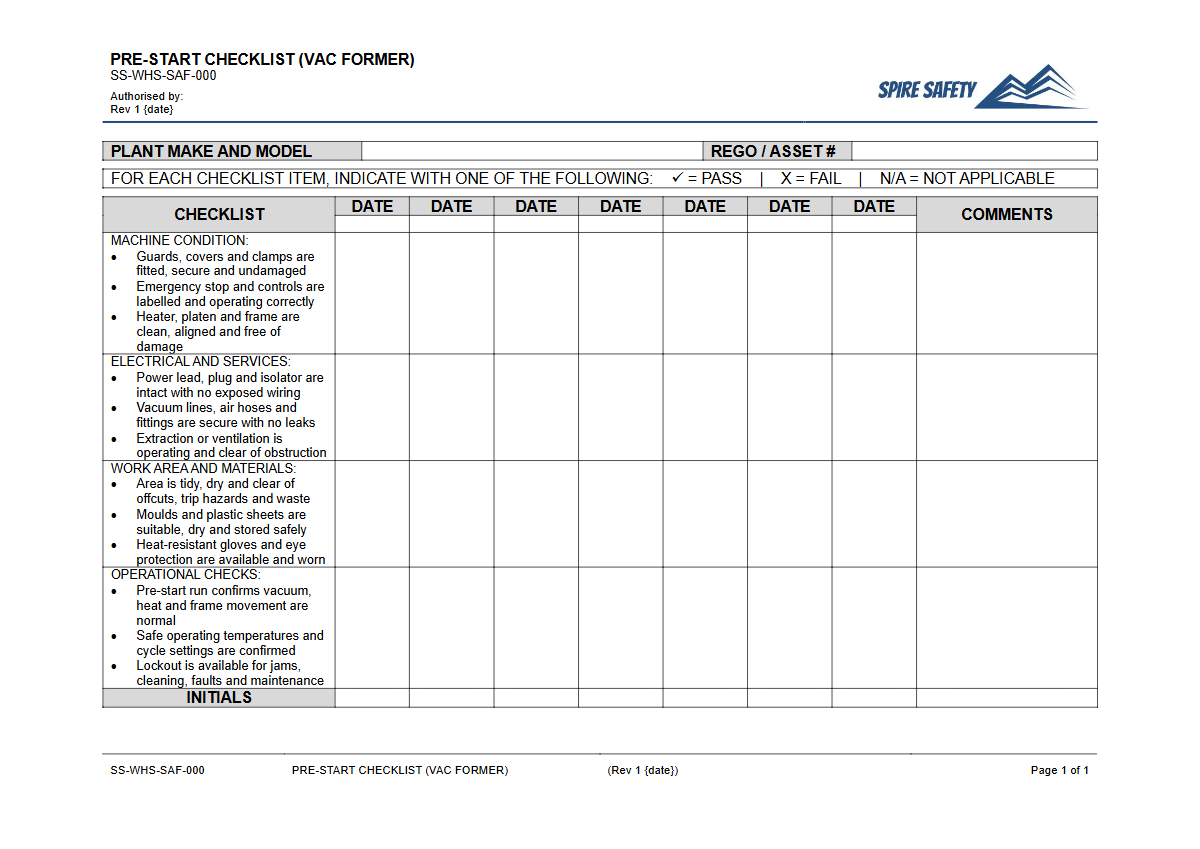
Download our free Pre-Start Checklist (Vac Former) Template. This user-friendly DOCX and PDF resource helps formalise safety checks before operation.
Free Pre-Start Checklist (Vac Former) Template
DOCX • 125 KB + PDF
Updated Oct 2026
No signup required
Purpose of the Free Pre-Start Checklist (Vac Former) Template
This free Pre-Start Checklist (Vac Former) Template provides a structured framework for conducting essential safety inspections before operating a vacuum forming machine. Systematically checking the equipment's condition helps identify potential faults, damage, or hazards that could lead to injury or equipment failure.
Using a formal checklist ensures that key safety components, such as heating elements, vacuum pumps, guards, and emergency stops, are verified as safe for use.
Integrating this checklist into your daily routine is a practical step towards proactive risk management. It creates a documented record of inspections, which is a fundamental component of many effective WHS management systems. By formalising this process, an organisation can demonstrate its commitment to maintaining plant and equipment in a safe condition, aligning with good practice under Australian Work Health and Safety (WHS) legislation.
Video walkthrough
How to use the Free Pre-Start Checklist (Vac Former) Template
Our template is available as a DOCX file, which is fully editable, and a PDF for immediate use. The primary step is to adapt the checklist to your specific machinery and operational context.
Different vacuum formers have unique features, controls, and associated risks that a generic list cannot fully capture.
IMPORTANT: This document is a template only. We have developed it as a starting point, but you must customise it to reflect the specific make, model, and configuration of your vacuum former, your operational procedures, and the unique risks present in your workplace.
Follow these steps for effective implementation:
- Review and Customise: Download the DOCX file and walk through each checkpoint with a competent person, such as an experienced operator or maintenance technician. Add, remove, or modify items to accurately reflect your equipment. For example, if your machine has specific pneumatic clamps or a guillotine, add checks for those components.
- Train Operators: Ensure all operators are trained not just on how to use the vacuum former, but also on how to complete the pre-start check correctly. They must understand what each item means and what constitutes a 'pass' or 'fail'.
- Implement and Monitor: Integrate the checklist into the start-of-shift or pre-use procedure. Supervisors should periodically review completed checklists to ensure they are being filled out diligently and not just 'pencil-whipped'.
This process is similar for other types of computer-controlled or automated machinery. If your workshop also uses other equipment, you might find value in our pre-start checklist for a CNC router.
When to use it
A pre-start checklist for a vacuum former should be completed before the machine is used for the first time each day or at the beginning of each shift. This frequency ensures that the equipment's condition is verified before any production work begins, catching any issues that may have developed overnight or between shifts.
Additional situations where the checklist should be used include:
- After scheduled or unscheduled maintenance has been performed.
- If the machine has been moved or reconfigured.
- Following an incident, even a minor one, to ensure no damage has occurred.
Regular safety communication reinforces the importance of these checks. You can use our Pre-Start Checks and Plant Maintenance Toolbox Talk to facilitate discussions about why these inspections are critical for everyone's safety.
Who should use it
The primary person responsible for completing the pre-start checklist is the trained and authorised operator of the vacuum former. They have hands-on control of the machine and are best positioned to notice subtle changes or developing faults.
Empowering operators with this responsibility fosters a stronger safety culture and sense of ownership.
Others who have a role in the process include:
- Supervisors or Team Leaders: They are responsible for ensuring operators complete the checks correctly and for taking appropriate action when faults are reported. This includes isolating the equipment ('tagging out') and arranging for repairs. Periodically verifying these processes through observation is a key part of supervisory due diligence.
- Maintenance Personnel: They rely on the information from pre-start checks to identify recurring problems and schedule preventative maintenance before a major failure occurs.
- WHS Managers/Officers: They use the completed records as evidence of procedural compliance during safety reviews and WHS compliance audits.
The principle of operator-led checks applies across various modern fabrication tools. For instance, operators in a rapid prototyping environment might also use a specific pre-start checklist for a 3D printer to ensure its safe operation.
You can explore our entire free WHS resources library for more templates to support your safety management system.
Common mistakes
Common mistakes to avoid
- Using a generic checklist that doesn't match the specific make and model of the vacuum former.
- Skipping the check entirely to save time at the start of a shift.
- "Pencil-whipping" the form — signing it off without physically inspecting each item.
- Failing to report and tag out the equipment when a minor fault is found, assuming it's 'not a big deal'.
Legal references
Legal considerations
The following legal requirements may be relevant to this type of work.
- Work Health and Safety Act (Harmonised) — Provides the primary duties for protecting workers and other people from work health and safety risks.
- Work Health and Safety Regulations (Harmonised) — Sets out requirements supporting the management of workplace hazards and risks.
The following codes may be relevant to this type of work.
- Managing WHS Risks Code of Practice — Provides practical guidance on identifying hazards, assessing risks and applying effective controls.
- Work Health and Safety Consultation, Cooperation and Coordination Code of Practice — Provides practical guidance on consulting workers and coordinating with other duty holders.
- Managing the Work Environment and Facilities Code of Practice — Provides practical guidance on safe work environments, workplace facilities and related controls.
Did you know
Industrial Origins
Vacuum forming was developed in the 1930s but became widely adopted for industrial manufacturing after World War II, initially for creating aircraft components like cockpit canopies.
Material Versatility
A wide range of thermoplastics can be used in vacuum forming, including ABS, polycarbonate, and acrylic, making it one of the most versatile methods for producing plastic parts.
FAQ
Frequently asked questions
01Why is a pre-start check necessary for a vacuum former?
02What are the key hazards of a vacuum former?
03How often should a vacuum former pre-start check be done?
04Can this template be used for other types of plastic forming machines?
Share this resource
Free Pre-Start Checklist (Vac Former) Template
Browse Categories
How To Use It
- 1Download and open in Word or PDF.
- 2Replace the placeholders with your business details.
- 3Get it reviewed by a WHS specialist before rollout.
Need it customised?
Our WHS consultants can adapt this template to your site, run a gap analysis, or audit what you already have in place.
Book a Free Consultation WHS consulting servicesor call 1300 156 382