
Free Pre-Start Checklist (Tube Notcher) Template
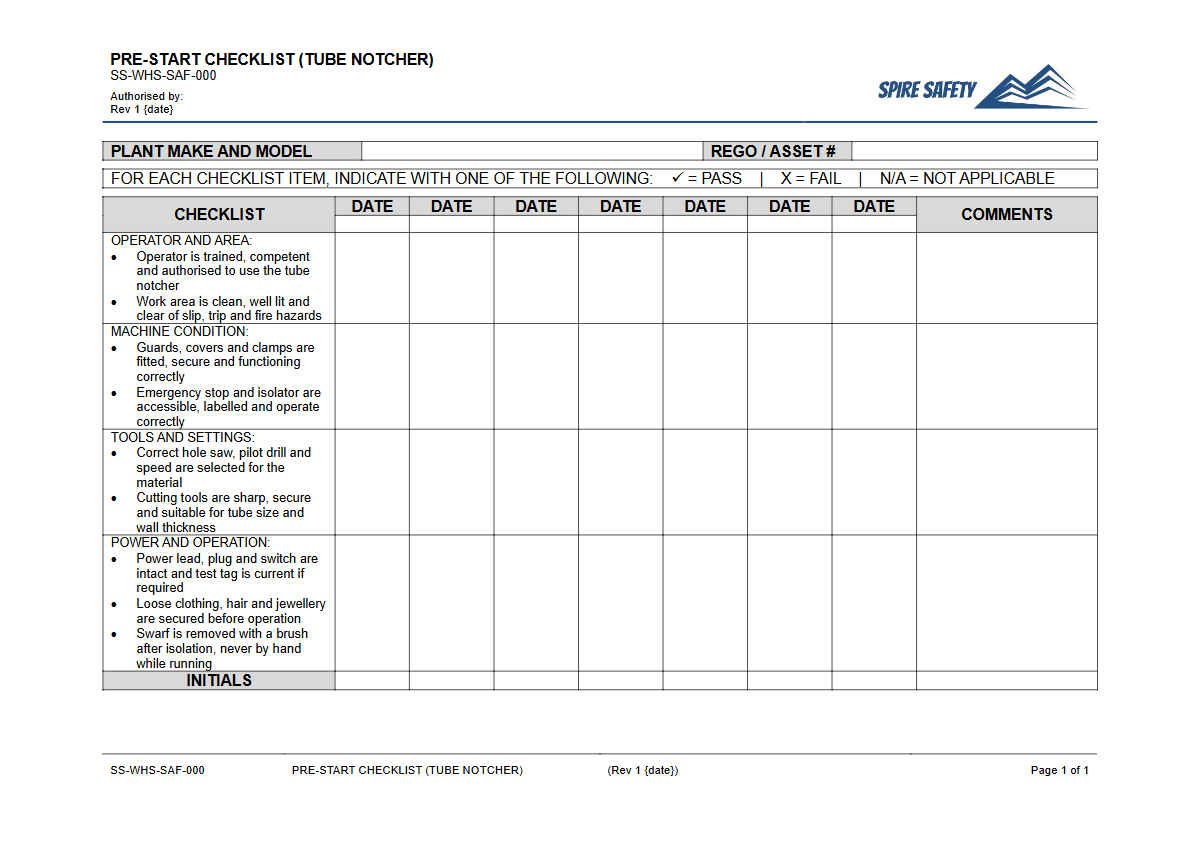
Download our free Pre-Start Checklist (Tube Notcher) Template. This structured Word & PDF document helps formalise daily equipment safety inspections.
Free Pre-Start Checklist (Tube Notcher) Template
DOCX • 125 KB + PDF
Updated Oct 2026
No signup required
Purpose of the Free Pre-Start Checklist (Tube Notcher) Template
Using a tube notcher involves significant risks, including entanglement, cuts, and crush injuries. A systematic pre-start inspection is a critical control measure to ensure the equipment is safe to operate before any work begins.
This free Pre-Start Checklist (Tube Notcher) Template provides a structured framework for operators to conduct thorough daily checks, helping to identify potential faults or hazards that could lead to an incident. Formalising this process helps a Person Conducting a Business or Undertaking (PCBU) meet their primary duty of care under Australian WHS law to provide and maintain safe plant.
Integrating regular, documented checks is a cornerstone of effective workshop safety. This checklist serves as a practical tool within broader comprehensive WHS management systems, providing tangible evidence that safety procedures are being followed.
By identifying issues early, organisations can prevent equipment failure, reduce downtime, and protect workers from harm. It also creates a valuable maintenance record over time, highlighting recurring issues that may require more significant engineering solutions or changes in procedure.
Consistent use of pre-start checklists reinforces a positive safety culture where checking equipment is a non-negotiable part of the daily routine. It's an ideal topic to reinforce with your team, and you can facilitate this discussion using a Pre-Start Checks and Plant Maintenance Toolbox Talk. This proactive approach to safety is far more effective than reacting to incidents after they occur.
Video walkthrough
How to use the Free Pre-Start Checklist (Tube Notcher) Template
This resource is available in both DOCX and PDF formats for your convenience. The DOCX version is fully editable, allowing you to tailor it to your specific operational needs.
To use the template, simply download the file and integrate it into your existing safety documentation. The checklist guides the operator through a logical inspection sequence, covering key areas such as guarding, power supply, cutting tools, and emergency stops.
Please note: This template provides a solid foundation based on general safety principles, but it is not a finished document. We have no way of knowing your specific make and model of tube notcher, its condition, the environment it's used in, or your unique operational risks.
You must adapt this checklist to suit your workplace's specific needs, incorporating details from the manufacturer's manual and the outcomes of your own risk assessments. For similar workshop equipment, you might find inspiration from resources like our CNC Router pre-start checklist.
Customisation is a critical step. Review the manufacturer's operating manual and any relevant technical specifications to add machine-specific checkpoints.
If you are unsure how to conduct the risk assessments needed to properly customise this document, seeking specialist WHS consulting can provide clarity and ensure your final checklist is robust and effective for managing the specific hazards in your workplace.
When to use it
The tube notcher pre-start checklist should be completed by a competent operator before the machine is used for the first time each day or at the beginning of each shift. This frequency ensures that any changes to the machine's condition, whether from use on a previous shift or from issues that have developed overnight, are identified before work commences.
It should not be seen as a one-time task but as an essential, recurring part of the safe operation workflow.
Who should use it
The checklist is designed to be completed by the trained and authorised operator of the tube notcher. These are the workers most familiar with the equipment's day-to-day behaviour and are best placed to notice subtle changes or developing faults.
Supervisors and managers also have a role; they are responsible for ensuring operators are completing the checks correctly and for reviewing the completed checklists. This review process helps identify any reported defects, action necessary repairs, and recognise trends in equipment issues.
Furthermore, it is crucial that the person operating the equipment is deemed competent. Competency involves more than just reading a manual; it requires training, experience, and assessment.
For related metalworking equipment, you can formalise this process using a document like our Verification of Competency (VOC) for a pipe threader. This ensures that the operator not only knows how to use the machine but also understands the associated risks and safety controls documented in the pre-start checklist.
Ultimately, this template is a tool to support the entire safety ecosystem of your workplace. To discover more tools to enhance your safety management, explore our free WHS resources library for a wide range of templates and guides.
Common mistakes
Common mistakes to avoid
- "Pencil-whipping" the form without physically inspecting the corresponding components.
- Using the generic template without customising it for the specific make, model, and risks of the workplace's tube notcher.
- Failing to immediately remove faulty equipment from service by using a lock-out tag-out procedure.
- Not reviewing completed checklists to identify recurring faults or patterns that may indicate a larger maintenance issue.
Legal references
Legal considerations
The following legal requirements may be relevant to this type of work.
- Work Health and Safety Act (Harmonised) — Provides the primary duties for protecting workers and other people from work health and safety risks.
- Work Health and Safety Regulations (Harmonised) — Sets out requirements supporting the management of workplace hazards and risks.
The following codes may be relevant to this type of work.
- Managing WHS Risks Code of Practice — Provides practical guidance on identifying hazards, assessing risks and applying effective controls.
- Work Health and Safety Consultation, Cooperation and Coordination Code of Practice — Provides practical guidance on consulting workers and coordinating with other duty holders.
- Managing the Work Environment and Facilities Code of Practice — Provides practical guidance on safe work environments, workplace facilities and related controls.
Did you know
Entanglement Hazard
Entanglement with rotating parts is one of the most severe hazards associated with workshop machinery like tube notchers. A pre-start check confirming all guards are in place and functional is a critical step in preventing life-altering injuries.
Proactive vs. Reactive
Studies have shown that proactive safety measures, such as pre-start inspections, are significantly more effective and less costly than reactive measures, which deal with the consequences of incidents and equipment failure.
FAQ
Frequently asked questions
01Is a pre-start checklist for a tube notcher legally required in Australia?
02How often should a tube notcher pre-start inspection be performed?
03What should an operator do if they find a fault during a pre-start check?
04Can I use a digital checklist on a tablet or app instead of this paper template?
Share this resource
Free Pre-Start Checklist (Tube Notcher) Template
Browse Categories
How To Use It
- 1Download and open in Word or PDF.
- 2Replace the placeholders with your business details.
- 3Get it reviewed by a WHS specialist before rollout.
Need it customised?
Our WHS consultants can adapt this template to your site, run a gap analysis, or audit what you already have in place.
Book a Free Consultation WHS consulting servicesor call 1300 156 382