
Free Pre-Start Checklist (Trench Roller) Template
Download our Free Pre-Start Checklist (Trench Roller) Template to formalise daily equipment inspections.
Free Pre-Start Checklist (Trench Roller) Template
DOCX • 125 KB + PDF
Updated Oct 2026
No signup required
Purpose of the Free Pre-Start Checklist (Trench Roller) Template
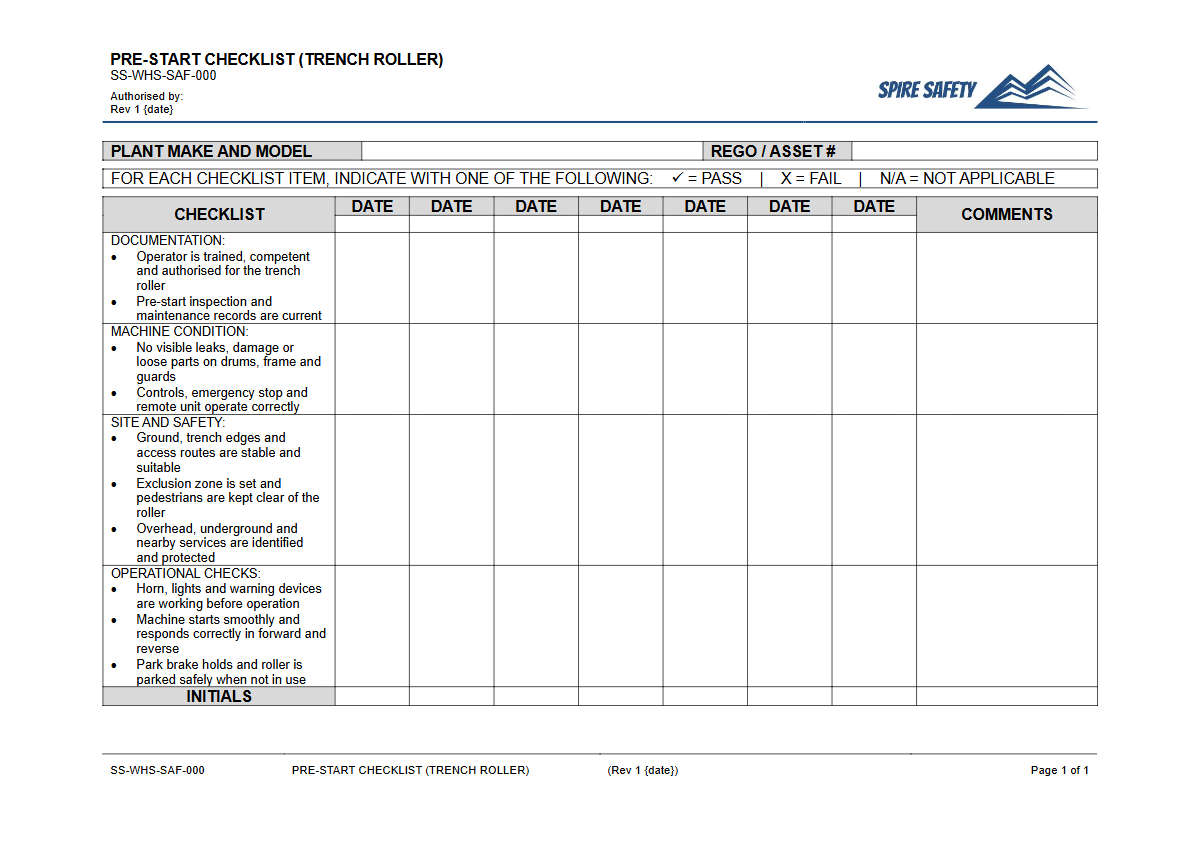
Operating a trench roller, also known as a remote-controlled compactor, involves significant risks, including rollovers, mechanical failures, and exposure to hydraulic fluids. This Free Pre-Start Checklist (Trench Roller) Template provides a structured starting point for developing a robust inspection process to identify these hazards before work commences.
Systematically checking key components helps prevent incidents, reduce equipment downtime, and demonstrates a commitment to meeting health and safety obligations. A documented pre-start check creates a clear record that the equipment was in a safe condition at the start of each shift.
Using a formal checklist helps standardise the inspection process across all operators and sites. It ensures that critical items like remote control functionality, guards, hydraulic systems, and warning devices are not overlooked.
While this checklist is a vital tool, it should be used in conjunction with a comprehensive Roller SOP (Safe Operating Procedure) that outlines the entire work process, from startup to shutdown.
Video walkthrough
How to use the Free Pre-Start Checklist (Trench Roller) Template
This template is available in both DOCX and PDF formats for your convenience. The DOCX version is fully editable, allowing you to tailor it to the specific models of trench rollers used in your workplace and the unique conditions of your site.
It is crucial to adapt the checklist to reflect the manufacturer's recommendations and any site-specific hazards, such as ground conditions, trench stability, or proximity to other plant.
Follow these steps to implement the checklist effectively:
- Download the template and add your company logo and specific site details.
- Review the checklist items against the operator's manual for your trench roller. Add, remove, or modify checks as necessary.
- Train operators on how to complete the checklist thoroughly and what to do if a fault or defect is identified.
- Establish a clear procedure for reporting and rectifying faults, including 'tag out' procedures for unsafe equipment.
Note: This document is a template and must be customised to your specific workplace, equipment, and operational risks. We are not responsible for your WHS compliance; you are.
This template should be integrated into your broader safety management system.
For high-risk activities involving trenching and compaction, a pre-start check is just one part of the required safety documentation. You may also need to develop a Safe Work Method Statement for Padfoot Roller Operation to detail the specific steps, risks, and controls for the task.
When to use it
A pre-start checklist for a trench roller should be completed by the operator at the beginning of every shift or before the equipment is used for the first time on a given day. If operators change during a shift, the new operator should also perform a pre-start inspection to verify the machine's condition.
This routine ensures that any damage or faults that may have occurred during previous operation, transport, or even overnight are identified before the equipment is put back into service.
Regularly reinforcing the importance of these checks is essential for building a strong safety culture. You can use a dedicated Pre-Start Checks and Plant Maintenance Toolbox Talk to remind your team about their responsibilities and the reasons behind the process.
The checklist should be treated as an active tool, not just a paperwork exercise.
Who should use it
This checklist is primarily designed for use by competent and authorised plant operators who are responsible for the safe operation of the trench roller. They are the first line of defence in identifying equipment faults. However, other personnel have responsibilities related to its use:
- Supervisors and Site Managers: Should ensure that operators are completing the checklists correctly and that any reported faults are addressed in a timely manner. They are responsible for reviewing the records as part of their site safety inspections.
- Maintenance Personnel: Use the completed checklists to identify recurring issues, schedule preventative maintenance, and manage repairs.
- WHS Officers: Can use the checklist records during audits and inspections to verify that safety procedures are being followed.
Integrating tools like this pre-start checklist into your organisation's overarching WHS management systems ensures that equipment safety is managed systematically, rather than reactively. If you need assistance aligning your plant safety procedures with legislative requirements, consider seeking expert WHS consulting. You can also explore our complete free WHS resources library for more templates to support your safety framework.
Common mistakes
Common mistakes to avoid
- Failing to physically check components and just ticking boxes from memory.
- Ignoring minor hydraulic leaks, which can indicate a future catastrophic hose failure.
- Neglecting to check the condition of the drum pads or shell, leading to poor compaction results.
- Not testing the emergency stop and other safety functions of the remote control unit.
Legal references
Legal considerations
The following legal requirements may be relevant to this type of work.
- Work Health and Safety Act (Harmonised) — Provides the primary duties for protecting workers and other people from work health and safety risks.
- Work Health and Safety Regulations (Harmonised) — Sets out requirements supporting the management of workplace hazards and risks.
The following codes may be relevant to this type of work.
- Managing WHS Risks Code of Practice — Provides practical guidance on identifying hazards, assessing risks and applying effective controls.
- Work Health and Safety Consultation, Cooperation and Coordination Code of Practice — Provides practical guidance on consulting workers and coordinating with other duty holders.
- Managing the Work Environment and Facilities Code of Practice — Provides practical guidance on safe work environments, workplace facilities and related controls.
Did you know
Vibratory Compaction
The vibratory drum on a trench roller uses eccentric, rotating weights to create rapid impacts, which helps to consolidate soil and aggregate more effectively than static weight alone.
Infrared Control
Many remote-controlled trench rollers use infrared line-of-sight technology. This is a safety feature designed to stop the machine automatically if the operator moves out of sight or if an object obstructs the signal path.
FAQ
Frequently asked questions
01What is the most critical check on a remote-controlled trench roller?
02What should an operator do if they find a fault during a pre-start check?
03Are pre-start checklists a legal requirement in Australia?
04How long should pre-start checklist records be kept?
Share this resource
Free Pre-Start Checklist (Trench Roller) Template
Browse Categories
How To Use It
- 1Download and open in Word or PDF.
- 2Replace the placeholders with your business details.
- 3Get it reviewed by a WHS specialist before rollout.
Need it customised?
Our WHS consultants can adapt this template to your site, run a gap analysis, or audit what you already have in place.
Book a Free Consultation WHS consulting servicesor call 1300 156 382