
Free Pre-Start Checklist (Tree Grinder) Template
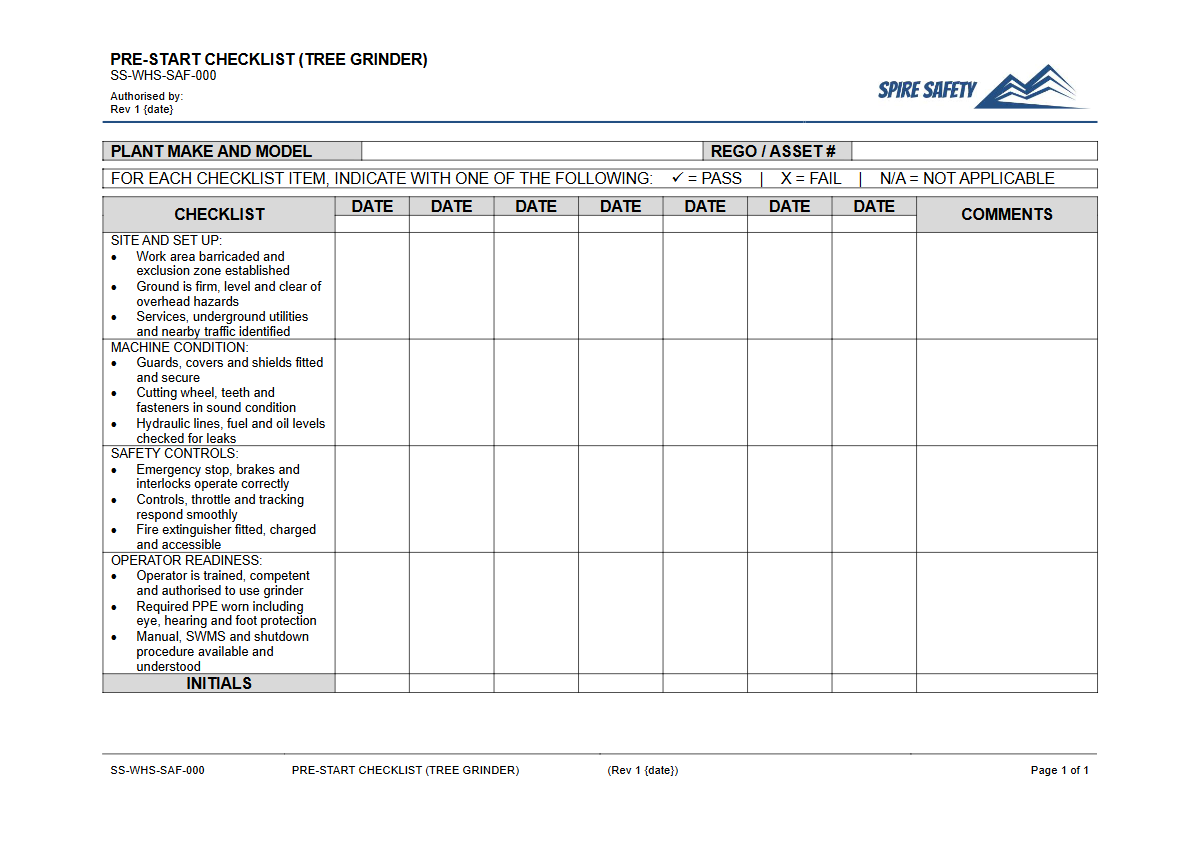
Download our free Pre-Start Checklist (Tree Grinder) Template to improve equipment safety and inspection protocols.
Free Pre-Start Checklist (Tree Grinder) Template
DOCX • 125 KB + PDF
Updated Oct 2026
No signup required
Purpose of the Free Pre-Start Checklist (Tree Grinder) Template
Tree grinders are powerful and inherently high-risk pieces of equipment. Ensuring they are safe to operate before each use is a critical WHS control measure.
Our Free Pre-Start Checklist (Tree Grinder) Template provides a structured format for operators to conduct and record these essential safety inspections. Systematically checking key components like guards, blades, emergency stops, and hydraulic systems helps identify potential faults or damage that could lead to serious incidents.
Formalising this process not only helps meet your duty of care as a PCBU but also creates a clear record of equipment maintenance and safety diligence.
Regular, documented inspections are a cornerstone of effective plant safety. They encourage a proactive safety culture where equipment condition is constantly monitored.
To help embed this behaviour across your teams, consider using our Pre-Start Checks and Plant Maintenance Toolbox Talk Template to train workers on the importance and correct execution of these daily checks.
Video walkthrough
How to use the Free Pre-Start Checklist (Tree Grinder) Template
This resource is provided as a downloadable DOCX file, allowing for full customisation, and a PDF for immediate use. After downloading, a competent person should review and adapt the checklist to align with the specific make and model of the tree grinder(s) used in your workplace, as well as the unique environmental and operational risks present.
Key steps for implementation include:
- Customise: Add your company branding and specific check items based on the manufacturer's instructions and your risk assessments.
- Train: Ensure all operators are trained on how to use the checklist correctly and understand what each item entails.
- Implement: Integrate the checklist into your daily start-up procedures. Ensure operators complete it before commencing any work.
- Review: Establish a process for supervisors to review completed checklists and a clear procedure for reporting and rectifying any identified faults. Any 'Fail' item should trigger an immediate 'tag out' and repair process.
Important Note: This template is a starting point. We have developed it to align with general Australian WHS principles, but it is not a complete, out-of-the-box solution.
You must customise this document to suit the specific equipment, tasks, and control measures relevant to your workplace to ensure it is effective.
Pre-start checks are a vital component of a holistic safety framework. Integrating this checklist into your broader WHS management systems ensures that equipment safety is managed systematically, rather than as an isolated task.
This creates a more robust and defensible safety program.
When to use a Pre-Start Checklist
A pre-start checklist for a tree grinder should be completed by the operator at the beginning of each shift or before the equipment is used for the first time on any given day. If operators change over mid-shift, the incoming operator should also conduct a check to verify the machine's condition before they begin work.
This consistent frequency ensures that any damage or faults that may have occurred during previous operation, transport, or even overnight are identified before the machine is put back into service.
This checklist is one part of the safe operation puzzle. For the task itself, procedures must be documented.
A document like our Free Angle Grinder SWMS (Safe Work Method Statement) Template can serve as a useful reference for structuring a similar document for tree grinding operations.
Who should use it
The primary user of this checklist is the trained and competent operator of the tree grinder. They are the person with hands-on control of the equipment and are best placed to notice subtle changes or potential defects.
Supervisors also have a key role; they are responsible for ensuring the checks are being completed diligently and for taking action on any reported issues. Maintenance personnel may also use the checklist as a reference when diagnosing faults or as a sign-off sheet after conducting repairs, confirming the equipment is safe to return to service.
Verifying that an operator is competent to not only use the machine but also inspect it correctly is a critical step. While this checklist helps guide the inspection, assessing underlying knowledge is also important.
Our Free Angle Grinder VOC (Verification of Competency) Template provides a framework for assessing competency on similar high-risk tools, which can be adapted for your needs.
Integrating Checks into Your Compliance Activities
Beyond daily use, completed checklists serve as valuable records for safety analysis and auditing. They demonstrate a history of due diligence and can help identify recurring issues with specific machines, indicating a need for more significant maintenance or replacement.
A regular review of these records should be part of your WHS compliance auditing program to verify that procedures are being followed effectively in the field. Find more templates and tools to support your safety system in our complete free WHS resources library.
Common mistakes
Common mistakes to avoid
- Using the template without customising it for the specific machine and site conditions.
- 'Pencil-whipping' the form without physically performing each check item.
- Failing to immediately tag out and report equipment that fails an inspection point.
- Not training operators on how to properly conduct the checks and what to look for.
Legal references
Legal considerations
The following legal requirements may be relevant to this type of work.
- Work Health and Safety Act (Harmonised) — Provides the primary duties for protecting workers and other people from work health and safety risks.
- Work Health and Safety Regulations (Harmonised) — Sets out requirements supporting the management of workplace hazards and risks.
The following codes may be relevant to this type of work.
- Managing WHS Risks Code of Practice — Provides practical guidance on identifying hazards, assessing risks and applying effective controls.
- Work Health and Safety Consultation, Cooperation and Coordination Code of Practice — Provides practical guidance on consulting workers and coordinating with other duty holders.
- Managing the Work Environment and Facilities Code of Practice — Provides practical guidance on safe work environments, workplace facilities and related controls.
Did you know
Chipping and Grinding Risks
According to Safe Work Australia, incidents involving wood chippers and grinders often result in severe injuries like amputation. The most common cause is workers making contact with the rotating blades, often while feeding material into the machine.
The 'Hierarchy of Control'
Pre-start checks are considered an 'administrative control' within the hierarchy of risk control. They are a crucial supplement to higher-level controls like safe design (engineering) and guarding, but cannot replace them.
FAQ
Frequently asked questions
01What key items should be on a tree grinder pre-start checklist?
02Why is a documented pre-start check important for tree grinders?
03How often should a tree grinder pre-start inspection be completed?
04Can I use a generic pre-start checklist for any tree grinder?
Share this resource
Free Pre-Start Checklist (Tree Grinder) Template
Browse Categories
How To Use It
- 1Download and open in Word or PDF.
- 2Replace the placeholders with your business details.
- 3Get it reviewed by a WHS specialist before rollout.
Need it customised?
Our WHS consultants can adapt this template to your site, run a gap analysis, or audit what you already have in place.
Book a Free Consultation WHS consulting servicesor call 1300 156 382