
Free Pre-Start Checklist (Tree Shear) Template
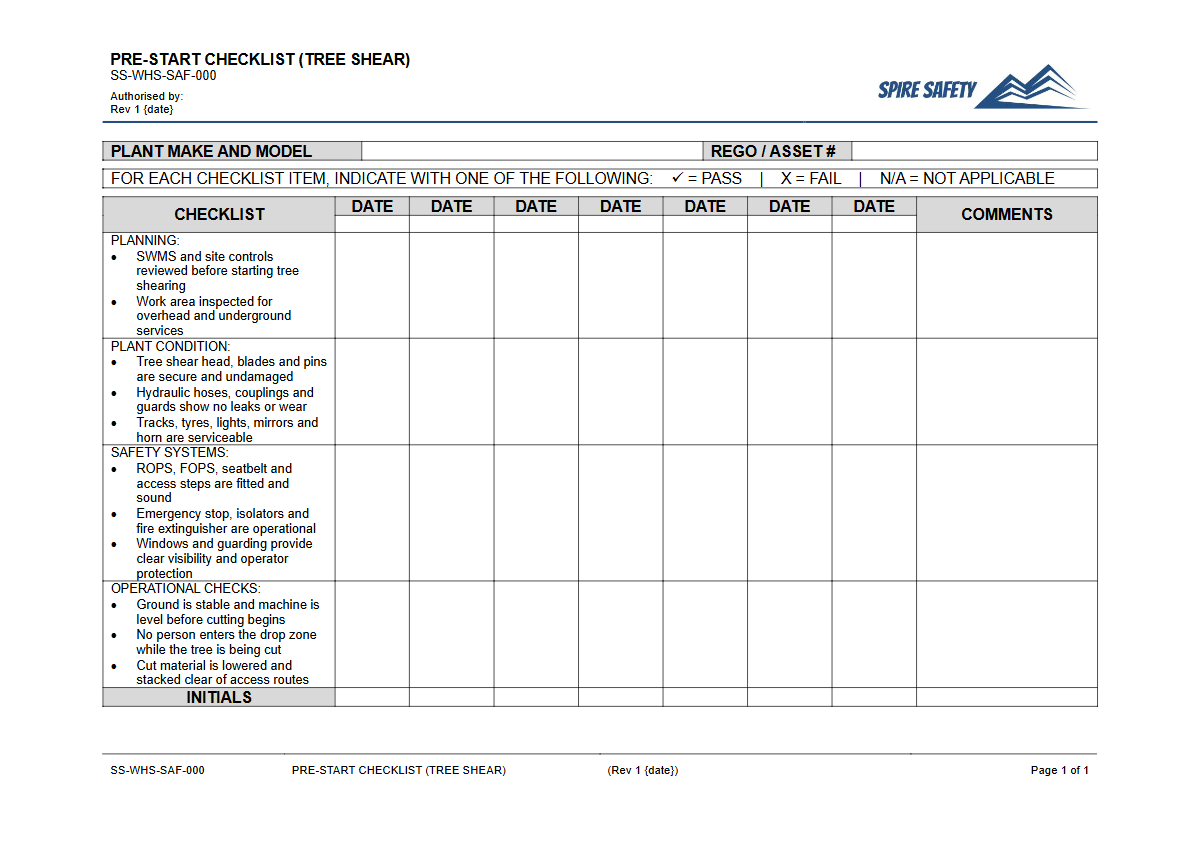
Download our free Pre-Start Checklist (Tree Shear) Template. This customisable DOCX and PDF resource helps formalise safety checks for tree shears.
Free Pre-Start Checklist (Tree Shear) Template
DOCX • 125 KB + PDF
Updated Oct 2026
No signup required
Purpose of the Free Pre-Start Checklist (Tree Shear) Template
This Free Pre-Start Checklist (Tree Shear) Template provides a structured format for operators to conduct thorough safety and maintenance inspections before using a tree shear attachment. Using a checklist helps formalise the inspection process, ensuring that critical components like hydraulics, cutting blades, and mounting points are systematically checked for faults or damage.
The primary purpose is to identify and control potential hazards before operation begins, preventing equipment failure, property damage, and serious injury to workers. A documented pre-start check creates a record of the equipment's condition, which is a key part of demonstrating due diligence under Australian WHS laws.
Regular inspections are a fundamental part of any effective plant safety program. Consistently applying these checks helps foster a proactive safety culture where potential issues are identified early.
This routine can be further supported by regular team safety discussions, which can be guided by a pre-start checks and plant maintenance toolbox talk to reinforce best practices.
Video walkthrough
How to use the Free Pre-Start Checklist (Tree Shear) Template
This Pre-Start Checklist is designed for ease of use. First, download the template in your preferred format—DOCX for easy editing or PDF for straightforward printing.
The next step is crucial for its effectiveness and your organisation's compliance. You must adapt the checklist to reflect the specific make and model of the tree shear(s) used in your workplace, along with the unique environmental and operational risks associated with your site.
Add or remove items to ensure the checklist is comprehensive and relevant.
Important: This document is a template and serves as a starting point. We have developed it based on common industry practice, but you MUST customise it to suit your specific equipment, operational context, and internal procedures.
Integrating this customised checklist into your broader WHS management systems ensures it aligns with your overall safety strategy.
Key Inspection Areas to Include
When customising your checklist, ensure it covers all critical aspects of the tree shear attachment and its carrier machine. Key areas for inspection typically include:
- General Condition: Look for any cracks, dents, or signs of stress on the shear's frame and body. Check that all nuts, bolts, and fasteners are secure.
- Hydraulics: Inspect all hydraulic hoses, fittings, and cylinders for leaks, cracks, abrasion, or other damage. Low or leaking hydraulic fluid is a major operational risk.
- Cutting Blades and Arms: Check the condition of the cutting edges for sharpness, chips, or cracks. Ensure the grappling or accumulating arms function correctly and are free from damage.
- Mounting and Attachment: Verify that the attachment is securely connected to the carrier machine (e.g., excavator, skid steer). Check all pins, couplers, and locking mechanisms for wear and proper engagement.
- Controls: From the operator's cabin, test the function of the shear's controls to ensure they are responsive and operate smoothly through their full range of motion.
- Safety Features: Ensure all guards, safety decals, and any manufacturer-specified safety features are in place and in good condition.
The core principles of these checks are transferable across different types of machinery. Similar structured inspections are vital for other equipment, as demonstrated in resources like our Free Pre-Start Checklist (Aerator) Template.
When to use it
The Pre-Start Checklist for a tree shear should be completed before the start of every work shift or before the equipment is used for the first time each day. It is a pre-operational check designed to catch issues before the machinery is put under load.
Completing the check should become a non-negotiable part of the operator's daily routine. These daily checks often happen alongside other pre-work activities, such as daily team meetings, which can be documented using a Pre-Start Meeting Template to communicate daily hazards and work plans.
Who should use it
This checklist should be used by the trained, competent, and authorised operator of the tree shear. The operator has the most hands-on interaction with the equipment and is best placed to notice subtle changes in its condition or performance.
Supervisors and maintenance personnel should also be familiar with the checklist. Supervisors are responsible for ensuring the checks are being completed correctly and for taking action when faults are reported.
Completed checklists should be reviewed periodically to identify recurring maintenance issues or patterns of wear, providing valuable data for your maintenance program and safety management. Verifying that these processes are consistently followed can be a component of internal or external WHS compliance audits.
Common mistakes
Common mistakes to avoid
- "Pencil-whipping" the form without physically inspecting the equipment.
- Using a generic checklist that doesn't cover the specific features and risks of the tree shear model.
- Failing to immediately tag out and report equipment with identified safety-critical defects.
- Not reviewing completed checklists to identify trends or recurring mechanical faults.
Legal references
Legal considerations
The following legal requirements may be relevant to this type of work.
- Work Health and Safety Act (Harmonised) — Provides the primary duties for protecting workers and other people from work health and safety risks.
- Work Health and Safety Regulations (Harmonised) — Sets out requirements supporting the management of workplace hazards and risks.
The following codes may be relevant to this type of work.
- Managing WHS Risks Code of Practice — Provides practical guidance on identifying hazards, assessing risks and applying effective controls.
- Work Health and Safety Consultation, Cooperation and Coordination Code of Practice — Provides practical guidance on consulting workers and coordinating with other duty holders.
- Managing the Work Environment and Facilities Code of Practice — Provides practical guidance on safe work environments, workplace facilities and related controls.
Did you know
Hydraulic System Hazards
Hydraulic systems on machinery like tree shears operate under extreme pressure, often exceeding 3,000 PSI. A pinhole leak in a hydraulic hose can release fluid at a velocity high enough to penetrate skin, causing severe injury.
Attachment Failure
A significant number of incidents involving excavator attachments occur because of incorrect or incomplete coupling. Pre-start checks that specifically verify the security of pins and locking mechanisms are critical to preventing accidental detachment.
FAQ
Frequently asked questions
01What should be included in a tree shear pre-start inspection?
02How often should a tree shear pre-start checklist be completed?
03Who is responsible for conducting the pre-start check on a tree shear?
04Why is it important to document pre-start checks?
Share this resource
Free Pre-Start Checklist (Tree Shear) Template
Browse Categories
How To Use It
- 1Download and open in Word or PDF.
- 2Replace the placeholders with your business details.
- 3Get it reviewed by a WHS specialist before rollout.
Need it customised?
Our WHS consultants can adapt this template to your site, run a gap analysis, or audit what you already have in place.
Book a Free Consultation WHS consulting servicesor call 1300 156 382