
Free Pre-Start Checklist (Trash Chute) Template
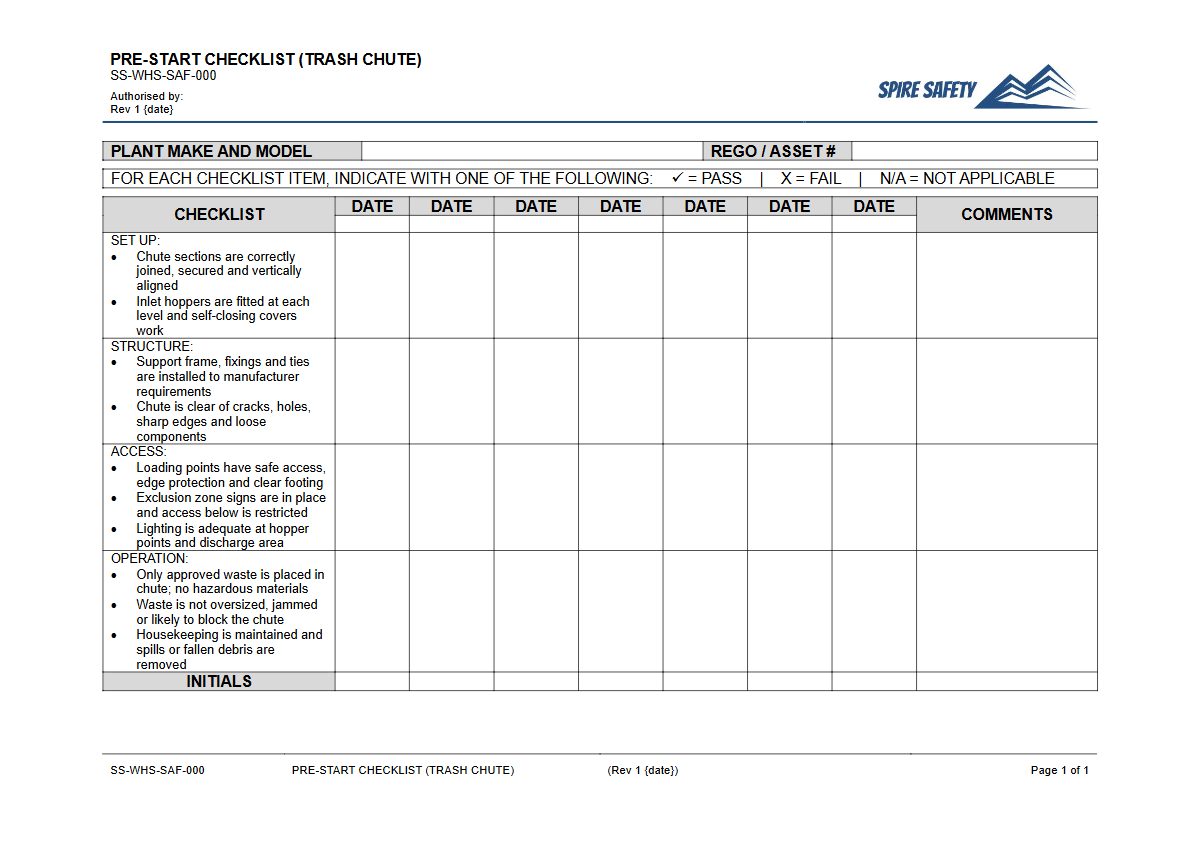
Download our free Pre-Start Checklist (Trash Chute) Template in DOCX and PDF. A structured starting point for formalising daily equipment inspections.
Free Pre-Start Checklist (Trash Chute) Template
DOCX • 125 KB + PDF
Updated Oct 2026
No signup required
Purpose of the Free Pre-Start Checklist (Trash Chute) Template
Trash chutes, common on construction sites and in multi-storey buildings, pose significant risks if not properly installed, maintained, and inspected. Using a structured checklist before each shift helps identify and control hazards such as blockages, structural failure, falling objects, and fire.
This free Pre-Start Checklist (Trash Chute) Template provides a systematic framework for operators to conduct these essential safety checks, helping your organisation meet its primary duty of care obligations under WHS legislation.
Regular inspections are a fundamental component of equipment safety management. Formalising this process ensures that potential issues are identified before they lead to incidents, injuries, or costly equipment damage.
It also creates a documented record of your safety diligence. To further embed this safety behaviour, consider running sessions based on our pre-start checks and plant maintenance toolbox talk with your teams.
Video walkthrough
How to use the Free Pre-Start Checklist (Trash Chute) Template
This template is designed as a starting point, aligned with Australian WHS principles. To implement it effectively, follow these steps:
- Download: Choose between the DOCX and PDF formats. The DOCX file can be edited to suit your specific needs.
- Customise: This is a critical step. You must customise this template for your specific workplace. Add your company branding and review each checkpoint to ensure it is relevant to the make and model of the trash chute system in use, your site conditions, and your operational procedures. We cannot know the specific risks of your site, so customisation is essential.
- Train: Ensure all operators are trained on how to use the checklist correctly. They must understand what each item means and the procedure to follow if a defect is found (e.g., tag out, notify a supervisor).
- Implement: Integrate the checklist into your daily routine. Checks should be completed before the first use of the chute on each shift. Completed checklists should be reviewed by a supervisor and stored as a record.
Documenting safety discussions and procedures is vital for a strong safety culture. You can use a pre-start meeting template to record toolbox talks and daily safety briefings where these checklists are discussed.
When to use a Trash Chute Pre-Start Checklist
A pre-start inspection should be conducted at the beginning of every shift or before the chute is first used for the day. It is a quick, practical check to verify the equipment is safe for its immediate purpose.
This is particularly important on dynamic sites like high-rise construction and demolition projects where conditions can change daily. For tasks deemed high-risk, a more detailed assessment like a Safe Work Method Statement for Concrete Truck Operations may also be required for associated activities.
These daily checks do not replace the need for periodic, detailed inspections and maintenance by a competent person. A robust maintenance schedule should be in place to address long-term wear and tear, structural integrity, and compliance with manufacturer specifications.
Who should use this Pre-Start Checklist
This checklist should be completed by a competent person who has been trained in the safe operation of the specific trash chute system. This is typically the operator or a designated worker assigned to the task.
Site supervisors or WHS managers should review the completed checklists to monitor the condition of equipment and ensure safety procedures are being followed. These daily checks form an important data source for your overall WHS management systems, providing leading indicators of potential plant failures.
Management has a responsibility to ensure that operators are not only provided with tools like this checklist but are also competent and confident in their use. Regular reviews of completed checklists can highlight recurring issues that may require engineering solutions or changes to work procedures.
These reviews are often a key part of formal WHS compliance auditing processes. You can discover more helpful documents in our free WHS resources library to support your safety framework.
Common mistakes
Common mistakes to avoid
- Using a generic checklist without customising it for the specific chute model and site conditions.
- Failing to train operators on how to properly conduct the checks and what to do if a fault is found.
- Completing the checklist as a paperwork exercise without physically inspecting the items.
- Not immediately removing a faulty or damaged chute from service until it is repaired and certified as safe.
Legal references
Legal considerations
The following legal requirements may be relevant to this type of work.
- Work Health and Safety Act (Harmonised) — Provides the primary duties for protecting workers and other people from work health and safety risks.
- Work Health and Safety Regulations (Harmonised) — Sets out requirements supporting the management of workplace hazards and risks.
The following codes may be relevant to this type of work.
- Managing WHS Risks Code of Practice — Provides practical guidance on identifying hazards, assessing risks and applying effective controls.
- Work Health and Safety Consultation, Cooperation and Coordination Code of Practice — Provides practical guidance on consulting workers and coordinating with other duty holders.
- Managing the Work Environment and Facilities Code of Practice — Provides practical guidance on safe work environments, workplace facilities and related controls.
Did you know
Fire Hazard
Unmaintained chutes can accumulate dust and debris, creating a fire risk. In the event of a fire, they can also act as a chimney, rapidly spreading smoke and flames between floors.
Structural Load
A blockage in a tall chute can result in a significant build-up of weight, potentially exceeding the structure's design load and causing a catastrophic failure of the chute or its anchors.
FAQ
Frequently asked questions
01What is a trash chute pre-start checklist?
02Is it a legal requirement in Australia to inspect a trash chute before use?
03Who is a 'competent person' to conduct a trash chute inspection?
04How often should a trash chute be inspected?
Share this resource
Free Pre-Start Checklist (Trash Chute) Template
Browse Categories
How To Use It
- 1Download and open in Word or PDF.
- 2Replace the placeholders with your business details.
- 3Get it reviewed by a WHS specialist before rollout.
Need it customised?
Our WHS consultants can adapt this template to your site, run a gap analysis, or audit what you already have in place.
Book a Free Consultation WHS consulting servicesor call 1300 156 382