
Free Pre-Start Checklist (Travel Lift) Template
Streamline safety inspections for your travel lift with our free template. This structured checklist helps identify hazards before operation.
Free Pre-Start Checklist (Travel Lift) Template
DOCX • 125 KB + PDF
Updated Oct 2026
No signup required
Purpose of the Free Pre-Start Checklist (Travel Lift) Template
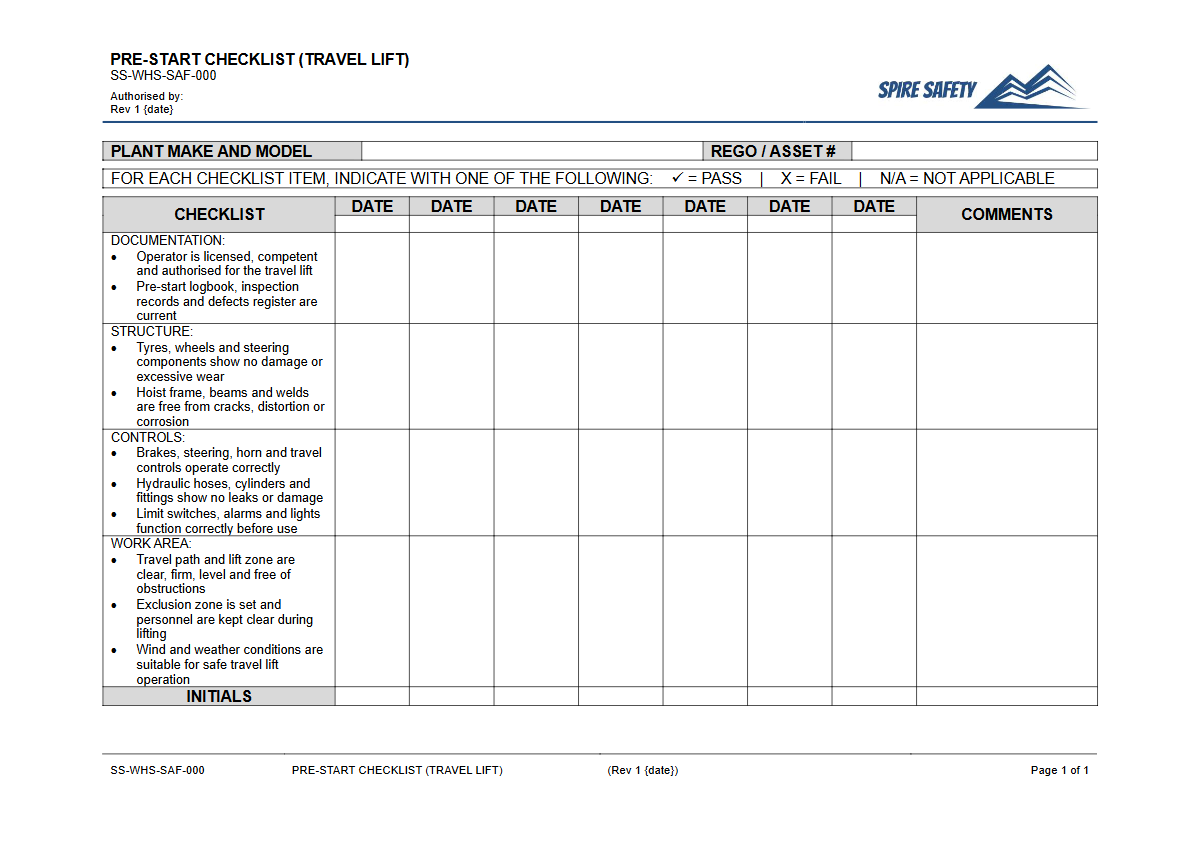
Operating a travel lift involves significant risks, making pre-operational checks a critical safety control. This Free Pre-Start Checklist (Travel Lift) Template provides a structured framework for operators to conduct thorough inspections before each use.
Its primary purpose is to systematically identify any mechanical faults, hydraulic leaks, structural damage, or other hazardous conditions that could lead to equipment failure, property damage, or serious injury. Regular use of this checklist helps create a consistent safety routine, ensuring the machinery is fit for service.
By documenting these daily checks, your organisation creates a valuable record of equipment condition and due diligence. This documentation is essential for tracking maintenance needs and demonstrating proactive risk management.
Integrating such procedures into your broader safety framework is key to fostering a strong safety culture. A well-documented pre-start program forms a foundational part of effective WHS management systems, providing evidence that plant safety is being actively managed.
Video walkthrough
How to use the Free Pre-Start Checklist (Travel Lift) Template
This template is provided as a starting point in both DOCX and PDF formats. To implement it effectively, a Person Conducting a Business or Undertaking (PCBU) should follow these steps:
- Download: Select your preferred format, either the customisable DOCX file or the print-ready PDF.
- Customise: This is the most critical step. You must adapt the checklist to the specific make, model, and configuration of the travel lift(s) used in your workplace. Review the manufacturer's operating manual and your own risk assessments to add or remove items. We have provided a general list, but your equipment will have unique features and critical components that need to be included.
- Train: Ensure all operators are trained not only on how to operate the travel lift but also on how to properly conduct the pre-start inspection using the finalised checklist. They must understand what each item means and the procedure for reporting defects.
- Implement: Integrate the checklist into your daily operational procedures. Establish a clear process for where completed checklists are stored and who reviews them.
Pre-start checks are just one component of managing high-risk plant. For complex tasks, other documents are also necessary.
For example, a Safe Work Method Statement (Scissor Lift Operation) Template shows the kind of detailed procedure required for operating similar types of mobile equipment safely.
When to use it
A pre-start check for a travel lift must be completed before the equipment is used for the first time on any given day or at the beginning of each shift. If the travel lift has been idle for an extended period or has undergone maintenance, a pre-start check should also be performed before it is returned to service.
Consistency is crucial; a check that is only performed sporadically offers a false sense of security.
These completed records should be retained according to your organisation's procedures and may be reviewed during internal or external safety audits. Having a complete history of daily checks can be invaluable for identifying recurring issues and for processes like WHS compliance auditing.
Who should use it
The primary user of this checklist is the competent and licenced operator assigned to the travel lift for that shift. They are responsible for physically conducting the inspection and accurately recording the status of each item. However, responsibility for the overall process extends further:
- Supervisors and Managers: They are responsible for ensuring operators are trained and are diligently completing the checks. They must also review the completed forms, sign off where required, and action any reported faults or deficiencies promptly.
- Maintenance Personnel: They will be engaged when the pre-start check identifies a defect that requires repair or technical assessment before the equipment can be used safely.
- WHS Officers: They may use the completed checklists to monitor compliance, analyse trends, and verify the effectiveness of safety procedures.
Defining these roles and responsibilities is a key part of implementing any safety procedure. If you need assistance clarifying obligations within your workplace, engaging with WHS consulting services can provide expert guidance and support.
Common mistakes
Common mistakes to avoid
- Operator 'pencil-whipping' the list without physically inspecting the components.
- Failing to remove the equipment from service after identifying a serious defect.
- Using a generic plant checklist that doesn't cover travel lift-specific components like slings and lifting blocks.
- Not providing adequate training to operators on how to identify potential faults.
Legal references
Legal considerations
The following legal requirements may be relevant to this type of work.
- Work Health and Safety Act (Harmonised) — Provides the primary duties for protecting workers and other people from work health and safety risks.
- Work Health and Safety Regulations (Harmonised) — Sets out requirements supporting the management of workplace hazards and risks.
The following codes may be relevant to this type of work.
- Managing WHS Risks Code of Practice — Provides practical guidance on identifying hazards, assessing risks and applying effective controls.
- Work Health and Safety Consultation, Cooperation and Coordination Code of Practice — Provides practical guidance on consulting workers and coordinating with other duty holders.
- Managing the Work Environment and Facilities Code of Practice — Provides practical guidance on safe work environments, workplace facilities and related controls.
Did you know
Lifting Power
Large marine travel lifts, also known as mobile boat hoists, can have staggering lifting capacities. Some of the biggest models in the world are capable of lifting vessels weighing over 1,500 tonnes.
FAQ
Frequently asked questions
01What should be included in a travel lift pre-start checklist?
02How often should a travel lift pre-start check be performed?
03Who is responsible for completing the travel lift pre-start check?
04What happens if a fault is found during a travel lift inspection?
Share this resource
Free Pre-Start Checklist (Travel Lift) Template
Browse Categories
How To Use It
- 1Download and open in Word or PDF.
- 2Replace the placeholders with your business details.
- 3Get it reviewed by a WHS specialist before rollout.
Need it customised?
Our WHS consultants can adapt this template to your site, run a gap analysis, or audit what you already have in place.
Book a Free Consultation WHS consulting servicesor call 1300 156 382