
Free Pre-Start Checklist (Tray Truck) Template
Download our free Pre-Start Checklist (Tray Truck) Template. This customisable DOCX & PDF helps you formalise daily checks and manage WHS risks. Get yours now.
Free Pre-Start Checklist (Tray Truck) Template
DOCX • 125 KB + PDF
Updated Oct 2026
No signup required
Purpose of the Free Pre-Start Checklist (Tray Truck) Template
Operating a tray truck, like any heavy vehicle, carries significant risks if the equipment is not properly maintained and inspected. This Free Pre-Start Checklist (Tray Truck) Template provides a structured framework for operators to conduct thorough, routine safety inspections before starting work.
Using a formal checklist helps ensure that no critical checks are missed, identifies potential defects before they cause an incident, and creates a documented record of your organisation's commitment to safety. Regular pre-start checks are a fundamental part of managing WHS risks associated with mobile plant and vehicles.
By systematically reviewing key components like brakes, tyres, lights, and load restraint points, you can proactively manage vehicle safety and meet your obligations as a Person Conducting a Business or Undertaking (PCBU). This process is vital for preventing on-road incidents, worksite accidents, and costly, unplanned maintenance.
Similar principles apply to other heavy machinery, as seen in our free Pre-Start Checklist for Forwarders, where routine inspection is key to safe operation.
Video walkthrough
How to use the Free Pre-Start Checklist (Tray Truck) Template
This resource is available as a fully editable DOCX file and a print-ready PDF. After downloading, you should integrate it into your daily operational procedures.
The checklist provides a solid foundation aligned with Australian WHS principles, but it is crucial to adapt it to your specific circumstances.
Important: We provide this template as a starting point. You must customise it to reflect the specific make, model, and configuration of your tray truck(s), your operational tasks (e.g., use of a tailgate lifter, specific cargo types), and the unique risks present in your workplace. This customisation ensures the checklist is a practical and effective tool within your broader WHS management system.
What's included in the checklist?
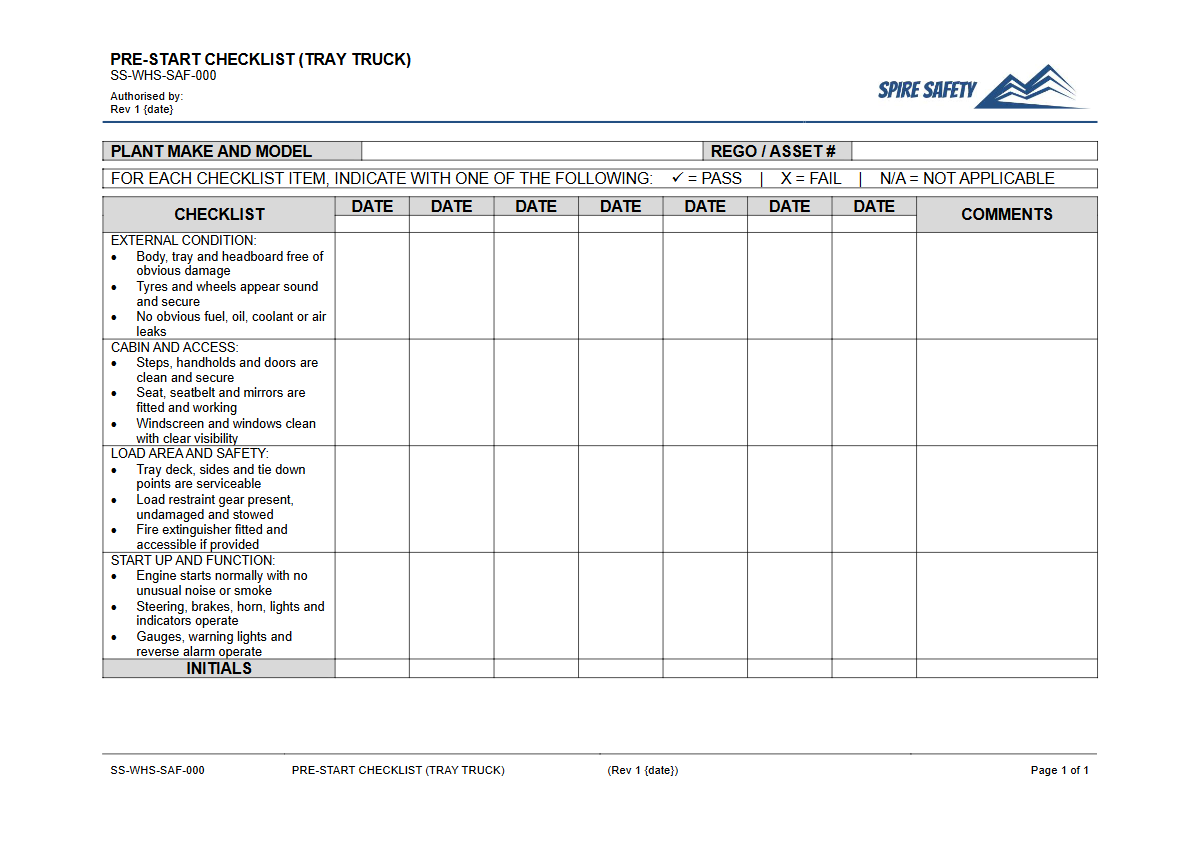
The template is structured to cover the main areas of a tray truck, promoting a logical and efficient inspection flow. Key sections include:
- General Information: Fields for date, operator name, vehicle registration, and odometer reading to ensure clear record-keeping.
- Cabin Checks: Verification of seatbelts, horn, mirrors, windscreen, and controls.
- Exterior & Body Checks: Inspection of tyres for pressure and wear, lights, indicators, and overall bodywork.
- Tray & Load Restraint: Checks for the condition of the tray surface, gates, and load anchor points.
- Fluid & Engine Checks: Verification of oil, coolant, and brake fluid levels.
- Safety Equipment: Confirmation that items like fire extinguishers, first aid kits, and warning triangles are present and serviceable.
- Action & Sign-off: A section to note any defects found and a sign-off area for the operator and supervisor.
When to use it
A Pre-Start Checklist for a tray truck should be completed before the vehicle is used for the first time each day or at the beginning of every shift. This frequency ensures that any issues that may have developed overnight or during a previous shift are identified before the vehicle is put into operation.
It should also be completed after any significant maintenance or repair work to verify the vehicle's safe status. These records can prove invaluable during internal reviews or formal WHS compliance audits.
Who should use it
The primary user of this checklist is the licensed and competent driver or operator assigned to the vehicle for a shift. They are best placed to identify any changes in the vehicle's condition or performance. However, responsibility extends beyond the operator. Supervisors and managers should ensure that the checks are being completed correctly and that any reported defects are addressed in a timely manner. Maintenance personnel may also reference the checklists to understand recurring issues. Integrating these practices is a core part of developing a safety culture, a process that can be guided by ISO 45001 consulting to meet international standards. While drivers check their vehicles, maintenance staff can also use checklists for workshop equipment, similar to our free Pre-Start Checklist for Bench Grinders, to ensure their tools are safe. For more templates covering a wide range of equipment, browse our free WHS resources library.
Common mistakes
Common mistakes to avoid
- "Pencil-whipping" the checklist without physically inspecting the truck.
- Failing to report and follow up on defects identified during the check.
- Using a generic car checklist that misses truck-specific items like load anchors or tray condition.
- Not customising the template for the specific make, model, and configuration of the tray truck.
Legal references
Legal considerations
The following legal requirements may be relevant to this type of work.
- Work Health and Safety Act (Harmonised) — Provides the primary duties for protecting workers and other people from work health and safety risks.
- Work Health and Safety Regulations (Harmonised) — Sets out requirements supporting the management of workplace hazards and risks.
The following codes may be relevant to this type of work.
- Managing WHS Risks Code of Practice — Provides practical guidance on identifying hazards, assessing risks and applying effective controls.
- Work Health and Safety Consultation, Cooperation and Coordination Code of Practice — Provides practical guidance on consulting workers and coordinating with other duty holders.
- Managing the Work Environment and Facilities Code of Practice — Provides practical guidance on safe work environments, workplace facilities and related controls.
Did you know
Vehicle Incidents
The transport, postal, and warehousing industry consistently has one of the highest rates of serious injuries and fatalities in Australia, with vehicle incidents being a primary cause.
Chain of Responsibility
Under Chain of Responsibility (CoR) laws, everyone in the supply chain, not just the driver, has a legal obligation to ensure the safety of all transport activities, including vehicle maintenance.
FAQ
Frequently asked questions
01Why is a tray truck pre-start checklist so important?
02What should be included in a tray truck pre-start inspection?
03How often should a pre-start check be done on a tray truck?
04Who is responsible for completing the checklist?
Share this resource
Free Pre-Start Checklist (Tray Truck) Template
Browse Categories
How To Use It
- 1Download and open in Word or PDF.
- 2Replace the placeholders with your business details.
- 3Get it reviewed by a WHS specialist before rollout.
Need it customised?
Our WHS consultants can adapt this template to your site, run a gap analysis, or audit what you already have in place.
Book a Free Consultation WHS consulting servicesor call 1300 156 382