
Free Pre-Start Checklist (Tower Crane) Template
Formalise daily equipment inspections for tower cranes with our free, customisable template. Identify faults and manage WHS risks effectively. Download now.
Free Pre-Start Checklist (Tower Crane) Template
DOCX • 125 KB + PDF
Updated Oct 2026
No signup required
Purpose of this Free Pre-start Checklist (Tower Crane) Template
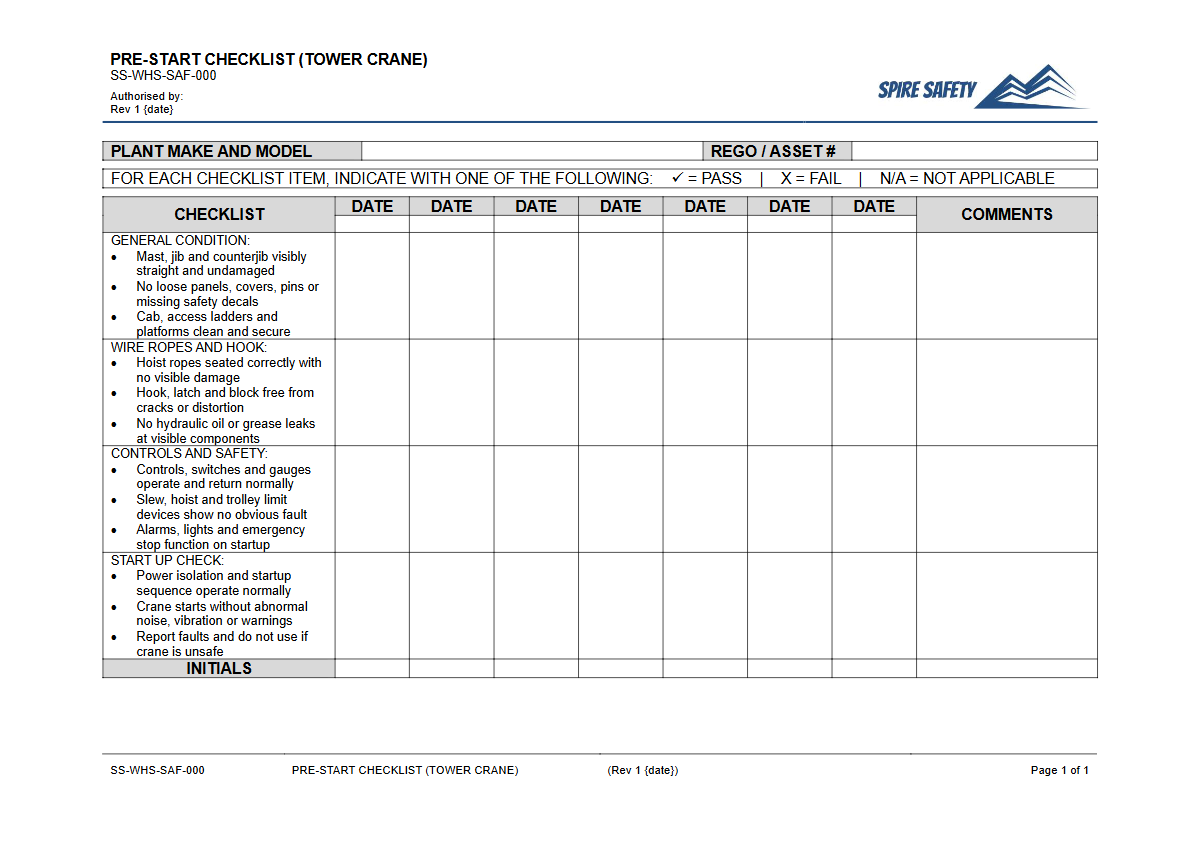
Operating a tower crane is a high-risk activity that demands rigorous safety protocols. This Free Pre-Start Checklist (Tower Crane) Template provides a structured format for operators to conduct thorough pre-operational inspections.
Its primary purpose is to systematically identify any faults, damage, or wear and tear before the crane is used, preventing potential incidents, equipment failure, and harm to workers. Using this checklist helps a Person Conducting a Business or Undertaking (PCBU) demonstrate due diligence, maintain safety records, and integrate critical checks into their broader WHS management systems.
Video walkthrough
How to use the Free Pre-Start Checklist (Tower Crane) Template
This resource is available for download in both DOCX and PDF formats. The DOCX version is fully editable, allowing you to tailor the checklist to your specific operational needs.
Effective implementation involves more than just downloading the file; it requires careful customisation and integration into your daily work procedures. Similar to how one would use a pre-start checklist for bridge cranes, this document should become a routine part of the operator's daily tasks.
Customising Your Pre-Start Checklist
It is crucial to adapt this template to the specific make and model of the tower crane being used, as well as the unique conditions of your work site. Manufacturer's instructions always take precedence and should be the primary source for inspection criteria.
Important: This template is a starting point developed in alignment with Australian WHS principles. We have designed it to be a helpful tool, but it is not a substitute for professional advice.
You must customise it to address the specific hazards and control measures relevant to your workplace and equipment. A generic checklist cannot cover all variables.
Key Inspection Areas
A comprehensive tower crane pre-start should cover several critical areas. Your customised checklist should include sections for:
- Structural Components: Checking the mast, jib, counter-jib, and tower sections for any signs of cracks, corrosion, or deformation.
- Mechanical Systems: Inspecting ropes, sheaves, hooks, the slewing ring, and braking systems for wear, proper lubrication, and correct function.
- Electrical Systems: Verifying the operation of limit switches, emergency stops, control panels, and warning devices. Just as a forwarder pre-start checklist would verify hydraulic systems, this check ensures all power and control functions are reliable.
- Operational Functions: Testing hoisting, slewing, and trolleying movements to ensure they are smooth and controlled.
- Safety Equipment: Ensuring access ladders, platforms, guardrails, and the operator's cabin are secure and free from defects.
When to use a Tower Crane Pre-Start Checklist
The pre-start checklist must be completed before the first use of the tower crane on every shift. It should also be used after any event that may have affected the crane's integrity, such as a severe storm, a power outage, or significant maintenance work.
Consistency is key; this daily habit is as fundamental as the checks performed on other site equipment, such as a pre-start checklist for a floor saw, to ensure a safe working environment for everyone.
Who should use this Pre-Start Checklist
This checklist is designed to be completed by the licensed and competent tower crane operator for that shift. The operator has the most hands-on interaction with the machine and is best placed to notice subtle changes in its performance or condition.
Site supervisors and managers are responsible for ensuring these checks are completed correctly and that any identified issues are addressed before operation commences. Records of these checks should be maintained and may be reviewed during internal or external safety audits. These records help demonstrate that safe work procedures are being followed, a key aspect verified through WHS compliance auditing services.
By embedding this process into your site's safety culture, you contribute to a safer, more productive workplace. For more templates and safety documents, you can browse our complete free WHS resources library.
Common mistakes
Common mistakes to avoid
- "Pencil-whipping" the checklist without physically inspecting the items.
- Using a generic checklist that doesn't match the specific crane's make and model.
- Failing to report and immediately address identified defects or damage.
- Poor record-keeping, with illegible, incomplete, or lost checklists.
Legal references
Legal considerations
The following legal requirements may be relevant to this type of work.
- Work Health and Safety Act (Harmonised) — Provides the primary duties for protecting workers and other people from work health and safety risks.
- Work Health and Safety Regulations (Harmonised) — Sets out requirements supporting the management of workplace hazards and risks.
The following codes may be relevant to this type of work.
- Managing WHS Risks Code of Practice — Provides practical guidance on identifying hazards, assessing risks and applying effective controls.
- Work Health and Safety Consultation, Cooperation and Coordination Code of Practice — Provides practical guidance on consulting workers and coordinating with other duty holders.
- Managing the Work Environment and Facilities Code of Practice — Provides practical guidance on safe work environments, workplace facilities and related controls.
Did you know
Crane Weathervaning
When not in use, tower cranes are often put into 'weathervane' mode, where the slewing brake is released. This allows the jib to rotate freely and align with the wind, reducing structural stress during high winds.
Self-Climbing Cranes
Many modern tower cranes are 'self-climbing'. They use hydraulic jacks to add new mast sections from below, allowing the crane to grow taller as the building it is constructing grows.
FAQ
Frequently asked questions
01What is the purpose of a tower crane pre-start checklist?
02How often should a tower crane be inspected?
03Who is responsible for filling out the pre-start checklist?
04Does this template cover all legal WHS requirements?
Share this resource
Free Pre-Start Checklist (Tower Crane) Template
Browse Categories
How To Use It
- 1Download and open in Word or PDF.
- 2Replace the placeholders with your business details.
- 3Get it reviewed by a WHS specialist before rollout.
Need it customised?
Our WHS consultants can adapt this template to your site, run a gap analysis, or audit what you already have in place.
Book a Free Consultation WHS consulting servicesor call 1300 156 382