
Free Pre-Start Checklist (Track Dozer) Template
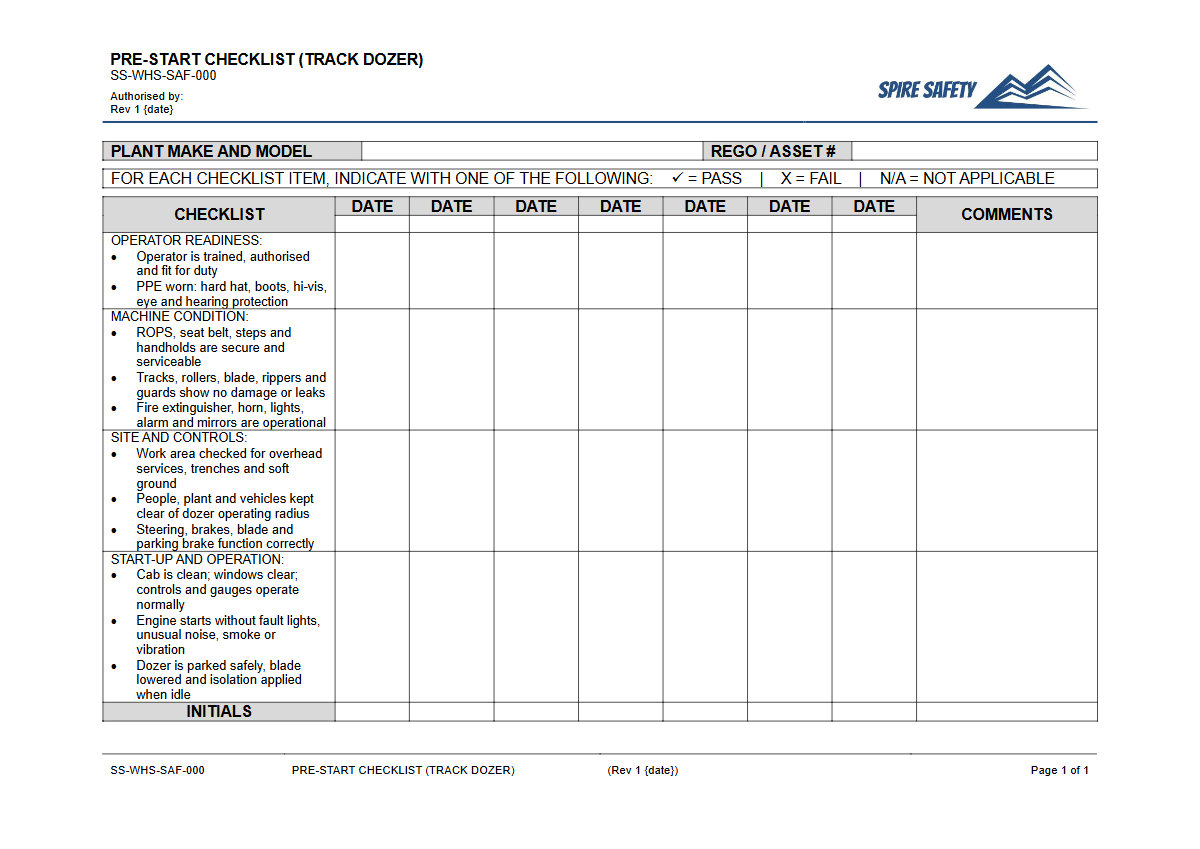
Download our free Pre-Start Checklist (Track Dozer) Template. This structured Word & PDF document helps formalise daily safety inspections. Download yours now.
Free Pre-Start Checklist (Track Dozer) Template
DOCX • 125 KB + PDF
Updated Oct 2026
No signup required
Purpose of the Free Pre-Start Checklist (Track Dozer) Template
Operating heavy machinery like a track dozer involves significant risks. A systematic pre-operational inspection is a critical control measure to ensure the equipment is safe to use.
This free Pre-Start Checklist (Track Dozer) Template provides a structured framework for operators to conduct thorough daily checks, identify potential defects, and prevent incidents before they happen. Formalising this process helps a Person Conducting a Business or Undertaking (PCBU) meet their primary duty of care under WHS legislation.
Video walkthrough
How to use the Free Pre-Start Checklist (Track Dozer) Template
The primary purpose of this track dozer pre-start checklist is to systematically verify that the machine is in safe working order before each shift. It's a proactive safety measure designed to catch mechanical issues, fluid leaks, structural damage, or safety system failures that could lead to an accident, equipment failure, or costly downtime.
Using a standardised checklist ensures all critical components are inspected consistently, creating a reliable record of the dozer's condition over time. It also forms a key part of your site's overall plant safety program and can be a valuable topic for a pre-start checks and plant maintenance toolbox talk to reinforce safe work practices.
Customisation is Essential
IMPORTANT: This resource is a starting point and must be adapted for your workplace. We recommend a competent person customises this template to reflect the specific make, model, and configuration of your dozer, the unique environmental conditions of your site, and the requirements of your organisation's WHS management systems. Generic checklists can miss model-specific hazards or critical inspection points.
When to use the Pre-Start Checklist
A pre-start check should be conducted by the operator at the beginning of every shift or before the dozer is used for the first time each day. The completed checklist should be signed, dated, and stored as a record.
If a fault is discovered during the inspection, the operator must not use the machine. The equipment should be immediately isolated, tagged out of service, and the issue reported to a supervisor in line with the procedures detailed in your FREE Dozer SOP (Safe Operating Procedure) Template.
Who should use this Pre-Start Checklist
This checklist should be completed by a person who is trained, authorised, and deemed competent to operate a track dozer. Competency involves more than just holding a licence; it means having the specific skills and knowledge to operate the machine safely and conduct a thorough inspection.
A Free Dozer VOC (Verification of Competency) Template can be used to formally assess and confirm an operator's ability to handle the equipment and its associated safety procedures, including pre-start checks.
Key Inspection Areas for a Track Dozer
While your customised checklist will be more detailed, a comprehensive dozer pre-start inspection typically covers several key areas:
- General Condition & Structure: Look for any signs of damage, cracks, or loose components on the frame, ROPS/FOPS, and guards.
- Tracks & Undercarriage: Check track tension, idlers, rollers, and sprockets for wear or damage. Ensure track guards are secure.
- Blade, Ripper & Attachments: Inspect cutting edges, end bits, and attachment points for security and wear. Check hydraulic cylinders and hoses for leaks or damage.
- Engine & Fluids: Check engine oil, coolant, hydraulic fluid, and fuel levels. Look for any visible leaks on the ground or around the engine bay.
- Cabin & Controls: Ensure the cabin is clean and free of debris. Check that all controls, gauges, lights, windscreen wipers, and the horn are functioning correctly. Verify the seatbelt and seat are in good condition.
- Safety Equipment: Confirm the presence and serviceability of the fire extinguisher and first aid kit.
Regularly reviewing your safety processes, including the effectiveness of your pre-start checks, is crucial for continuous improvement. These reviews can be incorporated into broader WHS compliance auditing to ensure ongoing alignment with safety standards and legislation.
Managing Your Safety Documentation
Keeping accurate records of pre-start checks is a legal requirement and good practice. These records demonstrate due diligence and can help identify recurring maintenance issues.
Whether you use digital forms or paper copies, ensure they are filed systematically and are accessible for review or audit. This template is just one of many tools available to help build a robust safety system.
Explore our complete free WHS resources library for more templates and guides to support your safety goals.
Common mistakes
Common mistakes to avoid
- Failing to physically check items instead of just ticking boxes from memory.
- Ignoring minor fluid leaks that could indicate a larger, more serious problem.
- Using a generic checklist that hasn't been customised for the specific dozer model and its attachments.
- Proceeding with operation despite identifying a significant safety defect or missing safety equipment.
Legal references
Legal considerations
The following legal requirements may be relevant to this type of work.
- Work Health and Safety Act (Harmonised) — Provides the primary duties for protecting workers and other people from work health and safety risks.
- Work Health and Safety Regulations (Harmonised) — Sets out requirements supporting the management of workplace hazards and risks.
The following codes may be relevant to this type of work.
- Managing WHS Risks Code of Practice — Provides practical guidance on identifying hazards, assessing risks and applying effective controls.
- Work Health and Safety Consultation, Cooperation and Coordination Code of Practice — Provides practical guidance on consulting workers and coordinating with other duty holders.
- Managing the Work Environment and Facilities Code of Practice — Provides practical guidance on safe work environments, workplace facilities and related controls.
Did you know
A Powerful History
The modern bulldozer design was developed by Benjamin Holt in 1904 for farming, and its tracked design was the inspiration for tanks used in World War I.
Sheer Force
Large mining dozers can weigh over 100 tonnes and have engines producing more than 1,000 horsepower, allowing them to push thousands of cubic metres of material per hour.
FAQ
Frequently asked questions
01What is a track dozer pre-start checklist for?
02How often should a dozer pre-start check be done?
03Is this dozer pre-start checklist compliant with WHS laws in Australia?
04What should an operator do if they find a defect?
Share this resource
Free Pre-Start Checklist (Track Dozer) Template
Browse Categories
How To Use It
- 1Download and open in Word or PDF.
- 2Replace the placeholders with your business details.
- 3Get it reviewed by a WHS specialist before rollout.
Need it customised?
Our WHS consultants can adapt this template to your site, run a gap analysis, or audit what you already have in place.
Book a Free Consultation WHS consulting servicesor call 1300 156 382