
Free Pre-Start Checklist (Trailer EWP) Template
Download our Free Pre-Start Checklist (Trailer EWP) Template in DOCX and PDF.
Free Pre-Start Checklist (Trailer EWP) Template
DOCX • 125 KB + PDF
Updated Oct 2026
No signup required
Purpose of the Free Pre-Start Checklist (Trailer EWP) Template
Regularly inspecting high-risk equipment is a cornerstone of workplace safety in Australia. Our Free Pre-Start Checklist (Trailer EWP) Template provides a structured starting point for operators to identify potential hazards before using a trailer-mounted Elevating Work Platform (EWP).
By formalising this process, you can significantly reduce the risk of equipment failure, property damage, and serious injury. This resource is available for immediate download in both DOCX and PDF formats, ready to be adapted to your specific operational needs.
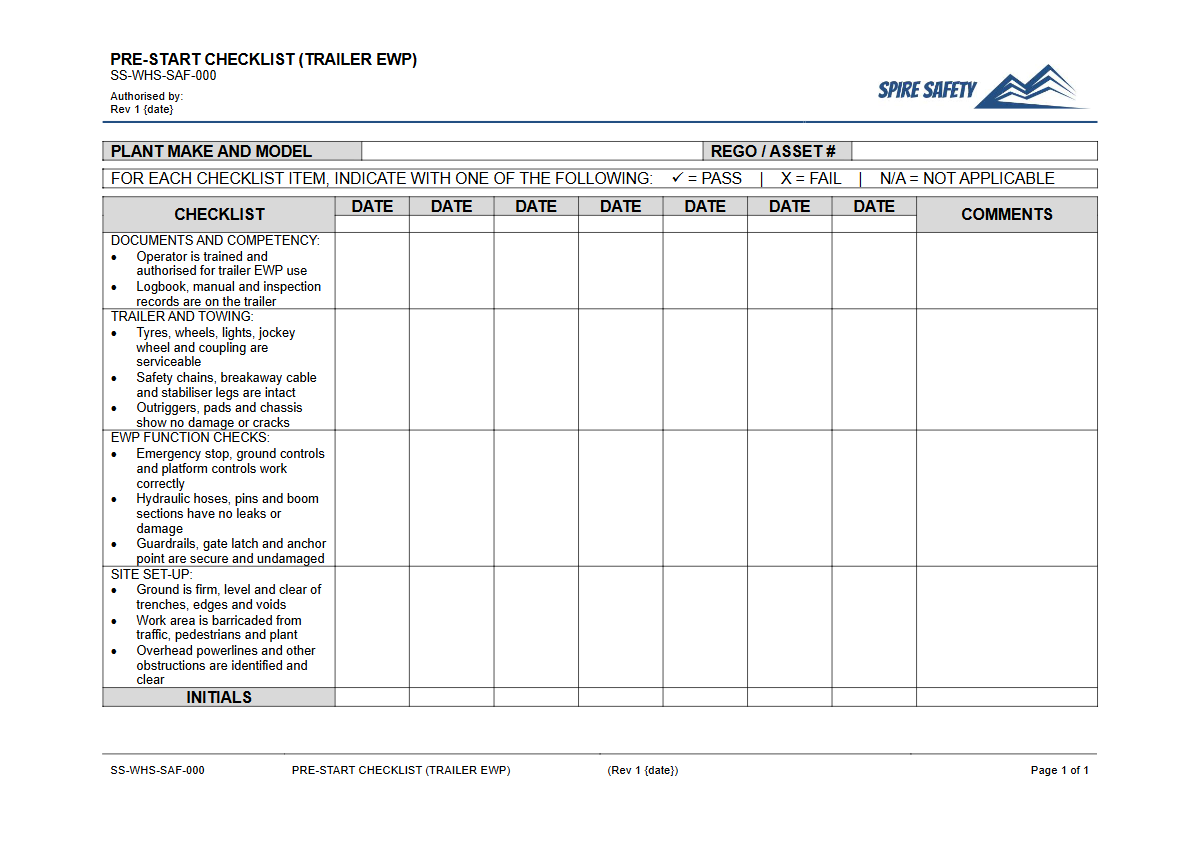
The primary purpose of this pre-start checklist is to create a formal, documented process for verifying that a trailer-mounted EWP is safe to use. It prompts the operator to systematically inspect critical components, from structural integrity and hydraulic systems to emergency controls and safety harnesses.
Using this template helps your organisation meet its primary duty of care obligations under WHS legislation by taking proactive steps to manage the risks associated with high-risk plant. A consistent inspection routine is a key part of your plant maintenance schedule.
Reinforce these principles with our Pre-Start Checks and Plant Maintenance Toolbox Talk to build a strong safety culture.
Video walkthrough
How to use the Free Pre-Start Checklist (Trailer EWP) Template
This template is designed for ease of use and customisation. After downloading the DOCX or PDF file, the first step is to adapt it to your workplace.
This involves reviewing the checklist items against the manufacturer’s operating manual for your specific EWP model and adding any checks relevant to your site or tasks, such as ground conditions or overhead power lines.
Once customised, the checklist should be integrated into your daily operational procedures. Train all licensed operators on how to complete the checklist thoroughly, emphasising that it is a practical inspection, not just a paperwork exercise.
Completed checklists should be reviewed by a supervisor and filed as a record of your safety diligence. Integrating this process into your broader WHS management systems ensures inspections are consistently completed, recorded, and any identified faults are properly managed.
Please note: This template is a starting point. We strongly recommend you customise it to reflect the specific make, model, and configuration of your equipment, as well as any unique site-based hazards.
When to use it
A pre-start inspection should be conducted at several key intervals to ensure ongoing safety. The most common and critical time to use the checklist is at the beginning of every shift, before the EWP is used for the first time that day.
This ensures the equipment's condition has not changed overnight and is ready for work.
Additionally, a check should be performed whenever the EWP is relocated to a new work area on a large site, as transit can sometimes affect components or settings. It is also good practice to conduct an inspection after the equipment has been idle for an extended period.
These checks are a critical activity to complete before the day's work commences, often in conjunction with a team briefing using a pre-start meeting template to discuss the tasks ahead.
Who should use it
The pre-start checklist must be completed by a person who is competent to operate the specific class of EWP. In Australia, this typically means a worker who holds a valid High Risk Work Licence (HRWL) for that EWP class (e.g., WP for boom-type EWPs over 11 metres).
The operator's training and experience enable them to not only follow the checklist but also to recognise signs of wear, damage, or malfunction that may not be explicitly listed.
Supervisors and managers also have a role. They are responsible for ensuring that operators are completing the checks correctly and that any reported faults are addressed immediately.
This includes implementing tag-out procedures to prevent the use of unsafe equipment. The process of using a pre-start checklist aligns closely with the procedural steps outlined in a Safe Work Method Statement for tip truck or trailer operations, where specific checks confirm that controls are in place before starting a high-risk task.
What's Covered in the Pre-Start Checklist
Our template provides a comprehensive framework aligned with Australian WHS practice. It prompts the user to inspect key areas, including:
- Structural Components: Checks for cracks, corrosion, or damage on the chassis, outriggers, boom sections, and platform.
- Fluid Levels: Verification of hydraulic oil, fuel, and coolant levels.
- Tyres and Wheels: Inspection for correct pressure, wear, and any visible damage.
- Operational Controls: Testing of both ground and platform controls for smooth operation, including emergency stop buttons.
- Safety Systems: Confirmation that emergency descent mechanisms, audible alarms, and warning lights are functional.
- Ancillary Equipment: Inspection of safety harnesses, lanyards, and anchor points for wear or damage.
Conducting these checks and keeping accurate records can be reviewed during a WHS compliance audit to verify that your safety procedures are being followed correctly. For more tools to enhance your safety framework, explore our complete free WHS resources library.
Common mistakes
Common mistakes to avoid
- Failing to check emergency descent controls from both the ground and the platform.
- Ignoring minor hydraulic leaks, which can indicate an impending and catastrophic system failure.
- Using the checklist as a 'tick-and-flick' exercise without proper visual and physical inspection.
- Not customising the generic template to the specific make and model of the trailer EWP in use.
Legal references
Legal considerations
The following legal requirements may be relevant to this type of work.
- Work Health and Safety Act (Harmonised) — Provides the primary duties for protecting workers and other people from work health and safety risks.
- Work Health and Safety Regulations (Harmonised) — Sets out requirements supporting the management of workplace hazards and risks.
The following codes may be relevant to this type of work.
- Managing WHS Risks Code of Practice — Provides practical guidance on identifying hazards, assessing risks and applying effective controls.
- Work Health and Safety Consultation, Cooperation and Coordination Code of Practice — Provides practical guidance on consulting workers and coordinating with other duty holders.
- Managing the Work Environment and Facilities Code of Practice — Provides practical guidance on safe work environments, workplace facilities and related controls.
Did you know
Leading Causes of Injury
Falls from height, electrocution, and structural failure are the leading causes of fatalities and serious injuries involving Elevating Work Platforms. Thorough pre-start checks are a critical control for preventing these incidents.
FAQ
Frequently asked questions
01Is a pre-start checklist a legal requirement for EWPs in Australia?
02What should an operator do if they find a fault during a pre-start check?
03How often does a trailer EWP need a major inspection?
04What's the difference between a trailer EWP and a self-propelled boom lift?
Share this resource
Free Pre-Start Checklist (Trailer EWP) Template
Browse Categories
How To Use It
- 1Download and open in Word or PDF.
- 2Replace the placeholders with your business details.
- 3Get it reviewed by a WHS specialist before rollout.
Need it customised?
Our WHS consultants can adapt this template to your site, run a gap analysis, or audit what you already have in place.
Book a Free Consultation WHS consulting servicesor call 1300 156 382