
Free Pre-Start Checklist (TIG Welder) Template
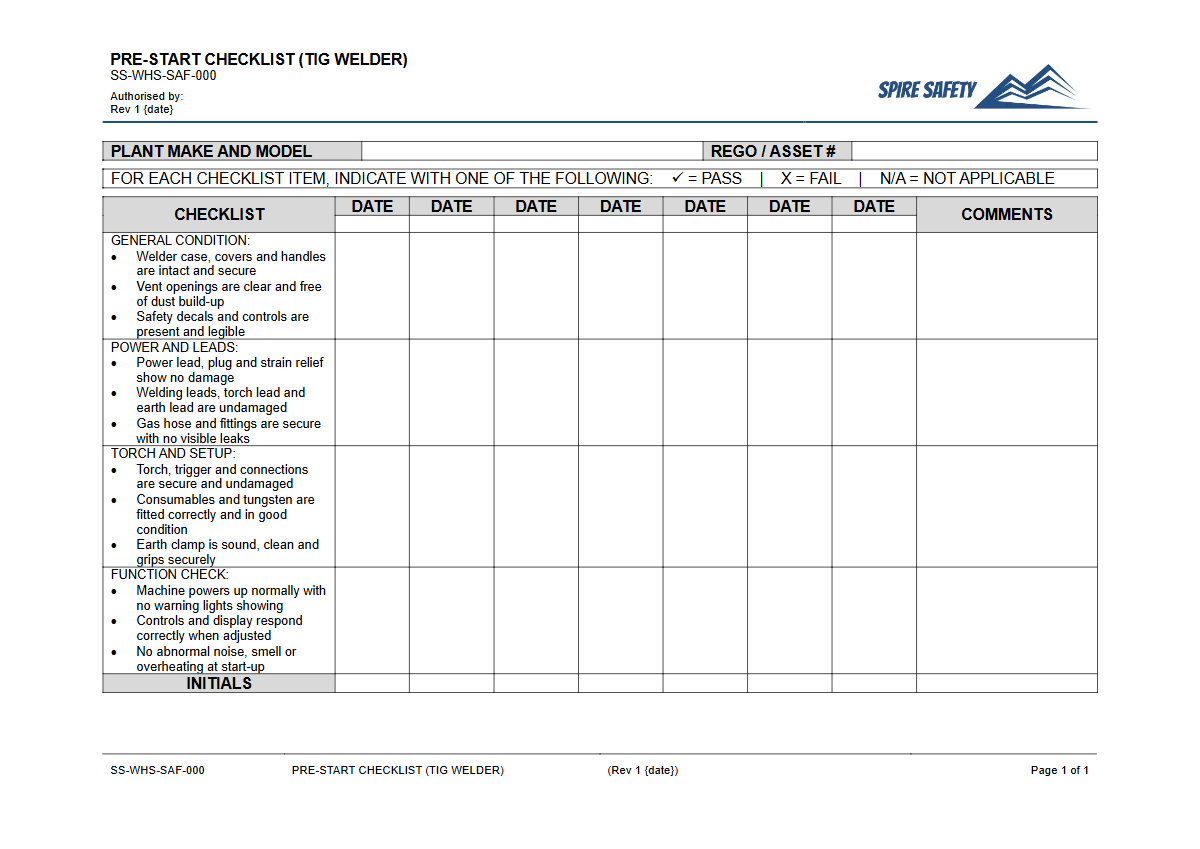
Download our free Pre-Start Checklist (TIG Welder) Template to formalise daily equipment checks and improve workplace safety. Available in DOCX & PDF.
Free Pre-Start Checklist (TIG Welder) Template
DOCX • 125 KB + PDF
Updated Oct 2026
No signup required
Purpose of the Free Pre-Start Checklist (TIG Welder) Template
Integrating a formal inspection process before using any high-risk equipment is a cornerstone of effective workplace health and safety. Our Free Pre-Start Checklist (TIG Welder) Template provides a structured framework for operators to systematically inspect their equipment before commencing work.
Using a TIG welder involves significant risks, including electric shock, severe burns from the arc and hot metal, exposure to ultraviolet (UV) radiation, and the inhalation of potentially hazardous fumes and gases. This checklist helps formalise the process of identifying and controlling these hazards before they can cause harm.
The primary purpose of this Pre-Start Checklist is to ensure the TIG welding unit and its associated components are in safe, working order. It prompts a physical inspection of critical parts like power cables, torches, gas lines, regulators, and safety features.
Documenting these checks also creates a valuable record for maintenance scheduling, incident investigations, and demonstrating WHS due diligence. Given the fumes generated during welding, ensuring adequate ventilation is critical; a similar structured approach can be applied using a pre-start checklist for fume cabinets to manage air quality in the work area.
Video walkthrough
How to Use the Free Pre-Start Checklist (TIG Welder) Template
This resource is available as a DOCX file for easy customisation and a PDF for straightforward printing. The provided list of checks is a comprehensive starting point aligned with Australian WHS practice, but it must be adapted to your specific operational context.
Different makes and models of TIG welders have unique features, controls, and maintenance requirements outlined by the manufacturer. You must review the manufacturer’s operating manual and incorporate its specific recommendations into your version of the checklist.
Important: We have provided a template as a starting point. It is essential that you customise this document to suit the specific equipment, processes, and risks present in your workplace.
Add your company branding, site-specific safety rules, and any additional checks relevant to your TIG welder model or common tasks. Integrating this customised checklist into your broader WHS management systems ensures it becomes a routine and auditable part of your safety procedures, rather than a standalone document.
When to Use It
A pre-start checklist should be completed before every use of the TIG welder. For workshops with continuous operations, this means at the beginning of each shift.
For intermittent use, it means before the operator begins their welding task. The condition of equipment can change unexpectedly due to previous use, damage during storage, or environmental factors.
A check that was valid yesterday does not guarantee the equipment is safe today. Regular, consistent use of the checklist embeds a positive safety behaviour and moves your organisation from a reactive to a proactive safety culture.
It ensures that identifying a fault becomes a routine part of the process, not an unexpected emergency.
Who Should Use It
The checklist is designed to be completed by the competent person who will be operating the TIG welder. The operator has the most immediate control over the equipment and is the first line of defence against incidents.
They must be trained not only in how to weld but also in how to perform the safety checks and what to do if a fault is discovered. Supervisors and managers have a responsibility to ensure these checks are being completed correctly and consistently.
They should review the completed checklists periodically to identify recurring faults or patterns that may indicate a need for more extensive maintenance or operator training. In a workshop environment, it's common to have multiple pieces of equipment requiring checks, such as our free template for bench grinder pre-starts, creating a comprehensive safety routine.
Ultimately, the Person Conducting a Business or Undertaking (PCBU) holds the primary duty of care to provide and maintain safe plant and equipment. Implementing mandatory pre-start inspections using a tool like this template is a key method for meeting that obligation.
Records of these checks serve as evidence that the PCBU is actively managing risks. Performing regular reviews of these documented processes is a key activity during formal WHS compliance auditing to verify that safety procedures are effective and consistently followed.
This template can be a valuable part of your safety toolkit, helping to manage risks associated with many types of industrial machinery beyond welders. The same principle of structured, pre-operational checks applies to complex equipment in other sectors, as seen in our granulator pre-start checklist for manufacturing and recycling. For a wider range of safety documents, explore our complete free WHS resources library.
Common mistakes
Common mistakes to avoid
- Skipping the checklist for 'quick' or 'minor' jobs.
- Failing to inspect the immediate work area for flammable materials or trip hazards.
- Using a generic checklist not customised for the specific TIG welder model.
- Neglecting to report 'small' faults like frayed cables, which can escalate into major failures.
Legal references
Legal considerations
The following legal requirements may be relevant to this type of work.
- Work Health and Safety Act (Harmonised) — Provides the primary duties for protecting workers and other people from work health and safety risks.
- Work Health and Safety Regulations (Harmonised) — Sets out requirements supporting the management of workplace hazards and risks.
The following codes may be relevant to this type of work.
- Managing WHS Risks Code of Practice — Provides practical guidance on identifying hazards, assessing risks and applying effective controls.
- Work Health and Safety Consultation, Cooperation and Coordination Code of Practice — Provides practical guidance on consulting workers and coordinating with other duty holders.
- Managing the Work Environment and Facilities Code of Practice — Provides practical guidance on safe work environments, workplace facilities and related controls.
Did you know
Arc Eye Risk
The intense UV radiation from a welding arc can cause a painful condition called 'arc eye' or 'photokeratitis', even from a brief, unprotected exposure of just a few seconds.
The 'T' in TIG
The 'T' in TIG stands for Tungsten. This metal has the highest melting point of all pure metals, which is why it is used for the non-consumable electrode in TIG welding to create the arc.
FAQ
Frequently asked questions
01Is a TIG welder pre-start checklist a legal requirement in Australia?
02What are the most critical items on a TIG welder pre-start?
03Can I use this template for MIG or Stick welders?
04What should I do if I find a fault during the pre-start check?
Share this resource
Free Pre-Start Checklist (TIG Welder) Template
Browse Categories
How To Use It
- 1Download and open in Word or PDF.
- 2Replace the placeholders with your business details.
- 3Get it reviewed by a WHS specialist before rollout.
Need it customised?
Our WHS consultants can adapt this template to your site, run a gap analysis, or audit what you already have in place.
Book a Free Consultation WHS consulting servicesor call 1300 156 382