
Free Pre-Start Checklist (Tile Saw) Template
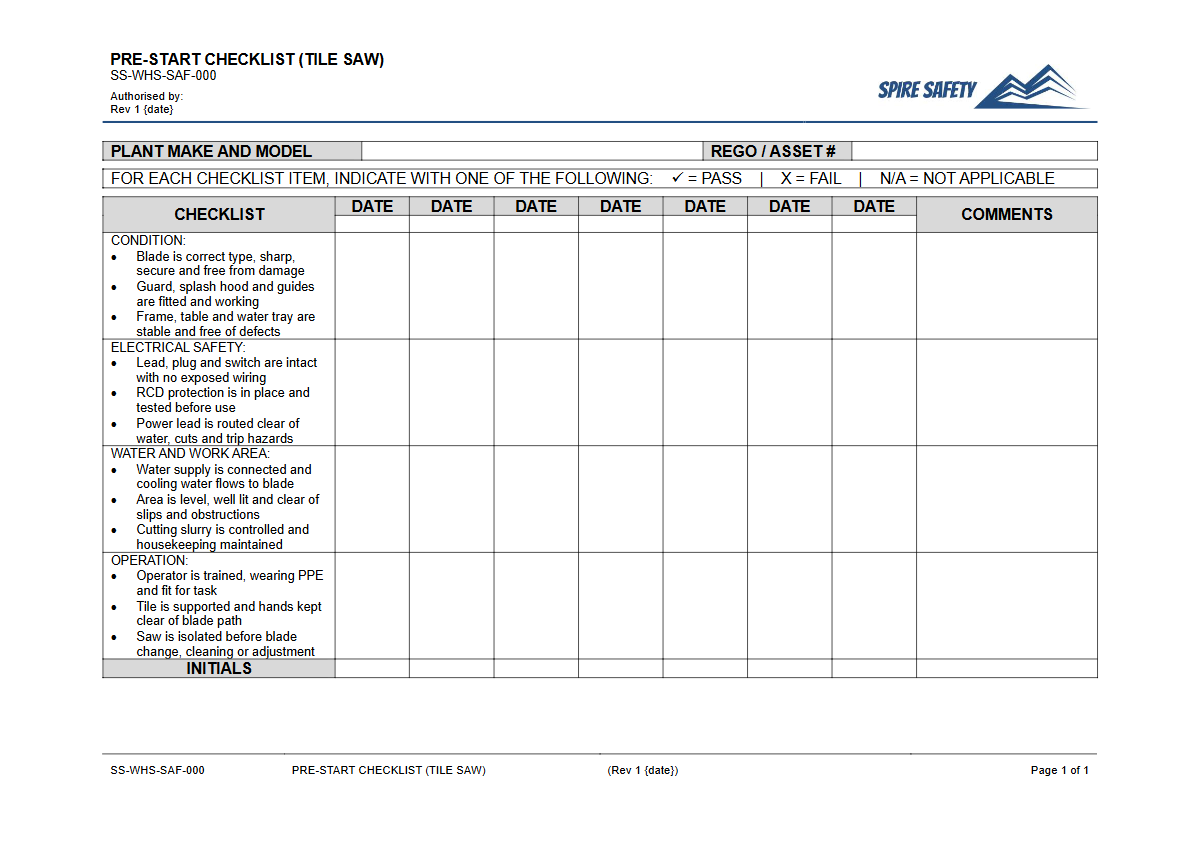
Download our free Pre-Start Checklist for tile saws.
Free Pre-Start Checklist (Tile Saw) Template
DOCX • 125 KB + PDF
Updated Oct 2026
No signup required
Purpose of the Free Pre-Start Checklist (Tile Saw) Template
Using a tile saw, or wet saw, introduces significant risks including deep cuts, electrocution from water and power interaction, and exposure to harmful crystalline silica dust. This Free Pre-Start Checklist (Tile Saw) Template provides a structured framework for operators to conduct thorough safety inspections before commencing work.
Formalising this process helps ensure the equipment is in safe working order, identifying potential faults with the blade, guards, water delivery system, or electrical components before they can cause an incident. A consistent pre-start routine is a fundamental part of a safe system of work, helping to prevent injuries, minimise equipment downtime, and demonstrate due diligence.
Regular inspections can also be discussed during a pre-start checks and plant maintenance toolbox talk to reinforce safety behaviours.
Key Inspection Points on a Tile Saw Pre-Start Checklist
While your customised checklist will vary based on your specific equipment, it should generally cover the following critical areas:
- Blade Condition: Inspecting for cracks, warping, missing teeth, or signs of excessive wear. Ensure the blade is the correct type and size for the material being cut and is securely mounted.
- Guards and Covers: Verifying that all safety guards, particularly the blade guard, are in place, secure, and function correctly.
- Water Delivery System: Checking that the water pump is operational, the reservoir is full, and water flows adequately over the blade to suppress dust and provide cooling.
- Electrical Components: Examining the power cord and plug for damage, cuts, or fraying. If the saw uses a Residual Current Device (RCD), its test button should be checked to ensure it is functional.
- Work Area: Ensuring the area around the saw is clear of trip hazards, is well-lit, and has stable, level footing. The setup should prevent water from pooling near electrical sources.
Similar principles of machine guarding and operational readiness apply to other workshop equipment, as seen in the requirements for a pre-start checklist for a CNC router.
Video walkthrough
How to Use the Free Pre-Start Checklist (Tile Saw) Template
Our template is provided in both DOCX and PDF formats to suit your organisation's needs. Download the file and integrate it into your daily operational procedures by following these steps:
- Customise the Document: Open the DOCX file and adapt the checklist items to match the specific make, model, and features of your tile saw. Add your company branding and any site-specific safety rules.
- Consult with Workers: Involve the operators who use the equipment daily. Their hands-on experience is invaluable for identifying practical inspection points and potential failure modes.
- Train and Implement: Train all relevant personnel on how to complete the checklist correctly. Emphasise that it is a physical inspection, not just a paperwork exercise. An effective pre-start check should be paired with a Verification of Competency for a tile saw to ensure operators are skilled and knowledgeable.
- Store Records: Keep completed checklists as a record of your safety and maintenance activities. These records can be valuable during incident investigations or safety audits.
Please note: This document is a template and is not a complete safety solution on its own. It must be customised by a competent person to suit your specific equipment, tasks, and workplace environment before use.
We do not guarantee this template will meet all of your legal obligations.
When to Use It
A pre-start checklist for a tile saw should be completed:
- At the beginning of each shift: This ensures the equipment is safe before the day's work begins.
- Before each use: If the saw is used intermittently by different operators throughout the day, each user should conduct their own check.
- After maintenance or repairs: Verifying that the equipment has been returned to a safe operational state.
- When moving the saw to a new location: To check for damage that may have occurred during transport.
These checks form one part of a wider WHS management system designed to proactively manage risk.
Who Should Use It
The primary user of the pre-start checklist is the equipment operator. The person performing the work is best placed to assess the immediate condition of the tool they are about to use. Supervisors and Site Managers are also responsible for ensuring these checks are completed consistently and correctly.
They may periodically review completed checklists to monitor compliance and identify recurring maintenance issues. These records are also essential inputs for internal and external WHS compliance audits. Find more helpful documents like this one in our complete free WHS resources library.
Common mistakes
Common mistakes to avoid
- Using a generic checklist without customising it for the specific tile saw model.
- Failing to check the water supply system, leading to excessive dust exposure or blade damage.
- Ignoring 'minor' issues like a frayed power cord or a cracked blade guard.
- "Ticking and flicking" the checklist without physically inspecting each item properly.
Legal references
Legal considerations
The following legal requirements may be relevant to this type of work.
- Work Health and Safety Act (Harmonised) — Provides the primary duties for protecting workers and other people from work health and safety risks.
- Work Health and Safety Regulations (Harmonised) — Sets out requirements supporting the management of workplace hazards and risks.
The following codes may be relevant to this type of work.
- Managing WHS Risks Code of Practice — Provides practical guidance on identifying hazards, assessing risks and applying effective controls.
- Work Health and Safety Consultation, Cooperation and Coordination Code of Practice — Provides practical guidance on consulting workers and coordinating with other duty holders.
- Managing the Work Environment and Facilities Code of Practice — Provides practical guidance on safe work environments, workplace facilities and related controls.
Did you know
Silica Dust Risk
Cutting tiles, stone, and concrete generates respirable crystalline silica dust. An effective water delivery system on a wet tile saw is a primary engineering control used to suppress this dust and help protect workers from silicosis.
Blade Speed Matters
A tile saw blade's RPM (revolutions per minute) rating must equal or exceed the saw's RPM. Using an underrated blade can cause it to shatter during operation, creating a serious projectile hazard.
FAQ
Frequently asked questions
01Is a pre-start checklist for a tile saw legally required in Australia?
02What's the difference between a pre-start check and a SWMS?
03How often should the tile saw's water system be checked?
04Can I use this template on a mobile phone or tablet?
Share this resource
Free Pre-Start Checklist (Tile Saw) Template
Browse Categories
How To Use It
- 1Download and open in Word or PDF.
- 2Replace the placeholders with your business details.
- 3Get it reviewed by a WHS specialist before rollout.
Need it customised?
Our WHS consultants can adapt this template to your site, run a gap analysis, or audit what you already have in place.
Book a Free Consultation WHS consulting servicesor call 1300 156 382