
Free Pre-Start Checklist (Tank Mixer) Template
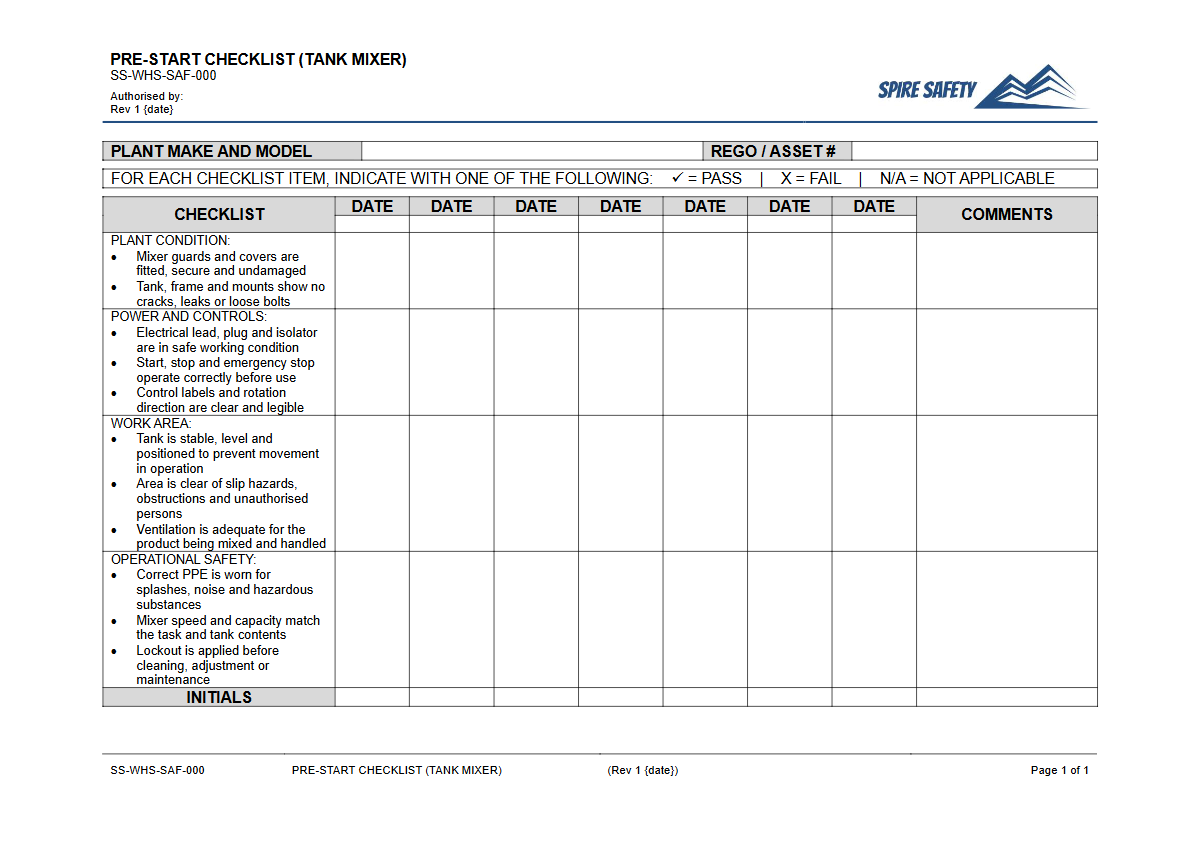
Download our free Pre-Start Checklist (Tank Mixer) Template to formalise daily equipment inspections and manage WHS risks. Get your DOCX and PDF now.
Free Pre-Start Checklist (Tank Mixer) Template
DOCX • 125 KB + PDF
Updated Oct 2026
No signup required
Purpose of the Free Pre-Start Checklist (Tank Mixer) Template
A tank mixer, whether used for chemicals, food products, or construction materials like concrete, presents significant workplace hazards if not properly maintained and inspected. This Free Pre-Start Checklist (Tank Mixer) Template provides a structured framework for operators to conduct consistent, thorough inspections before use.
Regular checks help identify and control risks such as entanglement in rotating parts, chemical exposure from leaks, electrical faults, and structural failures. Formalising this process helps a Person Conducting a Business or Undertaking (PCBU) meet their primary duty of care under Australian WHS laws.
Implementing a pre-start check is a critical risk control measure. It serves as the final practical check before the equipment is energised, ensuring any defects discovered during previous shifts or maintenance have been rectified. For high-risk activities involving mixers, these checks should be documented alongside other safety documents, such as a Safe Work Method Statement (SWMS) for Concrete Truck Operations.
Video walkthrough
How to use the Free Pre-Start Checklist (Tank Mixer) Template
This template is provided as a starting point in both DOCX and PDF formats. Download your preferred version and adapt it to the specific make, model, and application of the tank mixers at your worksite.
It is essential to involve operators and maintenance personnel in the customisation process to ensure the checklist is practical and covers all relevant safety components.
Key steps for implementation:
- Customise: Add or remove checklist items to match your specific tank mixer. Include fields for the operator's name, date, shift, and equipment ID. It is your responsibility to ensure this document is customised to reflect the specific hazards and controls in your workplace.
- Train: Ensure all operators are trained on how to properly complete the checklist and what actions to take if a defect is found.
- Implement: Integrate the checklist into your daily operational procedures. Make it a mandatory step before any operator uses a tank mixer.
- Review: Periodically review the completed checklists to identify recurring faults or trends, which can inform your maintenance schedule and safety improvements.
For related machinery, you may also find our free Pre-Start Checklist (Agitator) Template a useful reference point for developing your site-specific documentation.
When to use it
The Pre-Start Checklist for a Tank Mixer should be completed by the operator before the start of each shift or before the first use of the day. It should also be completed after a change in operator or following any maintenance or repair work to verify the equipment is safe to return to service.
Establishing this routine is fundamental to a proactive safety culture.
Conducting these checks consistently can be reinforced through regular workplace discussions. A Pre-Start Checks and Plant Maintenance Toolbox Talk Template can help you communicate the importance of these procedures to your team and ensure everyone understands their obligations.
Who should use it
The primary user of the checklist is the trained and authorised operator of the tank mixer. They are in the best position to physically inspect the equipment and identify any abnormalities.
Supervisors also have a role in ensuring the checks are being completed correctly and that any reported issues are addressed promptly. They must verify that operators are not only trained but competent in the task.
Assessing operator competence is a key part of a PCBU's duty. A specific tool for this is a Verification of Competency, or VOC.
While this checklist confirms daily readiness, a document like a Verification of Competency (Cement Mixer) Template can be adapted to formally confirm a worker has the skills and knowledge to operate similar mixing equipment safely.
Integrating Checklists into Your WHS Management System
A pre-start checklist is most effective when it is part of a broader safety framework. Simply 'ticking and flicking' without genuine inspection undermines its purpose.
The information gathered from these checks should be used to inform your preventative maintenance program, risk assessments, and training needs analysis.
Integrating this process into your organisation's procedures ensures accountability and continuous improvement. For businesses looking to formalise their safety procedures, Spire Safety offers expert guidance on developing and implementing robust WHS management systems that align with standards like ISO 45001.
To ensure the system is working as intended, periodic reviews are essential. This involves checking that operators are completing the forms correctly and that supervisors are actioning defects.
A formal WHS compliance auditing process can verify that your documented procedures are being followed in practice, providing assurance that your risk controls are effective on the ground. Explore our full free WHS resources library for more templates to support your safety system.
Common mistakes
Common mistakes to avoid
- Ticking boxes without physically inspecting the corresponding component.
- Failing to report minor defects, which can escalate into major failures.
- Using the equipment despite identifying a 'No-Go' fault on the checklist.
- Poor record-keeping, making it difficult to track recurring issues or prove due diligence.
Legal references
Legal considerations
The following legal requirements may be relevant to this type of work.
- Work Health and Safety Act (Harmonised) — Provides the primary duties for protecting workers and other people from work health and safety risks.
- Work Health and Safety Regulations (Harmonised) — Sets out requirements supporting the management of workplace hazards and risks.
The following codes may be relevant to this type of work.
- Managing WHS Risks Code of Practice — Provides practical guidance on identifying hazards, assessing risks and applying effective controls.
- Work Health and Safety Consultation, Cooperation and Coordination Code of Practice — Provides practical guidance on consulting workers and coordinating with other duty holders.
- Managing the Work Environment and Facilities Code of Practice — Provides practical guidance on safe work environments, workplace facilities and related controls.
Did you know
The Hierarchy of Control
Pre-start checklists are an administrative control. They are most effective when used with higher-level controls like engineering (e.g., fixed guarding) and elimination (e.g., removing the need for the hazardous task).
Machine Guarding
According to Safe Work Australia, contact with machinery is a leading cause of serious workplace injuries. A significant portion of these incidents involve missing or inadequate guarding, a key item on any pre-start checklist.
FAQ
Frequently asked questions
01What are the main hazards associated with a tank mixer?
02How often should a tank mixer pre-start check be performed?
03Who is responsible for ensuring pre-start checks are completed?
04Can I use a generic checklist for all my different tank mixers?
Share this resource
Free Pre-Start Checklist (Tank Mixer) Template
Browse Categories
How To Use It
- 1Download and open in Word or PDF.
- 2Replace the placeholders with your business details.
- 3Get it reviewed by a WHS specialist before rollout.
Need it customised?
Our WHS consultants can adapt this template to your site, run a gap analysis, or audit what you already have in place.
Book a Free Consultation WHS consulting servicesor call 1300 156 382