
Free Pre-Start Checklist (Surface Grind) Template
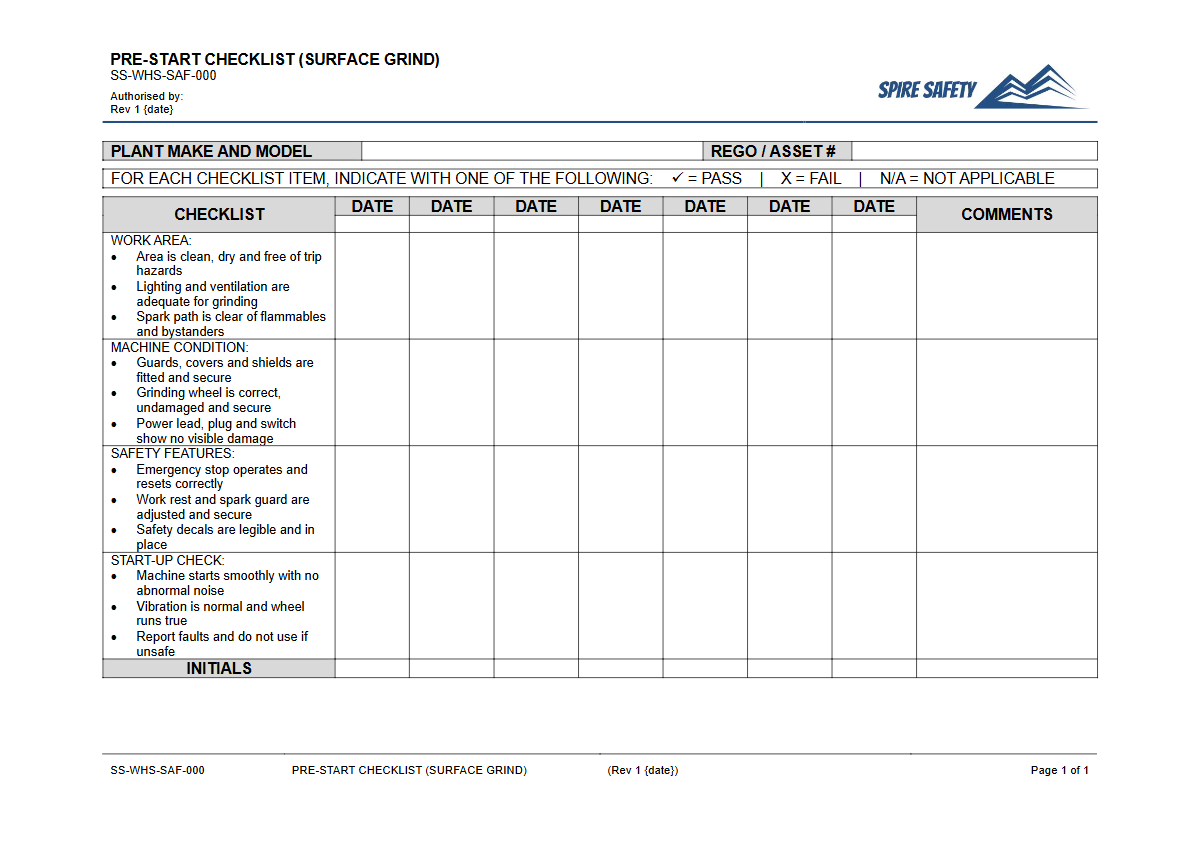
Download our free Pre-Start Checklist for Surface Grinders. This structured template helps formalise daily equipment checks and manage WHS risks.
Free Pre-Start Checklist (Surface Grind) Template
DOCX • 125 KB + PDF
Updated Oct 2026
No signup required
Purpose of the Free Pre-Start Checklist (Surface Grind) Template
Operating a surface grinder involves significant risks, including high-speed rotating parts, wheel disintegration, and potential for serious injury. Implementing a routine inspection process is a critical control measure.
This Free Pre-Start Checklist (Surface Grind) Template provides a structured framework to help your workers systematically inspect the equipment before use. It helps formalise the process of identifying and controlling hazards, ensuring the grinder is in safe working order before any job commences.
Regular use of this checklist creates a consistent record of inspections, which is a key part of demonstrating WHS due diligence and maintaining a safe system of work.
A documented pre-start process helps a Person Conducting a Business or Undertaking (PCBU) meet their primary duty of care under WHS legislation. It ensures that potential faults with guards, emergency stops, or the grinding wheel itself are identified before they can cause harm.
This structured approach is fundamental for any machinery, similar to the checks required for other workshop equipment. For related processes, you might also find value in our Free Pre-Start Checklist for Bench Grinders.
Video walkthrough
How to use the Free Pre-Start Checklist (Surface Grind) Template
This template is designed to be a practical tool for your workshop or factory floor. First, download the document in your preferred format (DOCX for easy editing or PDF).
Next, and most importantly, adapt the checklist to the specific make and model of the surface grinders used in your organisation. This may involve adding or removing checks related to unique features like magnetic chucks, coolant systems, or specific guarding arrangements.
Once customised, train all relevant operators and supervisors on how to complete the checklist correctly and what actions to take if a fault is found (e.g., tag-out procedures).
The completed checklists should be filed as part of your safety records. Regularly reviewing these documents can help identify recurring faults or patterns of wear, feeding valuable information into your maintenance schedules and broader safety management activities.
Integrating such tools into your daily operations is a core component of effective WHS management systems, transforming safety from a reactive task to a proactive habit.
A Note on Customisation
Please note: We have designed this document as a starting-point template, not a finished, universal document. To ensure it is effective, you must customise this checklist to reflect the specific makes, models, and configurations of surface grinders in your workplace.
You should also incorporate your unique operational risks, control measures, and emergency procedures.
When to use it
A surface grinder pre-start checklist should be completed before the machine is used for the first time each day or at the beginning of every shift. This frequency ensures that any damage or faults that may have occurred overnight, during maintenance, or during a previous shift are identified before the machine is put into operation.
It should be treated as a non-negotiable step in the safe operation of the equipment. If a machine is used by multiple operators during a single shift, a handover check may also be a valuable addition to your procedure, ensuring continuous safety oversight.
This proactive inspection is a vital part of managing plant safety throughout its lifecycle, from installation to decommissioning. The principles are similar to those applied to other powerful cutting and shaping equipment, such as those detailed in our Pre-Start Checklist for Floor Saws, where identifying faults early is critical to preventing incidents.
Who should use it
This checklist should be completed by a worker who is trained, competent, and authorised to operate the specific surface grinder. Competence involves more than just knowing how to operate the machine; it includes the ability to recognise potential hazards, understand the function of safety features, and know the correct procedure to follow if a defect is found.
Supervisors or team leaders should also be familiar with the checklist content to effectively oversee its implementation and verify that inspections are being completed diligently.
Periodically, a manager or safety officer should review the completed checklists to ensure the process is working as intended. This review process provides an opportunity for coaching and reinforcement, and can be a valuable input for regular WHS compliance auditing activities, helping to verify that your organisation's procedures are being followed correctly on the ground.
Key Areas Covered in the Checklist
This template prompts the operator to inspect several critical safety components and conditions before starting work. While you must customise it, the core sections focus on:
- Guards & Shields: Verifying that all physical guards (wheel guards, splash guards) are in place, secure, and undamaged.
- Grinding Wheel: A visual check for cracks, chips, or other damage. It also prompts a check to ensure the correct wheel is mounted for the intended job and material.
- Emergency Stops & Controls: Testing the function of all E-stop buttons and ensuring all operational controls are clearly labelled and responsive.
- Work Area: Checking for clear, unobstructed space around the machine, good lighting, and the absence of slip or trip hazards like oil spills or trailing cables.
- Personal Protective Equipment (PPE): Confirming the operator has and is using the required PPE, such as safety glasses or a face shield.
By systematically covering these points, the checklist helps formalise a comprehensive safety check. This structured method is just as important for ancillary equipment as it is for primary production machinery, a principle seen in resources like our Pre-Start Checklist (Granulator) Template. For more tools and templates, you can browse our complete free WHS resources library.
Common mistakes
Common mistakes to avoid
- Failing to check grinding wheel condition for cracks, chips, or signs of wear before use.
- Operating the grinder with wheel guards or other safety shields removed or improperly adjusted.
- Using a grinding wheel that is not rated for the machine's RPM or is unsuitable for the material being ground.
- Neglecting to wear appropriate personal protective equipment (PPE), especially impact-rated eye and face protection.
Legal references
Legal considerations
The following legal requirements may be relevant to this type of work.
- Work Health and Safety Act (Harmonised) — Provides the primary duties for protecting workers and other people from work health and safety risks.
- Work Health and Safety Regulations (Harmonised) — Sets out requirements supporting the management of workplace hazards and risks.
The following codes may be relevant to this type of work.
- Managing WHS Risks Code of Practice — Provides practical guidance on identifying hazards, assessing risks and applying effective controls.
- Work Health and Safety Consultation, Cooperation and Coordination Code of Practice — Provides practical guidance on consulting workers and coordinating with other duty holders.
- Managing the Work Environment and Facilities Code of Practice — Provides practical guidance on safe work environments, workplace facilities and related controls.
Did you know
Wheel Speed
The periphery of a standard grinding wheel can travel at speeds of over 3,000 metres per minute. A small, undetected crack can lead to catastrophic failure at these velocities.
The Ring Test
Before mounting a new vitrified grinding wheel, competent persons perform a 'ring test' by tapping it gently with a non-metallic object. A clear, metallic ring indicates the wheel is likely free of cracks, while a dull thud suggests it may be damaged and unsafe to use.
FAQ
Frequently asked questions
01Why is a pre-start check necessary for a surface grinder?
02What are the main hazards associated with surface grinders?
03How often should surface grinder pre-start checks be done?
04Does using this template guarantee WHS compliance?
Share this resource
Free Pre-Start Checklist (Surface Grind) Template
Browse Categories
How To Use It
- 1Download and open in Word or PDF.
- 2Replace the placeholders with your business details.
- 3Get it reviewed by a WHS specialist before rollout.
Need it customised?
Our WHS consultants can adapt this template to your site, run a gap analysis, or audit what you already have in place.
Book a Free Consultation WHS consulting servicesor call 1300 156 382