
Free Pre-Start Checklist (Surface Planer) Template
Download our free Pre-Start Checklist for Surface Planers. This DOCX & PDF template helps formalise safety checks for woodworking machinery. Get yours now.
Free Pre-Start Checklist (Surface Planer) Template
DOCX • 125 KB + PDF
Updated Oct 2026
No signup required
Purpose of the Free Pre-Start Checklist (Surface Planer) Template
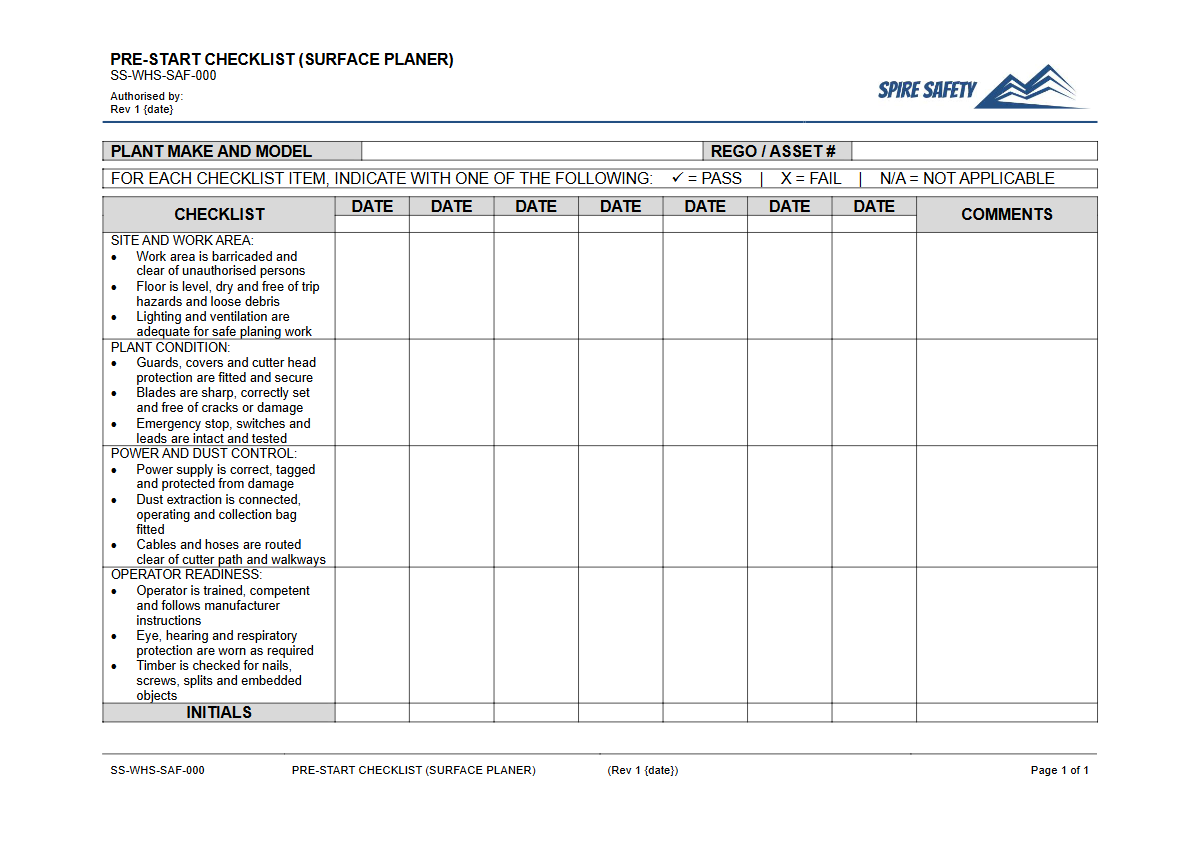
Operating a surface planer, also known as a jointer, presents significant workplace hazards, primarily from the high-speed rotating cutterhead. This Free Pre-Start Checklist (Surface Planer) Template provides a structured framework for operators to conduct essential safety inspections before use.
Systematically verifying the condition of the machine helps identify and control risks like blade contact, kickback, electrical faults, and excessive noise or dust exposure. Using a standardised checklist ensures that critical safety features, such as guards and emergency stops, are functional every time, reducing the likelihood of incidents and injuries.
This document is designed as a practical tool to support your organisation's plant safety procedures. It promotes a proactive safety culture by embedding routine checks into daily operations.
While the principles are similar, the specific inspection points for a planer are quite different from those you would find in a pre-start checklist for a CNC router, highlighting the need for equipment-specific documentation. Consistent use helps maintain a reliable record of plant condition, which is a key part of any robust plant safety program, a topic further explored in our Pre-Start Checks and Plant Maintenance toolbox talk.
Video walkthrough
How to use the Free Pre-Start Checklist (Surface Planer) Template
This template is a starting point for developing a checklist tailored to your specific workplace. Before implementation, a competent person should review and customise it to reflect the exact make and model of the surface planers in use, your site-specific hazards, and any unique operational requirements.
The checklist should be completed by the operator before the first use of the planer on their shift.
Each item on the list requires a physical and visual check. The operator should inspect the component, assess its condition, and tick it off.
If any defects, damage, or faults are identified, the machine must be immediately taken out of service, tagged appropriately, and reported to a supervisor for repair. The process should be clear and simple, promoting diligent checks rather than a 'tick and flick' exercise. The completed checklists should be filed as a record of your safety diligence and to integrate with your broader WHS management system.
A Note on Customisation
This is a template, not a finished document. We have no way of knowing your specific equipment, processes, or workplace risks.
You MUST customise this document to suit your organisation's needs. Incorporate details about your specific surface planer models, reference your internal safe work procedures, and add any other inspection points identified in your risk assessments.
This ensures the final checklist is relevant and effective for your operators.
When to use it
A pre-start checklist for a surface planer should be completed at the beginning of every shift or before the first use of the machine each day. It is a pre-operational check, meaning it must be done before any power is supplied to the machine for work purposes (though power may be needed to test functions like the emergency stop).
It should also be used after any maintenance or repair work to verify the machine is safe to return to service.
These routine checks are a fundamental part of ongoing plant risk management. They are not a substitute for scheduled preventative maintenance, but they act as a crucial first line of defence against equipment failure.
The effectiveness of these checks and the associated records can be periodically verified through WHS compliance auditing to ensure the safety system is functioning as intended.
Who should use it
The pre-start checklist should be completed by the person operating the surface planer. Operators must be trained and competent not only in the machine's use but also in how to properly conduct the pre-start inspection.
They need to understand what each item on the checklist means and what constitutes a 'pass' or 'fail'. Supervisors and managers are responsible for ensuring these checks are being completed correctly and for taking action when faults are reported.
The information gathered is valuable for Health and Safety Representatives (HSRs), maintenance personnel, and management for monitoring the condition and safety of workplace plant. Key findings and reminders about the importance of these checks are often discussed during daily toolbox talks or documented with pre-start meeting documentation. For more tools to support your safety processes, you can explore our complete free WHS resources library.
Common mistakes
Common mistakes to avoid
- Ignoring the condition of the spring-loaded cutterhead guard, leaving it stuck or damaged.
- Failing to check that appropriate push blocks or pads are available and in good condition.
- Overlooking the dust extraction system, leading to poor performance and hazardous dust exposure.
- Completing the checklist from memory without physically inspecting each component on the machine.
Legal references
Legal considerations
The following legal requirements may be relevant to this type of work.
- Work Health and Safety Act (Harmonised) — Provides the primary duties for protecting workers and other people from work health and safety risks.
- Work Health and Safety Regulations (Harmonised) — Sets out requirements supporting the management of workplace hazards and risks.
The following codes may be relevant to this type of work.
- Managing WHS Risks Code of Practice — Provides practical guidance on identifying hazards, assessing risks and applying effective controls.
- Work Health and Safety Consultation, Cooperation and Coordination Code of Practice — Provides practical guidance on consulting workers and coordinating with other duty holders.
- Managing the Work Environment and Facilities Code of Practice — Provides practical guidance on safe work environments, workplace facilities and related controls.
Did you know
Incredible Speed
The cutterhead on a typical surface planer can spin at speeds between 4,000 and 5,000 RPM. This high velocity is what allows for a smooth finish on the wood but also makes contact incredibly dangerous.
Wood Dust Dangers
Wood dust is not just a nuisance; it's a health hazard classified as a carcinogen. An effective dust extraction system, a key item on any pre-start checklist, is vital for protecting workers' respiratory health.
FAQ
Frequently asked questions
01What are the main hazards of a surface planer?
02Why is a pre-start check necessary for a surface planer?
03Can I use a generic plant checklist for a surface planer?
04How often should pre-start checks be completed for a surface planer?
Share this resource
Free Pre-Start Checklist (Surface Planer) Template
Browse Categories
How To Use It
- 1Download and open in Word or PDF.
- 2Replace the placeholders with your business details.
- 3Get it reviewed by a WHS specialist before rollout.
Need it customised?
Our WHS consultants can adapt this template to your site, run a gap analysis, or audit what you already have in place.
Book a Free Consultation WHS consulting servicesor call 1300 156 382