
Free Pre-Start Checklist (Suction Unit) Template
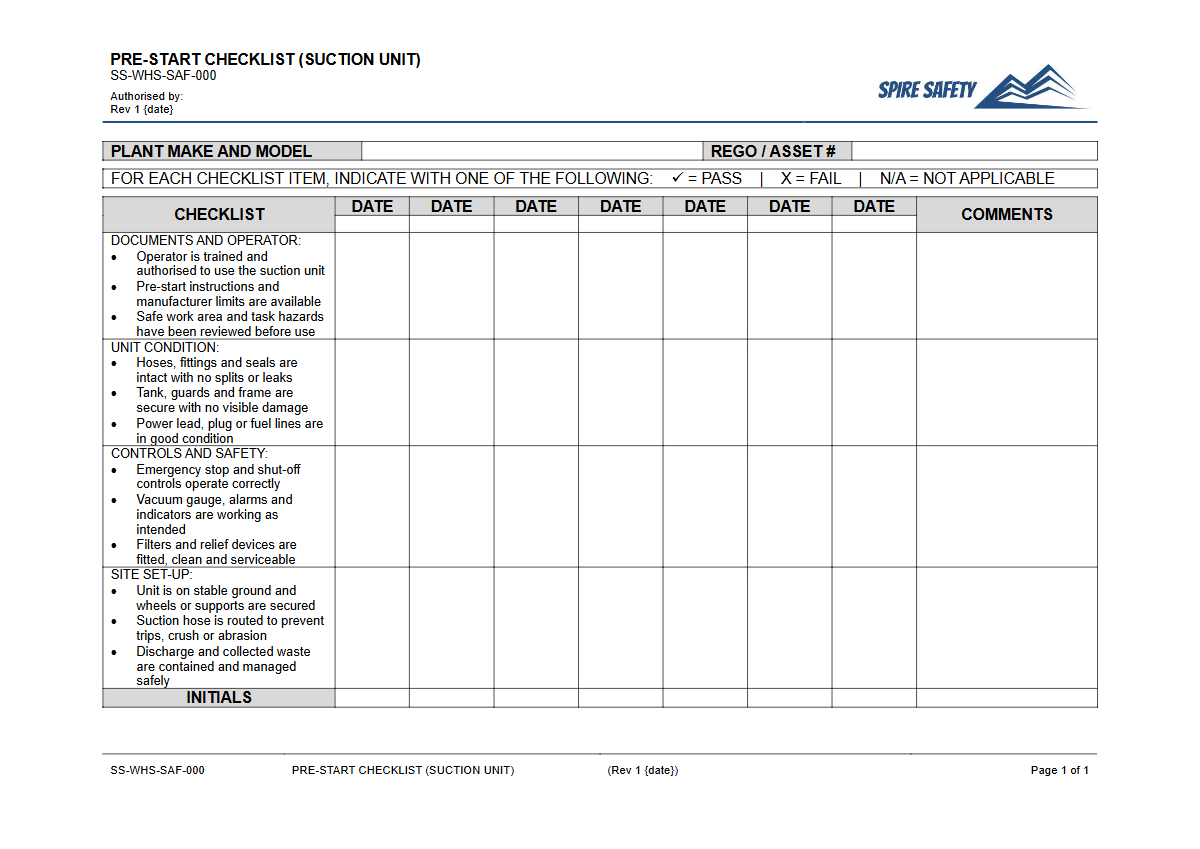
Download our free Pre-Start Checklist for Suction Units. This DOCX and PDF template helps formalise daily equipment safety checks and identify hazards.
Free Pre-Start Checklist (Suction Unit) Template
DOCX • 125 KB + PDF
Updated Oct 2026
No signup required
Purpose of the Free Pre-Start Checklist (Suction Unit) Template
Using a structured checklist before operating high-risk plant is a fundamental safety practice. This free Pre-Start Checklist (Suction Unit) Template provides a documented framework to help operators identify and control potential hazards before they cause an incident.
Regularly completing a pre-start check helps prevent unexpected equipment failure, ensures critical safety features are functional, and creates a formal record of daily inspections.
Regular pre-start checks are a critical component of comprehensive WHS management systems, demonstrating proactive risk management and a commitment to workplace safety. The template is aligned with Australian WHS principles and provides a structured starting point for inspecting key components such as hoses, nozzles, vacuum pumps, filters, fluid levels, and emergency stop mechanisms.
By identifying defects or maintenance needs early, organisations can take corrective action before a minor issue escalates into a serious breakdown or safety event. Findings from these checks can also provide valuable content for a Pre-Start Checks and Plant Maintenance Toolbox Talk, reinforcing safe work habits across the entire team.
Video walkthrough
How to use the Free Pre-Start Checklist (Suction Unit) Template
This resource is available for download in both DOCX and PDF formats. The DOCX version is fully editable, allowing your organisation to adapt the checklist to your specific operational needs.
The PDF version can be used for immediate printing and implementation once you are satisfied with your customised checklist.
Before implementation, you must review and customise the template to reflect the specific make, model, and configuration of the suction unit(s) used in your workplace. Consider adding or removing items based on the manufacturer’s instructions and the unique hazards of your work environment. For complex operations involving mobile plant, this checklist should be used alongside other risk assessment documents, such as a Safe Work Method Statement (SWMS) for Concrete Truck Operations.
Please note: We provide this template as a starting point. It is your organisation's responsibility to ensure the final document is customised to your specific plant, operational context, and legal obligations under WHS legislation.
When to use it
A pre-start checklist for a suction unit should be completed by the operator before the first use of the equipment on every shift. This routine ensures that the machine's condition is verified daily.
The checklist should also be used after significant maintenance or repairs, before the equipment is hired out, or when it is relocated to a new site with different operating conditions.
Completing this form creates a daily log of the equipment's condition, which is invaluable for tracking maintenance trends and demonstrating due diligence. The process can be integrated into team briefings, such as those documented using a template for daily pre-start meetings, to ensure all relevant personnel are aware of the equipment's operational status.
Completed checklists also serve as crucial evidence during internal or external WHS compliance audits, showing that systematic safety checks are an embedded part of your operations. If any 'fail' items are noted, the equipment must be tagged out of service and not used until the issue is rectified by a qualified person.
Who should use it
The pre-start checklist should be completed by the competent and authorised operator of the suction unit. This is the person with the most hands-on knowledge of the equipment's normal operating state.
Supervisors and managers also have a role in reviewing completed checklists to identify recurring faults, ensure corrective actions are taken promptly, and verify that the inspection process is being followed correctly.
Only workers who have been trained and deemed competent in the safe operation of the specific suction unit should be authorised to conduct the pre-start check and use the machinery. This document is designed for suction units, but the same principles apply to other machinery; for example, a pre-start checklist for an Air Handler would follow a similar process but cover different components.
By formalising equipment inspections with a dedicated checklist, your organisation can significantly reduce the risk of incidents and improve overall plant safety. To further strengthen your safety framework, explore our extensive free WHS resources library for more templates to support your management system.
Common mistakes
Common mistakes to avoid
- Failing to physically check hoses and couplings for cracks, abrasion, and secure connections.
- Ignoring filter condition or vacuum tank level indicators, leading to poor performance or damage.
- Neglecting to test the functionality of the emergency stop button and other safety cut-offs.
- Using a generic checklist without customising it for the specific make and model of the suction unit.
Legal references
Legal considerations
The following legal requirements may be relevant to this type of work.
- Work Health and Safety Act (Harmonised) — Provides the primary duties for protecting workers and other people from work health and safety risks.
- Work Health and Safety Regulations (Harmonised) — Sets out requirements supporting the management of workplace hazards and risks.
The following codes may be relevant to this type of work.
- Managing WHS Risks Code of Practice — Provides practical guidance on identifying hazards, assessing risks and applying effective controls.
- Work Health and Safety Consultation, Cooperation and Coordination Code of Practice — Provides practical guidance on consulting workers and coordinating with other duty holders.
- Managing the Work Environment and Facilities Code of Practice — Provides practical guidance on safe work environments, workplace facilities and related controls.
Did you know
Non-Destructive Digging
High-powered suction units are the core component of hydro-excavation trucks, a method of non-destructive digging. This technique uses pressurised water and a powerful vacuum to safely excavate soil around sensitive underground utilities.
Hose Hazards
A damaged or improperly secured suction hose can whip around violently if it detaches or fails under pressure. This is a major hazard, making hose and coupling inspections a critical part of every pre-start check.
FAQ
Frequently asked questions
01What is the purpose of a suction unit pre-start checklist?
02How often should a suction unit pre-start inspection be completed?
03Who is responsible for completing the suction unit pre-start check?
04Can this template be used for different types of suction units?
Share this resource
Free Pre-Start Checklist (Suction Unit) Template
Browse Categories
How To Use It
- 1Download and open in Word or PDF.
- 2Replace the placeholders with your business details.
- 3Get it reviewed by a WHS specialist before rollout.
Need it customised?
Our WHS consultants can adapt this template to your site, run a gap analysis, or audit what you already have in place.
Book a Free Consultation WHS consulting servicesor call 1300 156 382