
Free Pre-Start Checklist (Sump Pump) Template
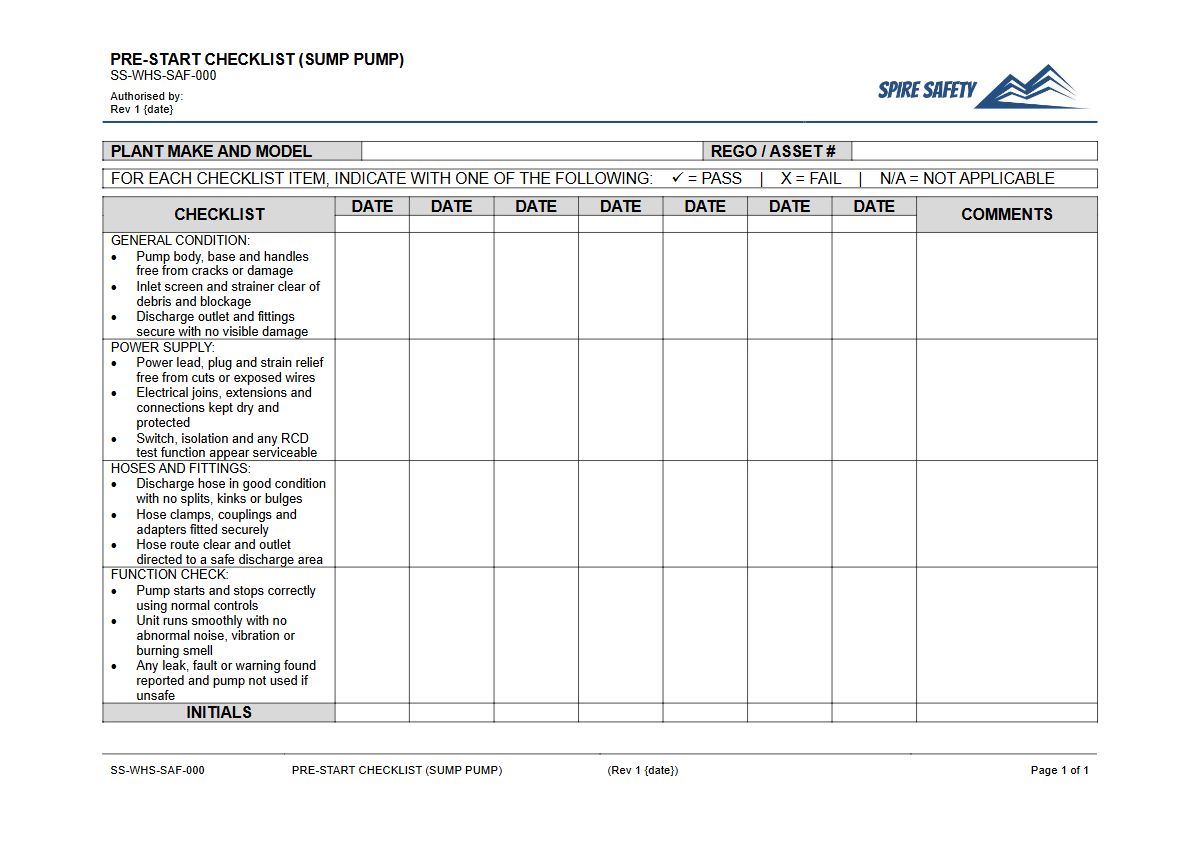
Formalise your equipment inspections with our Free Pre-Start Checklist (Sump Pump) Template. Download the DOCX and PDF to manage WHS risks effectively.
Free Pre-Start Checklist (Sump Pump) Template
DOCX • 125 KB + PDF
Updated Oct 2026
No signup required
Purpose of the Free Pre-Start Checklist (Sump Pump) Template
Regularly inspecting equipment is a fundamental requirement of Australian workplace safety laws. This Free Pre-Start Checklist (Sump Pump) Template provides a structured format for operators to verify that a sump pump is safe and ready for use before it is switched on.
Sump pumps are critical for preventing flooding and water damage in basements, construction sites, and excavations. A failure can lead to significant property damage, operational delays, and potential electrical or slip hazards.
Using a formal checklist helps ensure key components like the float switch, power source, and discharge lines are checked consistently, reducing the risk of unexpected failure.
Implementing documented pre-start checks is a practical way for a Person Conducting a Business or Undertaking (PCBU) to meet their primary duty of care. It provides evidence that steps are being taken to provide and maintain safe plant and equipment.
These daily records form an essential part of robust WHS management systems, demonstrating proactive risk management and creating a paper trail for maintenance and compliance activities.
How to use the Free Pre-Start Checklist (Sump Pump) Template
Download the template in your preferred format (DOCX for easy editing or PDF for straightforward printing) and integrate it into your daily operational procedures. The checklist guides the operator through a logical inspection sequence, covering the pump's physical condition, electrical safety, operational controls, and the surrounding work area.
Operators should tick off each item as they inspect it, noting any faults or concerns in the comments section. Any identified defects must be reported immediately according to your organisation's procedures, and the pump should be tagged out of service until it is repaired and deemed safe.
Important: This document is a template and must be customised. We have provided a solid foundation based on common safety practices, but you must adapt it to suit the specific make and model of your sump pump, its operating environment (e.g., construction site vs.
permanent building installation), and your internal safe work procedures. Always consult the manufacturer's operating manual for specific inspection and maintenance requirements. While this checklist covers sump pumps, other specialised equipment requires its own specific checks, such as our Pre-Start Checklist (Fire Pump) Template.
Video walkthrough
When to use it
A sump pump pre-start checklist should be completed before its first use on any given day or shift. It is also wise to conduct a check after the pump has been moved to a new location, following any maintenance or repair work, or after a long period of inactivity.
For pumps in critical flood-prevention roles, conducting checks before a forecasted heavy rainfall event is a crucial proactive measure. The goal is to identify potential issues before the pump is relied upon, not after it has failed to operate.
The frequency of checks can be adjusted based on a risk assessment. For example, a portable dewatering pump on a busy construction site may require more rigorous checks than a permanently installed pump in a clean, dry basement.
Similar principles apply to other machinery, and our free Pre-Start Checklist for Cooling Pumps offers another example of equipment-specific inspection routines.
Who should use it
The primary user of this checklist is the worker or operator tasked with setting up and running the sump pump. They are in the best position to conduct a hands-on inspection of the equipment they are about to use.
It is vital that these operators are trained and competent not only in using the pump but also in understanding what they are checking for during the pre-start inspection.
Supervisors and managers should use the completed checklists to verify that safety procedures are being followed and to monitor the condition of the equipment over time. Patterns of recurring faults can indicate a need for scheduled maintenance or equipment replacement.
These records are also valuable during WHS compliance audits as evidence of a functioning safety process. Finding the right template for your needs is easy in our free WHS resources library, which covers a wide range of plant and equipment.
Common mistakes
Common mistakes to avoid
- Failing to test the float switch manually, assuming it will work.
- Ignoring small nicks or damage to the power cord, which can pose a serious electrical hazard in wet conditions.
- Forgetting to check that the discharge pipe outlet is clear and directs water away from the foundation.
- Skipping pre-start checks during dry seasons, leading to the pump seizing from inactivity when it's finally needed.
Legal references
Legal considerations
The following legal requirements may be relevant to this type of work.
- Work Health and Safety Act (Harmonised) — Provides the primary duties for protecting workers and other people from work health and safety risks.
- Work Health and Safety Regulations (Harmonised) — Sets out requirements supporting the management of workplace hazards and risks.
The following codes may be relevant to this type of work.
- Managing WHS Risks Code of Practice — Provides practical guidance on identifying hazards, assessing risks and applying effective controls.
- Work Health and Safety Consultation, Cooperation and Coordination Code of Practice — Provides practical guidance on consulting workers and coordinating with other duty holders.
- Managing the Work Environment and Facilities Code of Practice — Provides practical guidance on safe work environments, workplace facilities and related controls.
Did you know
Float Switch Failure
The single most common reason for sump pump failure is a stuck or faulty float switch. This is why manually testing its movement and activation is a critical step in any pre-start check.
Discharge Line Dangers
A sump pump can move hundreds of litres of water per minute. If the discharge line is blocked, kinked, or frozen, the back-pressure can cause the motor to burn out or pipes to burst.
FAQ
Frequently asked questions
01How often should a sump pump pre-start check be done?
02What are the most critical items to check on a sump pump?
03What should an operator do if they find a fault during the pre-start inspection?
04Is this sump pump checklist a legal document?
Share this resource
Free Pre-Start Checklist (Sump Pump) Template
Browse Categories
How To Use It
- 1Download and open in Word or PDF.
- 2Replace the placeholders with your business details.
- 3Get it reviewed by a WHS specialist before rollout.
Need it customised?
Our WHS consultants can adapt this template to your site, run a gap analysis, or audit what you already have in place.
Book a Free Consultation WHS consulting servicesor call 1300 156 382