
Free Pre-Start Checklist (Stud Welder) Template
Download our Free Pre-Start Checklist for Stud Welders.
Free Pre-Start Checklist (Stud Welder) Template
DOCX • 125 KB + PDF
Updated Oct 2026
No signup required
Purpose of the Free Pre-Start Checklist (Stud Welder) Template
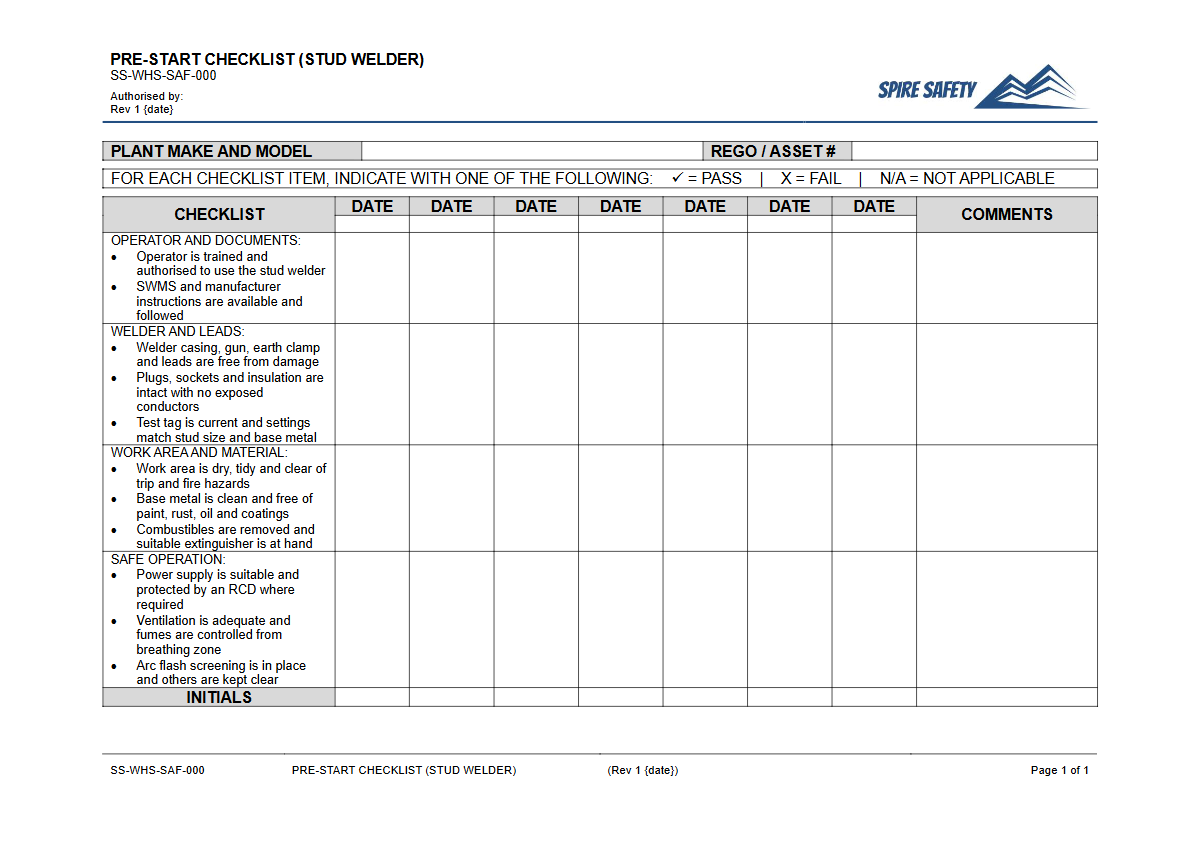
Operating a stud welder involves significant electrical and thermal energy, making diligent safety checks non-negotiable. This Free Pre-Start Checklist (Stud Welder) Template provides a structured framework for operators to inspect equipment before use, identifying potential faults or hazards that could lead to injury, equipment damage, or poor-quality welds.
Regular pre-start inspections are a fundamental part of a proactive safety culture and a key requirement under Australian WHS regulations for managing risks associated with plant and equipment. By formalising this process, organisations can systematically reduce the risk of electric shock, burns, and other workshop incidents.
Using a documented checklist helps ensure that no critical safety item is overlooked. It creates a consistent inspection routine across all shifts and operators, providing a clear record of due diligence.
This documentation can be invaluable during safety audits, incident investigations, or when reviewing maintenance schedules. Integrating such checks into your daily operations is a core component of robust WHS management systems, demonstrating a commitment to worker safety and operational excellence.
Video walkthrough
How to use the Free Pre-Start Checklist (Stud Welder) Template
This resource is available as a DOCX file for easy customisation and a PDF for immediate use. After downloading, you should adapt the checklist to suit your specific workplace needs.
The checklist prompts operators to inspect key components such as the power source, welding gun, control unit, cables, connectors, and the crucial earthing clamp. It also includes checks for the work area, ensuring it is free from trip hazards, flammable materials, and has adequate ventilation.
Important: This document is a template and must be customised. For the checklist to be effective, we recommend you modify it to reflect the specific makes and models of stud welders in use at your facility, your unique site conditions, and the specific tasks being performed.
A generic checklist may not cover all potential hazards. A well-defined safety process also includes clear instructions, which can be formalised using a Mig Welder Safe Operating Procedure (SOP) as a reference for creating your own welding procedures.
When to use it
A pre-start checklist for a stud welder should be completed before every use or, at a minimum, at the beginning of each shift where the equipment is expected to be used. The goal is to catch issues before the equipment is energised and put under load.
It is a preventative tool, not a reactive one. If the equipment has been idle for an extended period, moved to a new location, or has recently undergone maintenance, completing a pre-start check is essential to verify its safe operational status.
This routine can be reinforced through regular workplace communication. Discussing the importance of these checks and reviewing findings can be an effective topic for a Pre-Start Checks and Plant Maintenance toolbox talk, helping to embed the behaviour into your team's daily habits.
Who should use it
This checklist is designed primarily for the competent and authorised operators of the stud welding equipment. They are the individuals with the hands-on knowledge to identify abnormalities and are the most at risk if the equipment is faulty.
Supervisors should also use the checklist to verify that inspections are being completed correctly and to review any reported faults. Maintenance personnel may also reference the completed checklists to identify recurring issues that could indicate a need for more intensive servicing or component replacement.
Beyond daily checks, verifying an operator's ability to use equipment safely is a critical WHS duty. For related welding processes, a document like our Verification of Competency (TIG Welder) template can be adapted to assess and record operator skill.
Similar principles apply across different equipment; for instance, a Pre-Start Checklist for Air Arc equipment would follow a similar logic but be tailored to that specific tool's hazards. For a comprehensive review of your safety processes, engaging professional help for a WHS compliance auditing service can identify gaps and opportunities for improvement across all your plant and equipment procedures.
Common mistakes
Common mistakes to avoid
- Skipping the pre-start check entirely to save time, especially on urgent jobs.
- Using a generic checklist that doesn't cover the specific controls and features of the stud welder model.
- Noticing a minor fault, like a frayed cable or cracked connector, but failing to report it or tag the equipment out of service.
- Performing a 'tick and flick' exercise without physically inspecting each item on the checklist.
Legal references
Legal considerations
The following legal requirements may be relevant to this type of work.
- Work Health and Safety Act (Harmonised) — Provides the primary duties for protecting workers and other people from work health and safety risks.
- Work Health and Safety Regulations (Harmonised) — Sets out requirements supporting the management of workplace hazards and risks.
The following codes may be relevant to this type of work.
- Managing WHS Risks Code of Practice — Provides practical guidance on identifying hazards, assessing risks and applying effective controls.
- Work Health and Safety Consultation, Cooperation and Coordination Code of Practice — Provides practical guidance on consulting workers and coordinating with other duty holders.
- Managing the Work Environment and Facilities Code of Practice — Provides practical guidance on safe work environments, workplace facilities and related controls.
Did you know
A Spark of Invention
The Drawn Arc stud welding process was invented in 1936 at the New York Navy Yard. It was developed to attach wood decking over a metal base without creating holes through the metal plate, a significant innovation in shipbuilding.
The Power of a Good Earth
A faulty or loose earth connection in a stud welding circuit can increase electrical resistance, generating excess heat that can damage the clamp, cable, and even the welding machine itself.
FAQ
Frequently asked questions
01What is the difference between a pre-start checklist and a Safe Operating Procedure (SOP)?
02How often should a stud welder be formally inspected and tested?
03Can I use this checklist for any brand of stud welder?
04Why is checking the earthing (ground) clamp so important?
Share this resource
Free Pre-Start Checklist (Stud Welder) Template
Browse Categories
How To Use It
- 1Download and open in Word or PDF.
- 2Replace the placeholders with your business details.
- 3Get it reviewed by a WHS specialist before rollout.
Need it customised?
Our WHS consultants can adapt this template to your site, run a gap analysis, or audit what you already have in place.
Book a Free Consultation WHS consulting servicesor call 1300 156 382