
Free Pre-Start Checklist (Stick Welder) Template
Download our free Pre-Start Checklist (Stick Welder) Template. This DOCX & PDF resource helps formalise daily safety checks to manage WHS risks.
Free Pre-Start Checklist (Stick Welder) Template
DOCX • 125 KB + PDF
Updated Oct 2026
No signup required
Purpose of the Free Pre-Start Checklist (Stick Welder) Template
Using a stick welder, also known as a Manual Metal Arc Welder (MMAW), involves significant risks, including electric shock, severe burns, radiation exposure, and fire. This Free Pre-Start Checklist (Stick Welder) Template provides a structured framework for operators to inspect equipment before use, helping to identify and control hazards before they cause an incident.
Formalising these checks is a fundamental part of managing WHS obligations related to plant and equipment.
By systematically reviewing the welder, its components, and the surrounding work area, you create a safer environment for the operator and others nearby. This document serves as a practical tool to support your safe work procedures, providing a clear record that inspections have been completed.
Integrating such processes is a key component of a robust WHS management system, demonstrating proactive risk management.
Video walkthrough
How to use the Free Pre-Start Checklist (Stick Welder) Template
This template is designed for ease of use. First, download the file in your preferred format (DOCX for easy customisation or PDF for printing).
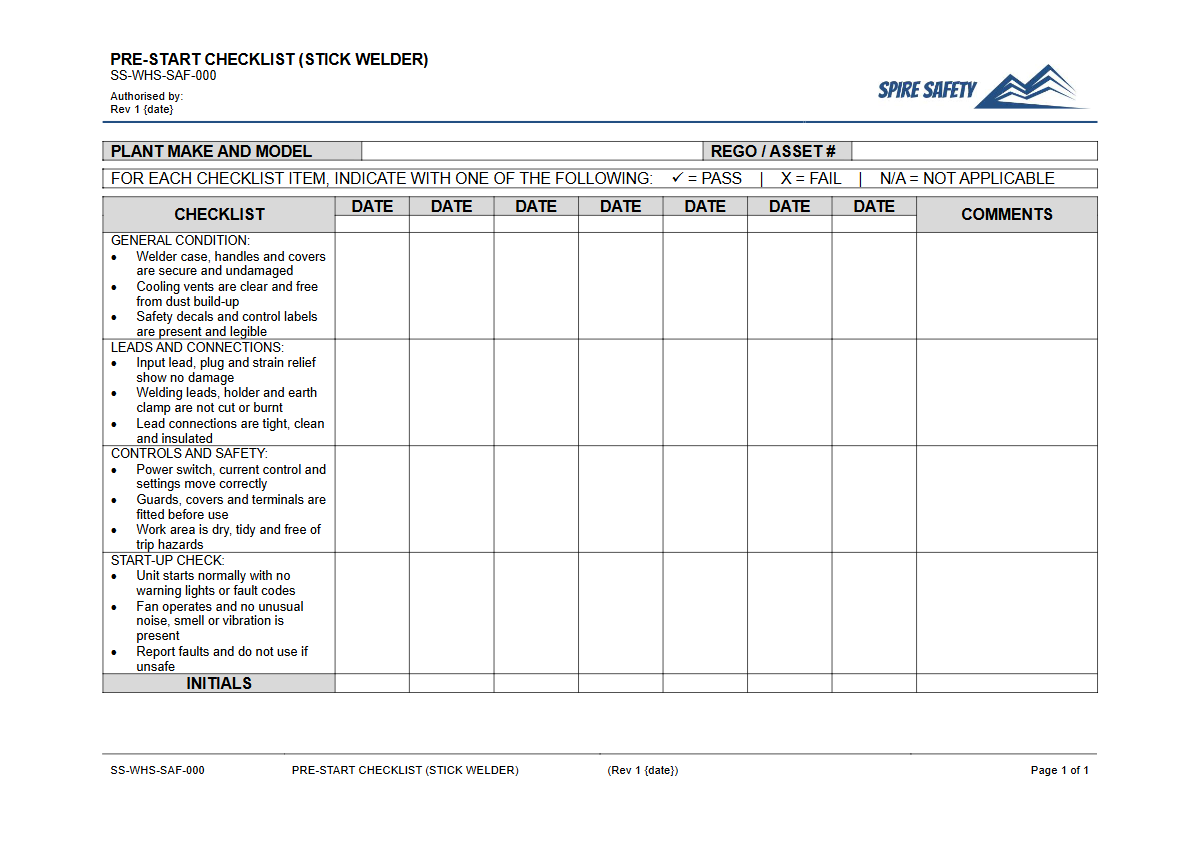
The checklist guides the user through a logical inspection sequence, covering critical safety items from personal protective equipment (PPE) to the physical condition of the welder and its leads.
Key inspection areas include:
- Work Area: Checking for flammable materials, adequate ventilation, and clear access/egress.
- Personal Protective Equipment (PPE): Ensuring the operator has and uses the correct welding helmet, gloves, and fire-retardant clothing.
- Welder Unit: Inspecting the casing, controls, and connections for damage or defects.
- Welding Leads & Connections: A critical check for frayed or damaged insulation on the electrode and work leads, and ensuring secure connections.
- Electrode Holder & Work Clamp: Verifying that the holder is fully insulated and the clamp provides a strong, clean connection.
IMPORTANT: This document is a template. We provide it as a starting point.
You must customise it to reflect the specific make and model of your stick welder, your unique workplace environment, specific tasks, and relevant Australian Standards. For example, if your welding operations produce significant fumes, you should also integrate checks from a fume cabinet pre-start checklist or similar ventilation inspection process.
When to use the Pre-Start Checklist
A pre-start inspection should be completed by the operator before every use or, at a minimum, at the beginning of each shift. Equipment condition can change overnight or between uses due to damage, wear and tear, or interference.
A quick but thorough check ensures the welder remains in a safe, operational state and prevents the use of faulty equipment.
Regularly completing this checklist helps build a culture of safety-consciousness where operators take ownership of their equipment's condition. If you need assistance embedding these types of checks into your daily operations, consider engaging specialist WHS consulting to help streamline your procedures.
Who should use the Pre-Start Checklist
The primary user of this checklist should be the person operating the stick welder. They have the most hands-on interaction with the equipment and are best placed to notice subtle changes or developing faults.
Competency is crucial; the operator must be trained and experienced enough to understand what they are looking for and to recognise when an item does not meet a safe standard.
Supervisors and managers also have a role. They are responsible for ensuring these checks are being carried out correctly and consistently.
They should periodically review completed checklists to identify recurring faults, which may signal a need for equipment replacement or improved maintenance schedules. These records are often reviewed during WHS compliance audits as evidence of a functioning safety system.
This checklist is one of many tools used to manage workshop safety. For consistency, similar checks should be implemented for all high-risk plant.
For instance, you might use a specific pre-start checklist for a bench grinder or other common workshop machinery. You can explore our extensive library of free WHS resources to find other templates to support your safety program.
Common mistakes
Common mistakes to avoid
- Ignoring frayed, cracked, or damaged insulation on welding leads.
- Performing checks from memory instead of using a formal, documented checklist.
- Failing to thoroughly inspect the work area for flammable or combustible materials before starting.
- Not ensuring the work clamp has a clean, solid, and direct connection to the workpiece, leading to poor performance and potential arcing.
Legal references
Legal considerations
The following legal requirements may be relevant to this type of work.
- Work Health and Safety Act (Harmonised) — Provides the primary duties for protecting workers and other people from work health and safety risks.
- Work Health and Safety Regulations (Harmonised) — Sets out requirements supporting the management of workplace hazards and risks.
The following codes may be relevant to this type of work.
- Managing WHS Risks Code of Practice — Provides practical guidance on identifying hazards, assessing risks and applying effective controls.
- Work Health and Safety Consultation, Cooperation and Coordination Code of Practice — Provides practical guidance on consulting workers and coordinating with other duty holders.
- Managing the Work Environment and Facilities Code of Practice — Provides practical guidance on safe work environments, workplace facilities and related controls.
Did you know
Welding Fume Risks
Welding fumes are classified as a Group 1 carcinogen by the International Agency for Research on Cancer (IARC). Effective local exhaust ventilation and correct respiratory protection are non-negotiable safety controls.
Arc Eye
The UV radiation from a welding arc can cause a painful condition called photokeratitis, or 'arc eye', similar to sunburn on the cornea. A compliant auto-darkening helmet or a fixed-shade lens of the correct rating is essential protection.
FAQ
Frequently asked questions
01What is a stick welder pre-start checklist?
02Why are pre-start checks important for welding?
03How often should I inspect my welding leads?
04Is this template suitable for MIG or TIG welders?
Share this resource
Free Pre-Start Checklist (Stick Welder) Template
Browse Categories
How To Use It
- 1Download and open in Word or PDF.
- 2Replace the placeholders with your business details.
- 3Get it reviewed by a WHS specialist before rollout.
Need it customised?
Our WHS consultants can adapt this template to your site, run a gap analysis, or audit what you already have in place.
Book a Free Consultation WHS consulting servicesor call 1300 156 382