
Free Pre-Start Checklist (Stair Lift) Template
Download our free Pre-Start Checklist (Stair Lift) Template to formalise daily equipment checks. This DOCX & PDF resource helps identify risks before use.
Free Pre-Start Checklist (Stair Lift) Template
DOCX • 125 KB + PDF
Updated Oct 2026
No signup required
Purpose of the Free Pre-Start Checklist (Stair Lift) Template
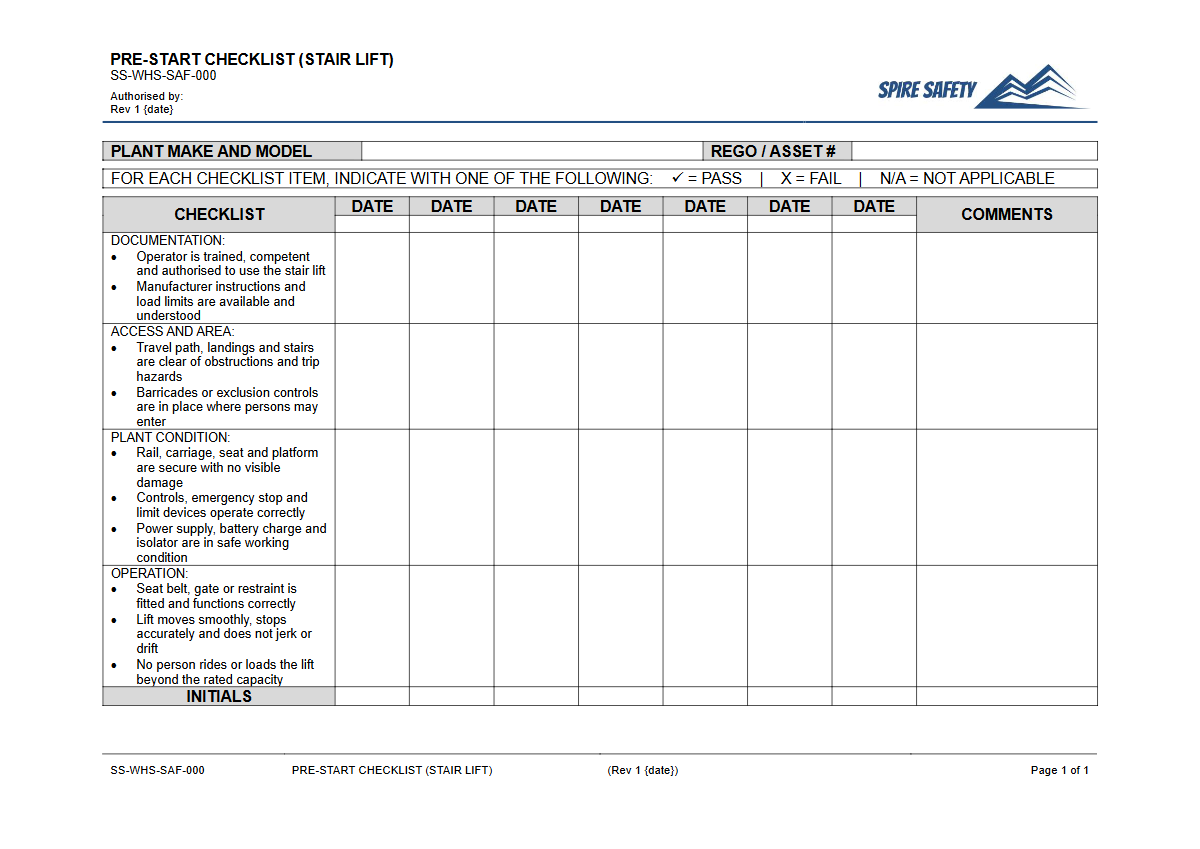
Regularly inspecting workplace equipment is a fundamental aspect of maintaining a safe environment. This free Pre-Start Checklist (Stair Lift) Template provides a structured format for operators to conduct daily safety inspections before using the equipment.
Using a checklist formalises the process, ensuring no critical safety component is overlooked. It prompts a systematic check of the stair lift’s key functions, including the controls, seat and seatbelt, footrest, emergency stop buttons, travel path, and any obstruction sensors.
Formalising these checks is a key activity within broader robust WHS management systems, helping to proactively identify potential faults or damage that could lead to an incident.
This document serves as a practical tool to fulfil a Person Conducting a Business or Undertaking's (PCBU) duty of care. By documenting these daily checks, an organisation can demonstrate it is taking reasonable steps to ensure the plant is safe for use.
The template helps create a consistent record of the equipment's condition, which is invaluable for tracking maintenance needs and investigating any incidents.
Video walkthrough
How to use the Free Pre-Start Checklist (Stair Lift) Template
This template is a starting point designed for easy adoption. First, download the document in your preferred format (DOCX or PDF).
The next step is crucial: you must customise the checklist to suit the specific make and model of the stair lift in your workplace, as well as the environment it operates in. Consult the manufacturer's operating manual to ensure all recommended checks are included.
Once customised, provide training to all authorised operators on how to properly complete the inspection. A pre-start check should be a physical inspection, not just a paper-filling exercise.
Encourage team members to discuss the process in safety meetings, perhaps using a Pre-Start Checks and Plant Maintenance Toolbox Talk to reinforce good practice. Completed checklists should be reviewed by a supervisor and filed for record-keeping purposes.
Any identified faults must be reported immediately, and the equipment tagged and removed from service until repaired by a competent person.
A Note on Customisation
This document is a template and not a complete, out-of-the-box solution. We have provided a solid foundation based on common Australian WHS practice, but you must adapt it to the unique hazards and operational context of your specific workplace and the stair lift model in use.
When to use it
A pre-start checklist should be completed before the stair lift is used for the first time each day or at the beginning of each new shift. This ensures that the equipment's condition is verified before it is put into operation.
Additionally, a check is recommended after any period of inactivity, after maintenance or repairs have been performed, or if there is any reason to suspect the equipment may have been damaged.
In environments like residential care facilities, where the equipment may be used frequently throughout the day by various people, establishing a clear 'first use of the day' check is vital. This process complements other safety initiatives, such as training on correct patient transfer techniques outlined in resources like an Aged Care Manual Handling Toolbox Talk.
Who should use it
The pre-start checklist is designed to be completed by trained and authorised operators of the stair lift. These are the individuals who rely on the equipment to perform its function safely.
They are best placed to notice subtle changes in performance or condition from one day to the next. Supervisors or managers also have a role to play; they are responsible for ensuring the checks are being completed correctly and for taking action when faults are reported.
Reviewing completed checklists helps management identify recurring issues that may indicate a need for more intensive maintenance or operator retraining.
It's important to distinguish this daily check from a formal competency assessment. While this checklist confirms daily operational safety, a document like a Scissor Lift VOC (Verification of Competency) Template is used for a more in-depth evaluation of a worker's skill and knowledge to operate specific types of plant safely.
Integrating these checks into a broader safety framework is also essential. For high-risk machinery, these checks are often a preliminary step before following a detailed procedure, such as a Safe Work Method Statement (SWMS) for scissor lift operations, which outlines the step-by-step process for performing a task safely.
To ensure these safety processes remain effective over time, many organisations find value in periodic, independent reviews. Engaging specialists for WHS compliance auditing can help verify that procedures like pre-start checks are being consistently implemented and that your overall safety management system is performing as intended.
Common mistakes
Common mistakes to avoid
- Failing to customise the checklist for the specific stair lift model and its unique features.
- Treating the check as a paper-filling exercise without conducting a thorough physical inspection.
- Neglecting to immediately tag and remove faulty equipment from service after a defect is found.
- Poor record-keeping, which prevents the tracking of recurring faults or demonstration of due diligence.
Legal references
Legal considerations
The following legal requirements may be relevant to this type of work.
- Work Health and Safety Act (Harmonised) — Provides the primary duties for protecting workers and other people from work health and safety risks.
- Work Health and Safety Regulations (Harmonised) — Sets out requirements supporting the management of workplace hazards and risks.
The following codes may be relevant to this type of work.
- Managing WHS Risks Code of Practice — Provides practical guidance on identifying hazards, assessing risks and applying effective controls.
- Work Health and Safety Consultation, Cooperation and Coordination Code of Practice — Provides practical guidance on consulting workers and coordinating with other duty holders.
- Managing the Work Environment and Facilities Code of Practice — Provides practical guidance on safe work environments, workplace facilities and related controls.
Did you know
The First Stair Lift
The first commercial stair lift was created in the 1920s by C.C. Crispen for a friend afflicted with polio. He originally called his invention the "Inclin-ator".
Beyond Mobility
Stair lifts aren't just for people. In some industrial and commercial settings, modified versions are used to safely transport goods, tools, and equipment between floors, reducing manual handling risks.
FAQ
Frequently asked questions
01Is a pre-start checklist for a stair lift legally required in Australia?
02What should I do if a fault is found during a stair lift pre-start check?
03How often should stair lift maintenance be performed?
04Can this template be used for any brand of stair lift?
Share this resource
Free Pre-Start Checklist (Stair Lift) Template
Browse Categories
How To Use It
- 1Download and open in Word or PDF.
- 2Replace the placeholders with your business details.
- 3Get it reviewed by a WHS specialist before rollout.
Need it customised?
Our WHS consultants can adapt this template to your site, run a gap analysis, or audit what you already have in place.
Book a Free Consultation WHS consulting servicesor call 1300 156 382