
Free Pre-Start Checklist (Spreader Beam) Template
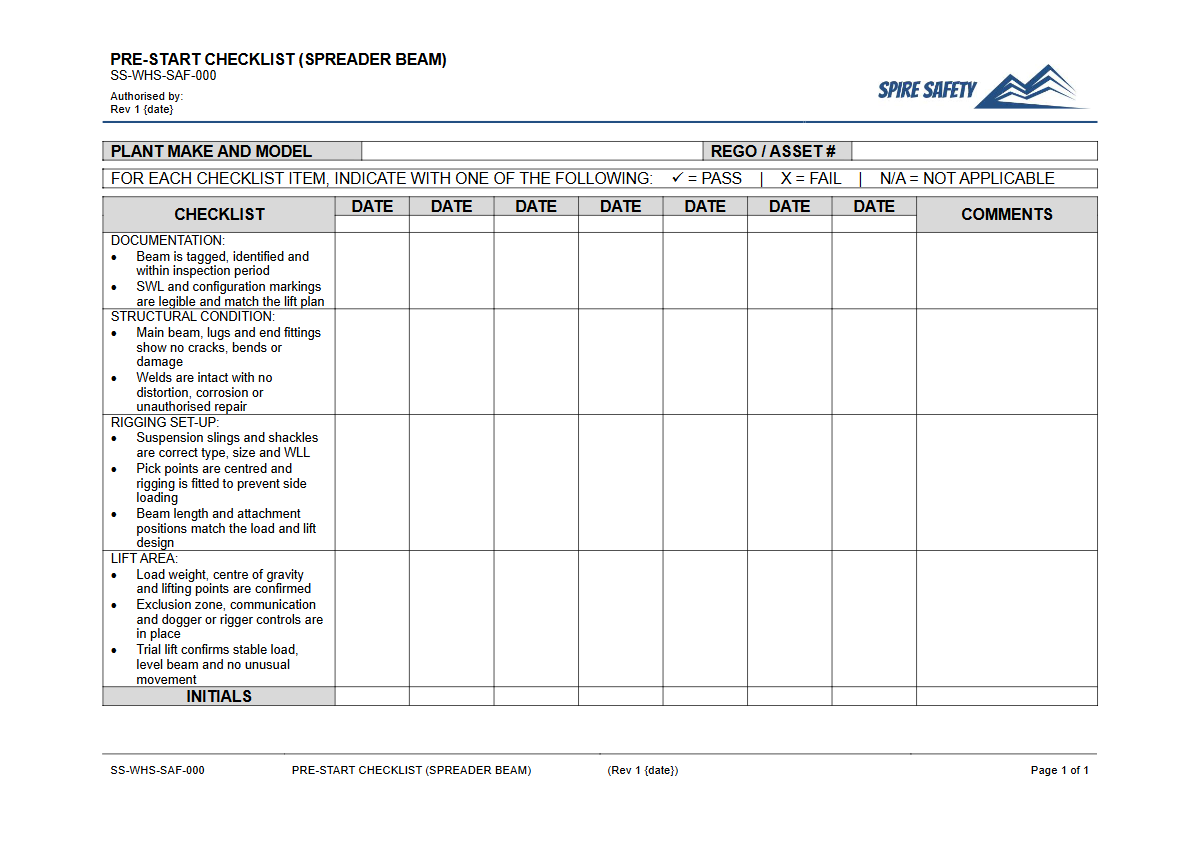
Download our Free Pre-Start Checklist (Spreader Beam) Template to formalise daily equipment inspections and identify hazards before lifting operations.
Free Pre-Start Checklist (Spreader Beam) Template
DOCX • 125 KB + PDF
Updated Oct 2026
No signup required
Purpose of the Free Pre-Start Checklist (Spreader Beam) Template
A spreader beam is a crucial piece of lifting equipment used to distribute the load of a lift across multiple points, enhancing stability and safety for wide or cumbersome objects. Given its role in high-risk lifting operations, ensuring its structural integrity before each use is non-negotiable.
This Free Pre-Start Checklist (Spreader Beam) Template provides a structured format for operators to conduct consistent and thorough inspections. Using this checklist helps your organisation identify potential defects, prevent equipment failure, and maintain a documented record of safety diligence, forming a key part of your safe system of work.
The primary purpose of this template is to formalise the inspection process. It prompts operators to systematically check critical components such as welds, lifting points, shackles, and data plates for the Working Load Limit (WLL).
This proactive approach to safety helps prevent incidents, protect personnel, and minimise costly downtime associated with equipment failure. For a more comprehensive approach to safe equipment use, this checklist should be used alongside a detailed Spreader SOP (Safe Operating Procedure) that outlines the specific steps for its operation.
Video walkthrough
How to use the Free Pre-Start Checklist (Spreader Beam) Template
This resource is available for immediate download in both DOCX and PDF formats. The DOCX version is fully editable, allowing you to tailor it to the specific spreader beams and lifting scenarios at your workplace.
The PDF version is ideal for quick printing and immediate use.
To get the most value from this template, follow these steps:
- Download: Select the DOCX or PDF version and save it to your system.
- Customise: Open the DOCX file and adapt the checklist items. Add your company branding, specific model numbers of your spreader beams, and any unique inspection points relevant to your operating environment or the types of lifts performed.
- Train: Ensure all operators and supervisors are trained on how to properly complete the checklist and what actions to take if a defect is found.
- Implement: Integrate the checklist into your daily pre-start routine for all lifting operations involving a spreader beam.
Important: This document is a template and must be customised to suit your specific workplace, equipment, and operational risks. We have provided a solid foundation, but you must review and amend it to ensure it aligns with your site-specific requirements and the manufacturer's instructions.
Integrating these checks into your broader WHS management systems ensures a consistent and documented approach to plant safety.
When to use it
A pre-start check for a spreader beam should be completed before its first use on any given day or shift. It is a mandatory step before the equipment is connected to a crane or hoist and attached to a load.
If the spreader beam is used for multiple, distinct lifting operations during a shift, a quick visual re-inspection is advisable before each new lift, especially if operating conditions change. Regular safety reinforcement, such as a Pre-Start Checks and Plant Maintenance Toolbox Talk, can help embed this critical habit among your team.
Who should use it
This Pre-Start Checklist should be completed by a person who is trained, competent, and authorised to operate lifting equipment and conduct inspections. This is typically the crane operator, rigger, or dogman responsible for the lift.
Supervisors and safety officers also have a role in ensuring these checks are consistently performed and accurately documented. The completed checklists serve as important records that can be reviewed during safety meetings or formal WHS compliance auditing to verify that safety procedures are being followed.
These documented checks are also vital for communicating equipment status between shifts or teams. Using a formal process like a Pre-Start Meeting Template ensures that any issues identified during the inspection are clearly communicated to all relevant personnel before work commences. You can find more templates and tools to support your safety processes in our free WHS resources library.
Common mistakes
Common mistakes to avoid
- Ignoring minor dents, scratches, or surface corrosion that could indicate deeper structural issues.
- Using incorrect shackles or rigging attachments that are not rated for the load or compatible with the beam's connection points.
- Failing to account for the weight of the spreader beam and rigging when calculating the total load (gross load).
- Continuing to use a beam after it has been shock-loaded, overloaded, or modified without re-certification.
Legal references
Legal considerations
The following legal requirements may be relevant to this type of work.
- Work Health and Safety Act (Harmonised) — Provides the primary duties for protecting workers and other people from work health and safety risks.
- Work Health and Safety Regulations (Harmonised) — Sets out requirements supporting the management of workplace hazards and risks.
The following codes may be relevant to this type of work.
- Managing WHS Risks Code of Practice — Provides practical guidance on identifying hazards, assessing risks and applying effective controls.
- Work Health and Safety Consultation, Cooperation and Coordination Code of Practice — Provides practical guidance on consulting workers and coordinating with other duty holders.
- Managing the Work Environment and Facilities Code of Practice — Provides practical guidance on safe work environments, workplace facilities and related controls.
Did you know
Load Distribution
A spreader beam works by converting the vertical lifting force from a single point into compressive forces along the beam, distributing the load to two or more pick points. This is different from a lifting beam, which experiences bending forces.
Tagging is Key
An illegible or missing data plate (or tag) with the manufacturer's details and Working Load Limit (WLL) is considered a critical defect. Without this information, the beam must be removed from service immediately.
FAQ
Frequently asked questions
01What are the critical checks for a spreader beam before a lift?
02Is a spreader beam considered lifting equipment?
03How often should a spreader beam be formally inspected?
04What should an operator do if they find a defect during a pre-start check?
Share this resource
Free Pre-Start Checklist (Spreader Beam) Template
Browse Categories
How To Use It
- 1Download and open in Word or PDF.
- 2Replace the placeholders with your business details.
- 3Get it reviewed by a WHS specialist before rollout.
Need it customised?
Our WHS consultants can adapt this template to your site, run a gap analysis, or audit what you already have in place.
Book a Free Consultation WHS consulting servicesor call 1300 156 382