
Free Pre-Start Checklist (Sprayer) Template
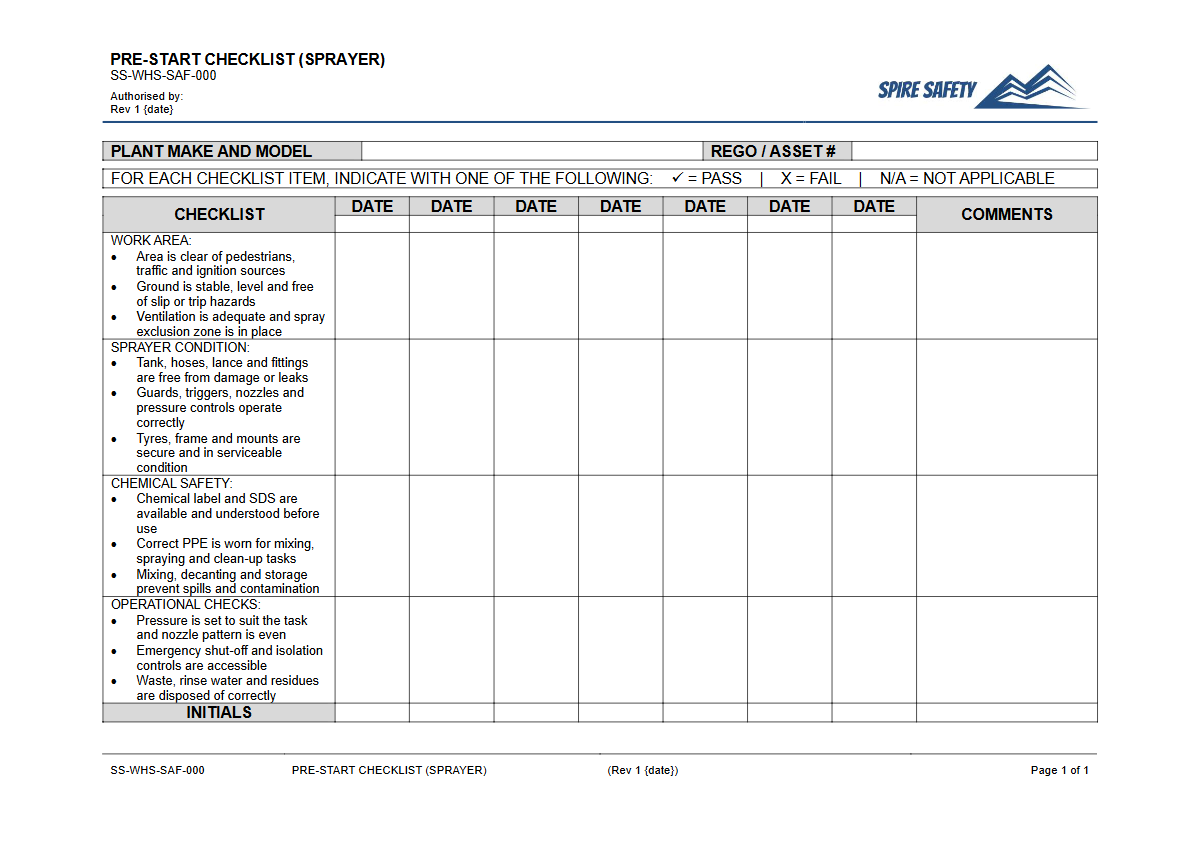
Download our free Pre-Start Checklist (Sprayer) Template. This structured Word & PDF resource helps formalise sprayer safety inspections and manage WHS risks.
Free Pre-Start Checklist (Sprayer) Template
DOCX • 125 KB + PDF
Updated Oct 2026
No signup required
Purpose of the Free Pre-Start Checklist (Sprayer) Template
Operating sprayer equipment involves significant risks, including chemical exposure, mechanical failure, and high-pressure injection injuries. A consistent pre-start inspection process is a critical control measure to ensure the equipment is safe to use before any work begins.
This free Pre-Start Checklist (Sprayer) Template provides a structured starting point for organisations to formalise their daily safety checks, helping to identify and address potential hazards before they cause an incident.
Using a documented checklist ensures that no steps are missed and creates a record of due diligence. It prompts operators to systematically inspect critical components like hoses, nozzles, pressure gauges, guards, and emergency stops.
Integrating this check with a clear operational guide, such as our free Sprayer SOP (Safe Operating Procedure) Template, helps build a comprehensive safe system of work for all sprayer-related tasks.
Common Sprayer Hazards
A thorough pre-start check helps manage a range of sprayer-specific hazards, including:
- Chemical Leaks: Damaged hoses, faulty seals, or cracked tanks can lead to unintended release of hazardous chemicals, posing risks of skin contact, inhalation, and environmental contamination.
- Blocked Nozzles: Obstructions can cause uneven application, pressure build-up, and potential line ruptures.
- Pressure System Failure: Malfunctioning pressure regulators, gauges, or relief valves can lead to over-pressurisation and catastrophic failure of components.
- Incorrect PPE: Failure to check for and use the correct Personal Protective Equipment (PPE) for the chemical being sprayed is a major cause of exposure incidents.
- Entanglement: Moving parts on engine-driven or PTO-driven sprayers, such as shafts and belts, pose a risk if guards are missing or damaged.
Video walkthrough
How to use the Free Pre-Start Checklist (Sprayer) Template
This resource is available as a DOCX file for easy customisation and a PDF for immediate use. The key to its effectiveness is ensuring it accurately reflects your specific workplace conditions.
This checklist should be treated as a foundation to build upon, not a final, universal document.
IMPORTANT: We provide this template as a structured starting point. You must review and customise it to address the specific models of sprayers used at your site, the types of chemicals handled, and the unique environmental and operational hazards of your workplace.
Its integration into your overall WHS management systems is crucial for it to be effective.
To implement the checklist, train all operators on how to complete it thoroughly. Establish a clear procedure for what to do when a fault is found, including tagging the equipment out of service and reporting the issue to a supervisor or the maintenance team.
Regular reviews of completed checklists can help identify recurring faults and inform preventative maintenance schedules.
When to use it
A pre-start checklist for a sprayer should be completed by the operator before every use or, at a minimum, at the beginning of each work shift. If multiple operators use the same machine during a single shift, a handover process should confirm that the initial check remains valid or that a new check is performed.
These daily checks can be discussed during daily briefings, which can be formalised using a Free Pre-Start Meeting Template to ensure all safety matters are communicated effectively.
Who should use it
This checklist is designed for several key roles within an organisation:
- Equipment Operators: The primary users who are responsible for conducting the physical inspection before they begin work.
- Supervisors and Managers: Responsible for ensuring operators are trained and competent in performing the checks, reviewing completed checklists, and taking action on any reported defects.
- Maintenance Personnel: Use the information from completed checklists to schedule repairs and conduct preventative maintenance, preventing minor issues from becoming major failures.
- WHS Professionals: Use the documented records as evidence of risk management practices during safety audits. Periodically verifying that these checks are being completed correctly is a key part of any internal WHS compliance auditing program.
By defining these roles, you create a closed-loop system where hazards are not only identified but also tracked, actioned, and resolved. For more ideas on reinforcing these concepts with your team, consider using a Pre-Start Checks and Plant Maintenance Toolbox Talk to facilitate discussion.
Common mistakes
Common mistakes to avoid
- Pencil-whipping the form without physically inspecting the equipment.
- Failing to immediately report and tag out faulty equipment identified during the check.
- Using a generic checklist that doesn't cover the specific model of sprayer or chemicals used.
- Forgetting to check the availability and good condition of the required Personal Protective Equipment (PPE).
Legal references
Legal considerations
The following legal requirements may be relevant to this type of work.
- Work Health and Safety Act (Harmonised) — Provides the primary duties for protecting workers and other people from work health and safety risks.
- Work Health and Safety Regulations (Harmonised) — Sets out requirements supporting the management of workplace hazards and risks.
The following codes may be relevant to this type of work.
- Managing WHS Risks Code of Practice — Provides practical guidance on identifying hazards, assessing risks and applying effective controls.
- Work Health and Safety Consultation, Cooperation and Coordination Code of Practice — Provides practical guidance on consulting workers and coordinating with other duty holders.
- Managing the Work Environment and Facilities Code of Practice — Provides practical guidance on safe work environments, workplace facilities and related controls.
Did you know
Maintenance Records
Completed pre-start checklists form a valuable part of your plant maintenance records, demonstrating proactive hazard identification and management to regulators.
Injection Injury Risk
High-pressure sprayers can cause severe injection injuries if a jet of fluid penetrates the skin, even from a pinhole leak. A thorough pre-start check of hoses and connections is the first line of defence against this serious hazard.
FAQ
Frequently asked questions
01Why are pre-start checks important for sprayers?
02What should be included in a sprayer pre-start checklist?
03How often should sprayer pre-start checks be done?
04Who is responsible for ensuring sprayer pre-starts are completed?
Share this resource
Free Pre-Start Checklist (Sprayer) Template
Browse Categories
How To Use It
- 1Download and open in Word or PDF.
- 2Replace the placeholders with your business details.
- 3Get it reviewed by a WHS specialist before rollout.
Need it customised?
Our WHS consultants can adapt this template to your site, run a gap analysis, or audit what you already have in place.
Book a Free Consultation WHS consulting servicesor call 1300 156 382