
Free Pre-Start Checklist (Soup Kettle) Template
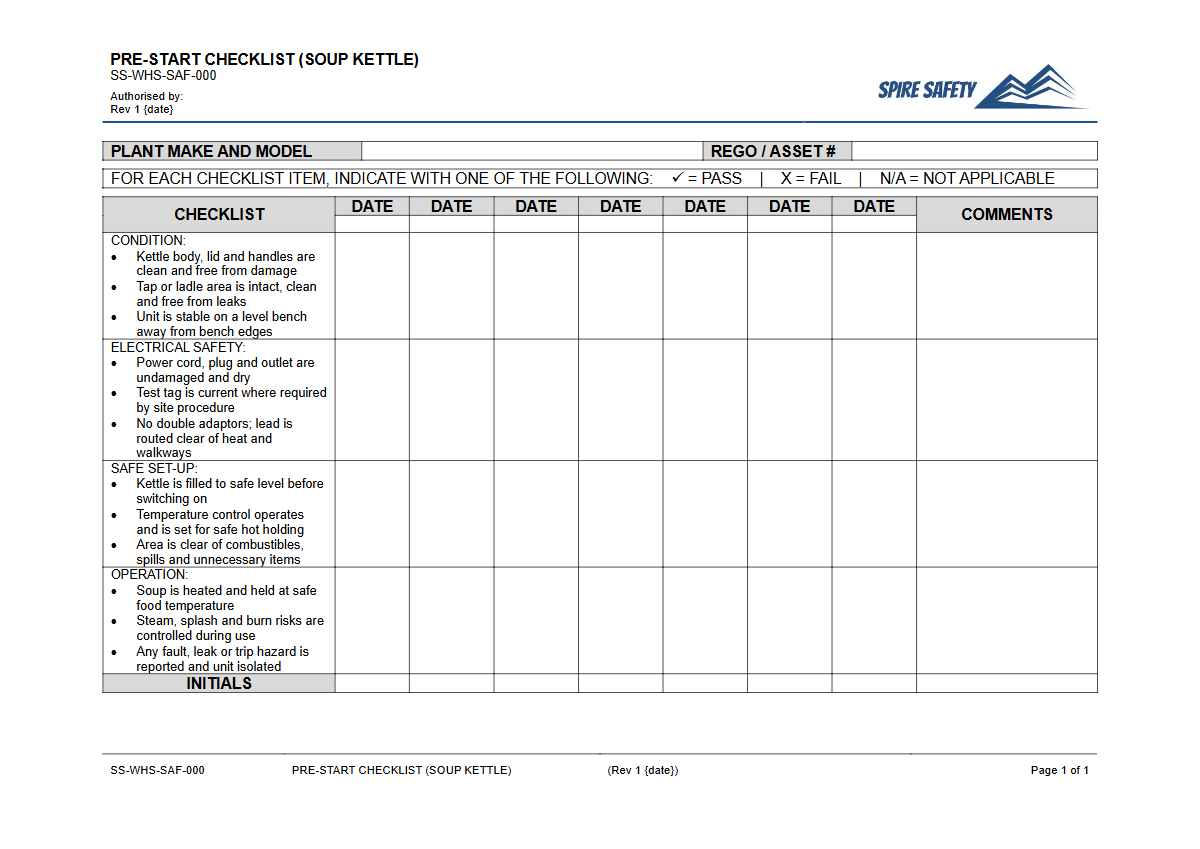
Download our free Pre-Start Checklist (Soup Kettle) Template to formalise daily safety checks in your commercial kitchen.
Free Pre-Start Checklist (Soup Kettle) Template
DOCX • 125 KB + PDF
Updated Oct 2026
No signup required
Purpose of the Free Pre-Start Checklist (Soup Kettle) Template
Commercial soup kettles are essential in many hospitality and catering environments, but they also present significant workplace hazards. This includes the risk of severe burns from hot surfaces and liquids, electrical shocks from faulty components, and slips from spills.
Using a structured Free Pre-Start Checklist (Soup Kettle) Template helps your organisation formalise daily safety inspections, ensuring the equipment is in safe working order before operation begins. This simple process systematically identifies potential faults, reduces the risk of injury, and promotes a proactive safety culture among kitchen staff.
Implementing routine inspections is a fundamental part of equipment safety management. By documenting these checks, you create a clear record of due diligence and demonstrate a commitment to worker safety.
For broader training on this topic, our Pre-Start Checks and Plant Maintenance Toolbox Talk can help reinforce these principles with your team.
Video walkthrough
How to Use the Free Pre-Start Checklist (Soup Kettle) Template
This template provides a solid foundation for your workplace's specific needs. Follow these steps to implement it effectively:
- Download: Choose between the DOCX and PDF formats. The DOCX version is fully editable.
- Customise: This is the most critical step. You must review and adapt the checklist to suit the specific make and model of soup kettle used in your workplace, your operational procedures, and any unique environmental risks. We are not familiar with your specific site, so you must add or remove items to ensure it is fit-for-purpose.
- Train: Ensure all relevant staff, including chefs, kitchen hands, and supervisors, are trained on how to correctly complete the checklist and what actions to take if a fault is identified.
- Implement: Integrate the checklist into your daily opening procedures. Store completed records in a designated location for easy access and review.
A pre-start checklist is an important tool, but it works best when it's part of a comprehensive safety framework. Integrating this process into your broader WHS management systems ensures that safety procedures are consistently applied, monitored, and improved over time.
When to Use a Soup Kettle Checklist
The pre-start checklist should be completed at the beginning of each workday or shift, before the soup kettle is switched on for the first time. It is a preventative tool designed to catch issues before they can cause harm.
Additionally, it's good practice to perform a check after the equipment has been moved, cleaned, or has undergone any maintenance to ensure it has been reassembled correctly and remains safe to use.
Who Should Use This Checklist
The checklist is designed to be used by the person operating the equipment. This is typically a chef, cook, or kitchen assistant.
Empowering the operator to conduct the check gives them direct responsibility for their own safety and the safety of those around them. Supervisors and managers should also be familiar with the checklist to ensure it is being completed correctly and to follow up on any reported defects. Discussing checklist findings can be a valuable part of daily team briefings, which can be documented using a Free Pre-Start Meeting Template.
Managing Related Risks
Beyond the equipment itself, consider the manual handling risks associated with its use, such as lifting heavy inserts filled with hot soup. The principles for safely managing these tasks are universal across industries.
Our Aged Care Manual Handling Toolbox Talk provides a useful framework for discussing safe lifting techniques that can be adapted for a kitchen environment.
Auditing and Review
Periodically, a manager or safety officer should review the completed checklists to identify recurring faults or patterns of non-compliance. This review process helps verify that the safety system is working as intended and identifies opportunities for improvement, such as additional training or equipment replacement.
A formal WHS compliance audit can provide a more in-depth, independent assessment of your overall safety practices.
Common mistakes
Common mistakes to avoid
- "Pencil-whipping" the checklist without physically inspecting each item.
- Failing to immediately report and quarantine faulty equipment.
- Using a generic checklist that doesn't cover the specific model of soup kettle in use.
- Neglecting to check the surrounding area for slip, trip, and fall hazards.
Legal references
Legal considerations
The following legal requirements may be relevant to this type of work.
- Work Health and Safety Act (Harmonised) — Provides the primary duties for protecting workers and other people from work health and safety risks.
- Work Health and Safety Regulations (Harmonised) — Sets out requirements supporting the management of workplace hazards and risks.
The following codes may be relevant to this type of work.
- Managing WHS Risks Code of Practice — Provides practical guidance on identifying hazards, assessing risks and applying effective controls.
- Work Health and Safety Consultation, Cooperation and Coordination Code of Practice — Provides practical guidance on consulting workers and coordinating with other duty holders.
- Managing the Work Environment and Facilities Code of Practice — Provides practical guidance on safe work environments, workplace facilities and related controls.
Did you know
Scald Prevention
Hot liquids are a leading cause of severe burns in commercial kitchens. A simple temperature check on a kettle's exterior or ensuring lids are secure can prevent many painful and serious scald injuries.
Electrical Safety Standards
Damaged power cords on portable appliances are a common source of electrical hazards. The standard AS/NZS 3760 outlines the requirements for regular inspection and testing of electrical equipment in the workplace.
FAQ
Frequently asked questions
01Why is a pre-start check necessary for a simple soup kettle?
02Can I use this template for other kitchen equipment like a deep fryer or oven?
03How often should the soup kettle pre-start check be completed?
04Who is responsible for signing off on the checklist?
Share this resource
Free Pre-Start Checklist (Soup Kettle) Template
Browse Categories
How To Use It
- 1Download and open in Word or PDF.
- 2Replace the placeholders with your business details.
- 3Get it reviewed by a WHS specialist before rollout.
Need it customised?
Our WHS consultants can adapt this template to your site, run a gap analysis, or audit what you already have in place.
Book a Free Consultation WHS consulting servicesor call 1300 156 382