
Free Pre-Start Checklist (Solar Inverter) Template
Download our Free Pre-Start Checklist (Solar Inverter) Template in DOCX and PDF.
Free Pre-Start Checklist (Solar Inverter) Template
DOCX • 125 KB + PDF
Updated Oct 2026
No signup required
Purpose of the Free Pre-Start Checklist (Solar Inverter) Template
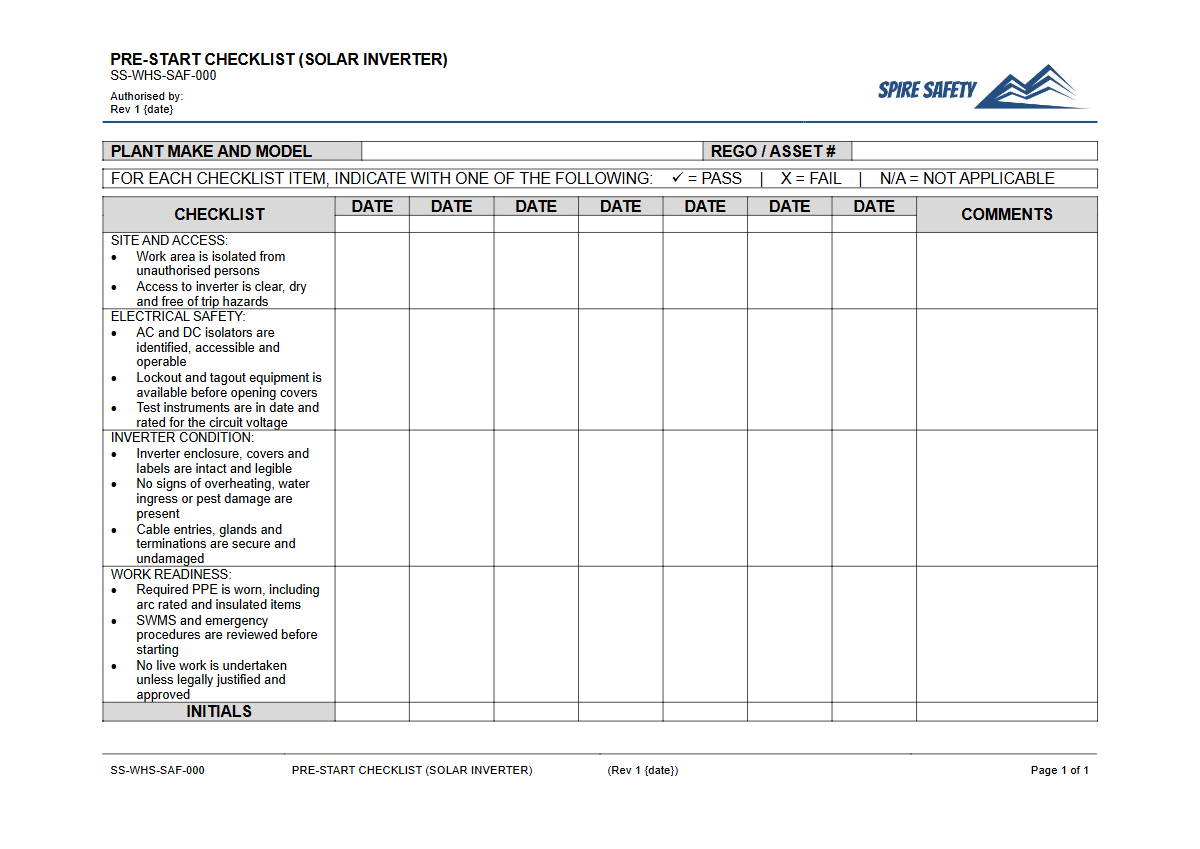
This Free Pre-Start Checklist (Solar Inverter) Template provides a structured starting point for documenting pre-operational safety inspections of solar power inverters. Using a formal checklist helps workers identify and control hazards before energising or interacting with the equipment, reducing the risk of electric shock, arc flash, or equipment damage.
It helps formalise the process of checking plant safety, moving beyond ad-hoc visual checks and creating a verifiable record that the inspection took place.
The primary purpose is to ensure the solar inverter is in a safe condition to operate. This involves verifying physical integrity, electrical connections, safety features, and the surrounding environment.
Consistent use of this checklist promotes a proactive safety culture, encourages hazard awareness among workers, and provides valuable data for maintenance scheduling. For a broader overview of this topic, our Pre-Start Checks and Plant Maintenance Toolbox Talk can help reinforce the importance of these inspections with your team.
Key Inspection Areas
A thorough Pre-Start Checklist for a Solar Inverter should cover several critical domains to manage risks effectively:
- Physical Condition: Checking for any signs of physical damage, corrosion, or water ingress on the inverter's casing.
- Electrical Safety: Ensuring all wiring is secure, conduits are intact, and there are no exposed conductors.
- Ventilation and Clearances: Verifying that air vents and cooling fans are unobstructed and that the required clearances around the unit are maintained to prevent overheating.
- Safety Signage: Confirming that all necessary warnings, shutdown procedures, and identification labels are in place, legible, and correct.
- System Status: Checking the inverter's display for any fault codes, error messages, or abnormal readings before proceeding with work.
Video walkthrough
How to use the Free Pre-Start Checklist (Solar Inverter) Template
This resource is available for download as a DOCX file for easy editing in Microsoft Word, or as a PDF for straightforward printing. The checklist is designed as a foundational document, aligned with Australian WHS principles, to guide the development of your site-specific procedures.
Integrating customised checklists into your organisation's overall WHS management systems is a key step in demonstrating systematic risk management.
Important: This template is a starting point. To be effective, we recommend you customise it to reflect the specific inverter models, site conditions, safe work procedures, and legislative requirements applicable to your workplace.
You should add, remove, or modify checklist items to ensure they are relevant to the equipment your workers use every day. For example, the checks for a small residential string inverter will differ from those for a large-scale commercial central inverter.
When to use a Pre-Start Checklist for a Solar Inverter
A pre-start check should be completed before the solar inverter is used for the first time on any given day or shift. It is a pre-operational check, meaning it occurs before the equipment is energised or before any maintenance or diagnostic work commences.
It should become a routine part of the daily workflow for any technician or operator interacting with the system.
This check is a valuable supplement to other safety documentation. For instance, after discussing daily tasks in a morning briefing, which can be documented using a Pre-Start Meeting Template, the operator would then perform the pre-start check on their specific equipment before starting the hands-on portion of their work.
Who should use this checklist
This checklist should be used by competent and authorised personnel who are tasked with operating, maintaining, or inspecting solar inverter systems. This typically includes licensed electricians, accredited solar installers, and trained maintenance technicians.
Users must possess the necessary technical knowledge to understand the items on the checklist and recognise the hazards associated with solar and inverter systems, particularly the risks of live electrical components.
Completed checklists create an important audit trail. They provide evidence that safety inspections are being consistently performed.
This documentation can be reviewed during internal safety assessments or more formal WHS compliance auditing to verify that safe work practices are being followed. For different types of electrical equipment, you may need a different set of checks, similar to how a pre-start checklist for an air handler would focus on different components and risks.
This template is one of many tools available to help strengthen your safety processes. We encourage you to explore our library of free WHS resources for other templates and guides that can support your organisation's health and safety objectives.
Common mistakes
Common mistakes to avoid
- Failing to customise the generic template for specific inverter models and site conditions.
- "Pencil-whipping" the checklist without physically or visually performing the required checks.
- Not taking immediate corrective action when a defect or hazard is identified during the inspection.
- Poor record-keeping of completed checklists, making them difficult to retrieve for audits or incident investigations.
Legal references
Legal considerations
The following legal requirements may be relevant to this type of work.
- Work Health and Safety Act (Harmonised) — Provides the primary duties for protecting workers and other people from work health and safety risks.
- Work Health and Safety Regulations (Harmonised) — Sets out requirements supporting the management of workplace hazards and risks.
The following codes may be relevant to this type of work.
- Managing WHS Risks Code of Practice — Provides practical guidance on identifying hazards, assessing risks and applying effective controls.
- Work Health and Safety Consultation, Cooperation and Coordination Code of Practice — Provides practical guidance on consulting workers and coordinating with other duty holders.
- Managing the Work Environment and Facilities Code of Practice — Provides practical guidance on safe work environments, workplace facilities and related controls.
Did you know
Cooling is Critical
A significant portion of inverter failures are due to overheating. Pre-start checks that verify clear ventilation and functioning cooling fans are critical for preventing equipment damage and potential fire risk.
Inverter Lifespan
Most modern string inverters for residential or commercial use have an expected lifespan of 10 to 15 years. Regular inspections help identify developing issues early, maximising both the safety and operational life of the unit.
FAQ
Frequently asked questions
01Is a pre-start checklist for a solar inverter legally required in Australia?
02What is the difference between a pre-start check and a SWMS?
03How often should solar inverters be inspected?
04Can I use this template for any brand of solar inverter?
Share this resource
Free Pre-Start Checklist (Solar Inverter) Template
Browse Categories
How To Use It
- 1Download and open in Word or PDF.
- 2Replace the placeholders with your business details.
- 3Get it reviewed by a WHS specialist before rollout.
Need it customised?
Our WHS consultants can adapt this template to your site, run a gap analysis, or audit what you already have in place.
Book a Free Consultation WHS consulting servicesor call 1300 156 382