
Free Pre-Start Checklist (Smoke Extract) Template
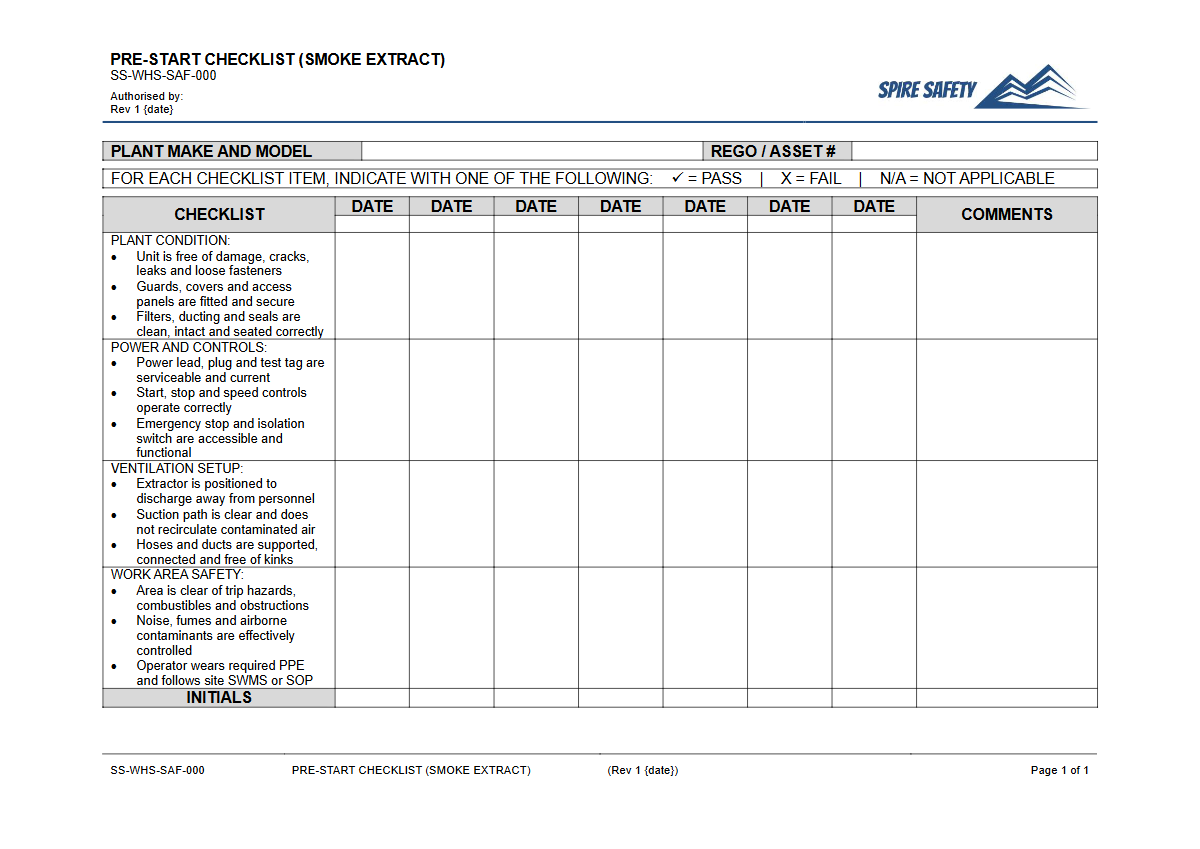
Download our free Pre-Start Checklist (Smoke Extract) Template (DOCX & PDF). A structured starting point for formalising daily safety inspections.
Free Pre-Start Checklist (Smoke Extract) Template
DOCX • 125 KB + PDF
Updated Oct 2026
No signup required
Purpose of the Free Pre-Start Checklist (Smoke Extract) Template
A smoke extract system is a critical life-saving installation designed to control the movement of smoke during a fire, maintaining clear escape routes for occupants and providing better access for firefighters. Ensuring this system is fully operational at all times is a fundamental WHS responsibility.
This free Pre-Start Checklist (Smoke Extract) Template provides a structured framework for conducting and documenting regular inspections, helping to verify that all components are in a state of readiness.
Using a formal checklist helps standardise the inspection process, reducing the risk of missed steps and creating a tangible record of due diligence. It prompts a systematic review of fans, dampers, controls, and power supplies, ensuring the system can be relied upon in an emergency.
Formalising this process is a key step in managing risks associated with fire and smoke in commercial, industrial, and residential buildings.
Video walkthrough
How to use the Free Pre-Start Checklist (Smoke Extract) Template
This template is provided as a starting point for developing a site-specific inspection document. To use it, simply download the DOCX or PDF file and integrate it into your safety procedures.
The DOCX version is fully editable, allowing you to add, remove, or modify checklist items to match the specific make, model, and configuration of your equipment.
Important: This is a template, not a finished document. It is essential that you customise it to your workplace.
We have provided a structured foundation based on common industry practice, but you must adapt it to reflect your specific smoke extract system, the manufacturer’s operational guidelines, and the unique risks identified in your facility's risk assessments. This customisation is a critical part of building effective WHS management systems.
When to use it
This Pre-Start Checklist should be used as part of a regular maintenance and safety schedule. The frequency of checks may be daily, weekly, or monthly, depending on the system's complexity, its operational environment, and requirements set by Australian Standards and the National Construction Code (NCC).
It is particularly important to conduct a thorough check after any maintenance, repairs, or modifications to the system to verify its correct function. These checks can be discussed in safety briefings, which can be reinforced with resources like our Pre-Start Checks and Plant Maintenance Toolbox Talk.
Who should use it
Inspections of smoke extract systems must be carried out by competent and trained personnel. This typically includes facilities managers, qualified maintenance technicians, or specialist fire safety contractors.
The individual conducting the check must have a thorough understanding of the system's design, its components, and its intended operation. They need to be able to accurately identify potential faults, understand the implications of a failed check, and know the correct procedure for reporting and escalating defects.
Key Areas Covered in the Checklist
A comprehensive smoke extract check involves inspecting multiple interconnected components. While your customised checklist will be specific to your system, it should generally cover:
- Control Panel: Verifying the panel is powered, free from faults or alarms, and that manual override switches are accessible.
- Fans and Motors: A visual inspection for damage, unusual noises, or excessive vibration during test runs.
- Dampers: Checking that smoke and fire dampers are unobstructed and in their correct standby position.
- Power Supply: Ensuring primary and backup power sources (like uninterruptible power supplies or generators) are functional.
- Sensors and Detectors: Confirming that smoke detectors linked to the system are clean, undamaged, and operational.
The principles of checking essential plant like this are similar across different air management equipment. For related systems, you may find our Free Pre-Start Checklist (Air Handler) Template a useful reference.
Record Keeping and Corrective Actions
Every completed checklist is a formal safety record. These documents should be signed, dated, and stored in an accessible location for auditing purposes and future reference.
The process doesn't end with the check; any identified defects, faults, or 'no' answers on the checklist must trigger a corrective action. This involves reporting the issue through the proper channels, isolating the system if necessary, and scheduling prompt repairs.
Regular reviews of these records are a crucial part of an effective safety program and can be verified through WHS compliance auditing to ensure procedures are being followed correctly.
Common mistakes
Common mistakes to avoid
- Performing the check as a 'tick-and-flick' exercise without physically verifying each item.
- Failing to document and immediately report identified faults or 'No' answers on the checklist.
- Allowing untrained or unauthorised personnel to conduct the inspection.
- Ignoring minor issues like unusual noises or vibrations, which can be early indicators of major component failure.
Legal references
Legal considerations
The following legal requirements may be relevant to this type of work.
- Work Health and Safety Act (Harmonised) — Provides the primary duties for protecting workers and other people from work health and safety risks.
- Work Health and Safety Regulations (Harmonised) — Sets out requirements supporting the management of workplace hazards and risks.
The following codes may be relevant to this type of work.
- Managing WHS Risks Code of Practice — Provides practical guidance on identifying hazards, assessing risks and applying effective controls.
- Work Health and Safety Consultation, Cooperation and Coordination Code of Practice — Provides practical guidance on consulting workers and coordinating with other duty holders.
- Managing the Work Environment and Facilities Code of Practice — Provides practical guidance on safe work environments, workplace facilities and related controls.
Did you know
Smoke vs. Fire
In a building fire, smoke inhalation is the leading cause of civilian deaths, not burns. Effective smoke control systems are therefore one of the most important life safety features in a building's design.
Dual-Purpose Systems
Many modern buildings use 'dual-purpose' systems where the daily ventilation and air-conditioning (HVAC) system is also designed to function as the smoke control system in an emergency.
FAQ
Frequently asked questions
01What is a smoke extract system?
02How often should smoke extract systems be tested in Australia?
03Is a pre-start checklist a legal requirement in Australia?
04Who is considered 'competent' to inspect a smoke extract system?
Share this resource
Free Pre-Start Checklist (Smoke Extract) Template
Browse Categories
How To Use It
- 1Download and open in Word or PDF.
- 2Replace the placeholders with your business details.
- 3Get it reviewed by a WHS specialist before rollout.
Need it customised?
Our WHS consultants can adapt this template to your site, run a gap analysis, or audit what you already have in place.
Book a Free Consultation WHS consulting servicesor call 1300 156 382