
Free Pre-Start Checklist (Silo Blower) Template
Download our free Pre-Start Checklist (Silo Blower) Template. This structured Word & PDF resource helps formalise equipment safety checks. Get started today.
Free Pre-Start Checklist (Silo Blower) Template
DOCX • 125 KB + PDF
Updated Oct 2026
No signup required
Purpose of the Free Pre-Start Checklist (Silo Blower) Template
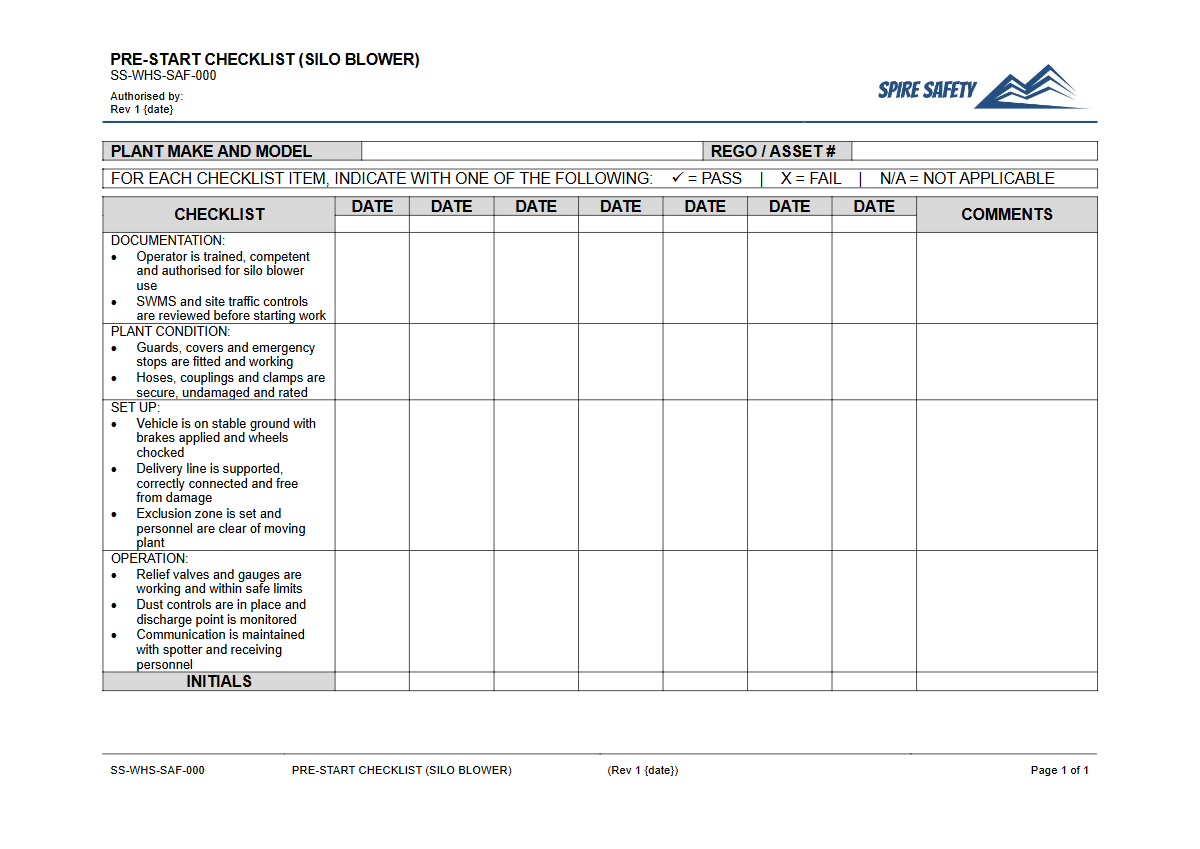
Regularly inspecting plant and equipment is a cornerstone of effective workplace safety. This Free Pre-Start Checklist (Silo Blower) Template provides a structured framework to formalise daily inspections of your silo blower equipment.
Using a checklist helps operators methodically identify potential faults, damage, or wear and tear before operation begins. Early detection of issues with components like hoses, pressure gauges, filters, and safety guards is crucial for preventing equipment failure, which can lead to serious injuries, property damage, and costly downtime.
By documenting these checks, your organisation can demonstrate a proactive approach to safety and risk management. This practice is a key part of fulfilling the primary duty of care for a Person Conducting a Business or Undertaking (PCBU) under Australian WHS legislation.
The checklist helps manage specific risks associated with silo blowers, such as uncontrolled releases of pressurised air, contact with moving parts, and exposure to hazardous dusts like cement powder. For high-risk tasks involving such equipment, a documented pre-start is often the first step in a broader safety process, which may also require a Safe Work Method Statement (SWMS) for Concrete Truck Operation.
Video walkthrough
How to use the Free Pre-Start Checklist (Silo Blower) Template
This Pre-Start Checklist is available for immediate download in both DOCX and PDF formats. The Word document can be easily edited to suit your specific needs, while the PDF is ready for printing and immediate use.
The template is designed as a structured starting point, aligned with general Australian WHS principles for plant safety.
Important: This template provides a foundation based on common industry practice, but it must be customised for your specific silo blower model, workplace environment, and operational procedures. We recommend consulting the manufacturer's instructions and conducting a site-specific risk assessment to add or remove checks as needed. Integrating customised tools like this into your daily operations is a key function of effective WHS management systems.
Example checks included:
- Hoses and couplings (condition, secure connections)
- Pressure relief valves and gauges (undamaged, correct readings)
- Filters and silencers (clean, intact)
- Guards and covers (in place, secure)
- Power source and controls (emergency stop function)
- General condition (leaks, cracks, excessive vibration)
When to use it
A pre-start inspection should be completed by a competent operator before the silo blower is used for the first time each day or at the beginning of every shift. This ensures the equipment is safe to operate before any work commences.
It should be a routine, non-negotiable part of the daily workflow. These checks can be discussed and documented as part of daily toolbox talks or pre-start meetings, reinforcing a consistent safety culture across all teams.
Our free Pre-Start Meeting Template can help formalise this broader process.
If the silo blower has been idle for an extended period, or after it has undergone maintenance or repairs, conducting a thorough pre-start check is essential to verify its operational readiness. For similar air-moving plant, you might also find our free Pre-Start Checklist (Air Handler) Template useful.
Who should use it
The pre-start check must be carried out by a person who is trained, competent, and authorised to operate the specific type of silo blower in use. Competency involves not just knowing how to operate the machine, but also understanding the associated hazards and the importance of each item on the checklist.
Supervisors have a responsibility to ensure these checks are being completed correctly and that any reported issues are addressed promptly before the equipment is used. Periodically reviewing completed checklists can be an important part of your internal safety verification processes or formal WHS compliance auditing.
Maintenance personnel may also use this checklist as a reference when performing repairs or preventative maintenance to ensure all key safety components are inspected. Reinforcing the 'how' and 'why' of these inspections is a perfect topic for a safety discussion; our Pre-Start Checks and Plant Maintenance Toolbox Talk can provide a useful guide. For expert guidance on implementing robust plant safety procedures, consider our WHS consulting services.
Common mistakes
Common mistakes to avoid
- "Pencil-whipping" the checklist without physically inspecting each item.
- Failing to tag out and immediately report faulty or damaged equipment.
- Using a generic checklist that doesn't account for the specific model or work environment.
- Neglecting to train operators on the purpose and importance of each check item.
Legal references
Legal considerations
The following legal requirements may be relevant to this type of work.
- Work Health and Safety Act (Harmonised) — Provides the primary duties for protecting workers and other people from work health and safety risks.
- Work Health and Safety Regulations (Harmonised) — Sets out requirements supporting the management of workplace hazards and risks.
The following codes may be relevant to this type of work.
- Managing WHS Risks Code of Practice — Provides practical guidance on identifying hazards, assessing risks and applying effective controls.
- Work Health and Safety Consultation, Cooperation and Coordination Code of Practice — Provides practical guidance on consulting workers and coordinating with other duty holders.
- Managing the Work Environment and Facilities Code of Practice — Provides practical guidance on safe work environments, workplace facilities and related controls.
Did you know
Pneumatic Power
Silo blowers use powerful pneumatic systems to move materials like cement or grain. A blocked or damaged hose can fail catastrophically, creating a significant hazard from high-pressure air and projectile materials.
Dust Dangers
Fine powders moved by silo blowers, such as cement, can contain respirable crystalline silica. Uncontrolled dust can create serious long-term health risks, making pre-start checks on seals and filters critical for worker safety.
FAQ
Frequently asked questions
01What is the difference between a pre-start check and scheduled maintenance?
02Does this silo blower checklist cover silica dust hazards?
03Who is responsible for ensuring pre-start checks are completed?
04How long should we keep completed pre-start checklists?
Share this resource
Free Pre-Start Checklist (Silo Blower) Template
Browse Categories
How To Use It
- 1Download and open in Word or PDF.
- 2Replace the placeholders with your business details.
- 3Get it reviewed by a WHS specialist before rollout.
Need it customised?
Our WHS consultants can adapt this template to your site, run a gap analysis, or audit what you already have in place.
Book a Free Consultation WHS consulting servicesor call 1300 156 382