
Free Pre-Start Checklist (Skidder) Template
Download our free Pre-Start Checklist (Skidder) Template to formalise daily equipment inspections. This structured DOCX and PDF helps manage WHS risks.
Free Pre-Start Checklist (Skidder) Template
DOCX • 125 KB + PDF
Updated Oct 2026
No signup required
Purpose of the Free Pre-Start Checklist (Skidder) Template
Operating a skidder involves significant risk due to its size, power, and the environments it works in, such as forestry and land clearing. A systematic inspection before each use is a fundamental safety measure.
Our free Pre-Start Checklist (Skidder) Template provides a structured framework to guide operators through a thorough check of the machine's mechanical and safety features. Using this checklist helps identify potential defects, fluid leaks, or damage before they can lead to accidents, equipment failure, or costly downtime.
It serves as a practical tool to support your duty of care under Australian WHS laws.
Regularly completing these checks creates a documented history of the plant's condition, which is invaluable for maintenance scheduling and incident investigations. Formalising this process demonstrates a commitment to proactive risk management and is a key component of a safe system of work for high-risk machinery.
This structured approach complements other critical safety documents, such as a Safe Work Method Statement (SWMS) for Concrete Truck Operations, by ensuring the equipment itself is fit for the tasks outlined.
Video walkthrough
How to use the Free Pre-Start Checklist (Skidder) Template
This template is designed for ease of use and customisation. After downloading the DOCX or PDF file, you should adapt it to the specific requirements of your workplace and the particular make and model of the skidder being used.
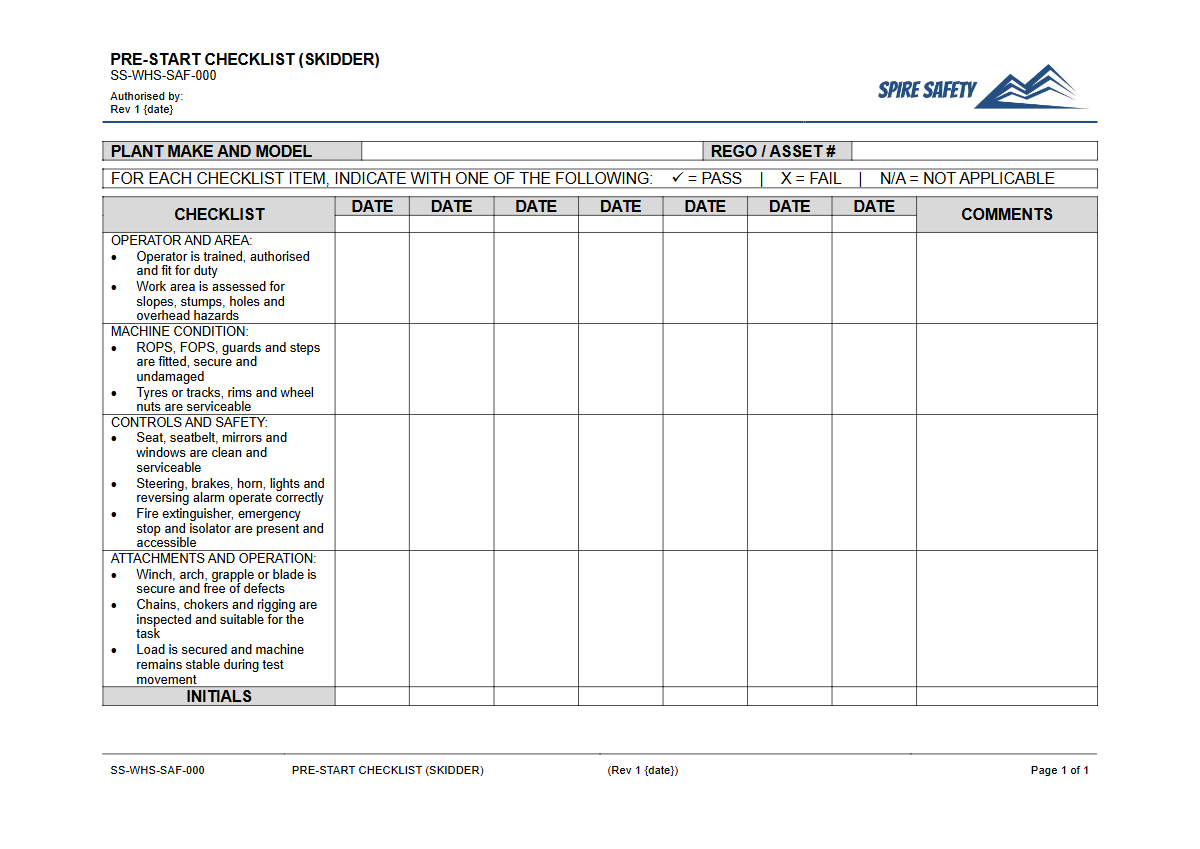
The checklist is logically sectioned, covering key areas like the engine, hydraulics, operator cabin, safety features (e.g., ROPS/FOPS, fire extinguisher), and attachments like grapples or winches.
The operator should walk around the machine, methodically inspecting each item listed and marking its condition as satisfactory or noting any defects. Any issues identified must be reported immediately according to your site's procedures, and the skidder should not be operated until it is deemed safe. Training operators on how to properly complete these checks is essential for the system to be effective; this can be reinforced with regular safety meetings, such as those facilitated by our Pre-Start Checks and Plant Maintenance Toolbox Talk.
Important: We have designed this template as a general guide. You must customise it to reflect the specific hazards, controls, manufacturer's recommendations, and operational context of your workplace.
Integrating this checklist into your site's broader safety protocols ensures it functions effectively as part of your overall safety management effort.
When to use it
A pre-start check must be completed before the skidder is used for the first time on any shift. This ensures that the machine's condition has not changed overnight and that it is safe to begin work.
It's a daily routine that should become second nature for every operator. It is also good practice to conduct a brief post-operation check to identify any damage that may have occurred during the shift, allowing for timely repairs.
Additionally, a full pre-start inspection should be performed after any significant maintenance or repair work has been completed to verify that the equipment is safe to return to service. This process often begins after a morning planning session or a free Pre-Start Meeting Template where daily tasks and hazards are discussed.
Who should use it
The pre-start checklist should be completed by a person who is competent to operate the skidder. This means they have received the necessary training, instruction, and information to understand the machine's functions and identify potential faults.
While the operator is primarily responsible for conducting the check, supervisors and managers have a duty to ensure the process is being followed correctly and that any reported defects are addressed promptly.
Completed checklists should be reviewed by a supervisor and retained as part of the organisation's safety records. This documentation is a critical element within comprehensive WHS management systems, providing evidence that safety procedures are being implemented consistently.
For organisations seeking to verify the effectiveness of their safety processes, these records are essential during a WHS compliance auditing process. If you need more templates or tools, you can browse our complete free WHS resources library for more downloads.
Common mistakes
Common mistakes to avoid
- "Pencil-whipping" the checklist without physically inspecting the machine.
- Using a generic checklist that doesn't cover the specific features of the skidder model.
- Failing to report identified defects or continuing to operate a faulty machine.
- Not retaining completed checklists for safety records and maintenance planning.
Legal references
Legal considerations
The following legal requirements may be relevant to this type of work.
- Work Health and Safety Act (Harmonised) — Provides the primary duties for protecting workers and other people from work health and safety risks.
- Work Health and Safety Regulations (Harmonised) — Sets out requirements supporting the management of workplace hazards and risks.
The following codes may be relevant to this type of work.
- Managing WHS Risks Code of Practice — Provides practical guidance on identifying hazards, assessing risks and applying effective controls.
- Work Health and Safety Consultation, Cooperation and Coordination Code of Practice — Provides practical guidance on consulting workers and coordinating with other duty holders.
- Managing the Work Environment and Facilities Code of Practice — Provides practical guidance on safe work environments, workplace facilities and related controls.
Did you know
Rollover Risk
Skidders have a high centre of gravity, making them particularly susceptible to rollovers, especially on steep or uneven terrain. This is why a functional Rollover Protective Structure (ROPS) is a non-negotiable safety feature checked in every pre-start.
Winch Hazards
The steel cables used on skidding winches can store enormous amounts of energy. A pre-start inspection must include checking the cable for fraying, kinks, or broken strands, as a failure under tension can be catastrophic.
FAQ
Frequently asked questions
01What should be included in a skidder pre-start checklist?
02How often should skidder pre-start checks be performed?
03What happens if a defect is found during a pre-start check?
04Is a generic pre-start checklist sufficient for a skidder?
Share this resource
Free Pre-Start Checklist (Skidder) Template
Browse Categories
How To Use It
- 1Download and open in Word or PDF.
- 2Replace the placeholders with your business details.
- 3Get it reviewed by a WHS specialist before rollout.
Need it customised?
Our WHS consultants can adapt this template to your site, run a gap analysis, or audit what you already have in place.
Book a Free Consultation WHS consulting servicesor call 1300 156 382