
Free Pre-Start Checklist (Sieve Bucket) Template
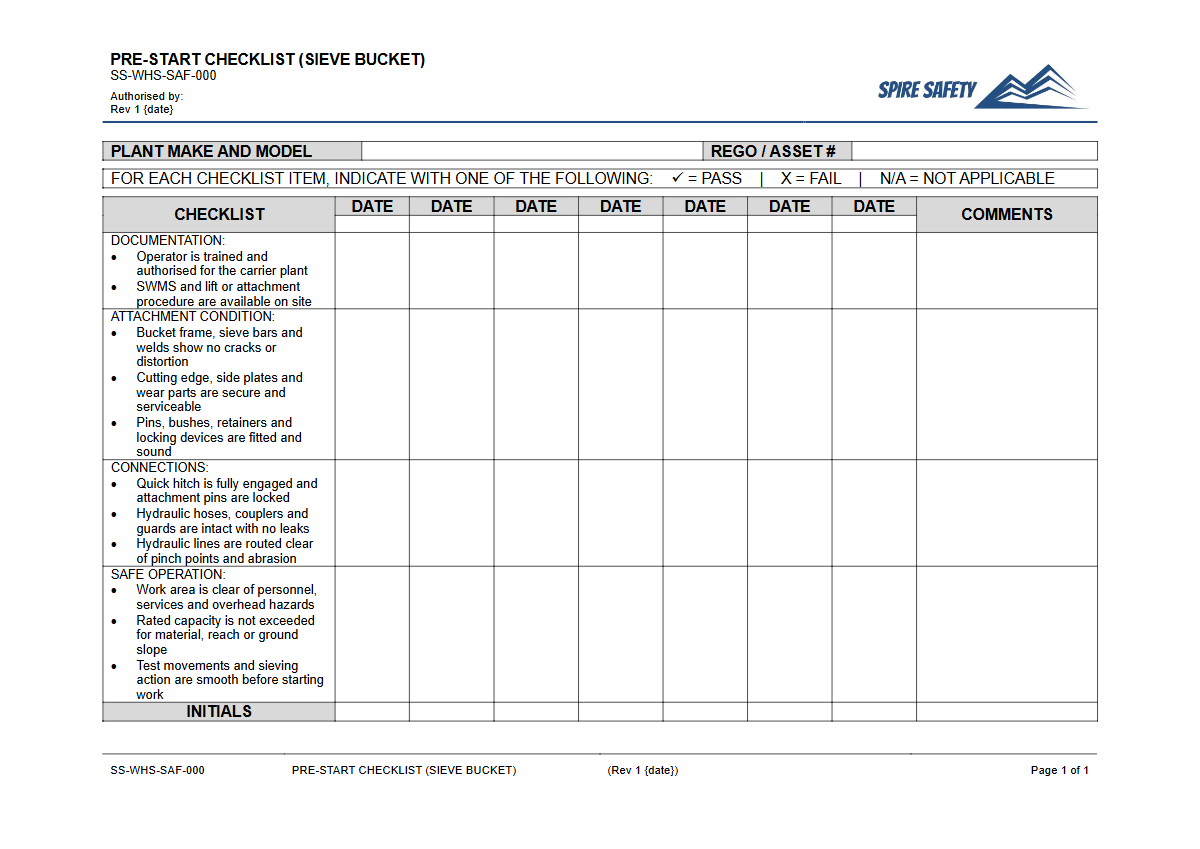
Download our free Pre-Start Checklist (Sieve Bucket) Template. This structured DOCX & PDF helps formalise equipment safety checks for excavator attachments.
Free Pre-Start Checklist (Sieve Bucket) Template
DOCX • 125 KB + PDF
Updated Oct 2026
No signup required
Purpose of the Free Pre-Start Checklist (Sieve Bucket) Template
Using a sieve bucket attachment on an excavator involves specific risks that differ from standard digging buckets. This Free Pre-Start Checklist (Sieve Bucket) Template provides a structured starting point for developing a formal inspection process tailored to this equipment.
Regular, documented checks are a critical control measure to ensure the structural integrity of the tines, welds, and mounting points before work commences, helping to identify potential faults that could lead to equipment failure or unexpected movement of materials.
A systematic pre-start inspection is a key part of a safe system of work for any piece of plant. The consequences of attachment failure can be catastrophic, as tragically demonstrated in a case where an excavator bucket fell and killed a worker. By implementing a daily check using a specific list, a Person Conducting a Business or Undertaking (PCBU) can demonstrate proactive steps to manage risks and fulfil their primary duty of care under WHS legislation.
This checklist helps formalise that process, ensuring operators do not overlook critical safety components.
Video walkthrough
How to use the Free Pre-Start Checklist (Sieve Bucket) Template
This resource is available for download as a DOCX file for easy editing and a PDF for straightforward printing. The DOCX version is designed to be a foundation for your site-specific document.
You should add your company branding, specific details of the sieve bucket models in use, and any unique hazards present at your worksite. The goal is to create a checklist that is practical, relevant, and easy for your operators to follow.
IMPORTANT: This document is a template and must be customised to suit the specific make and model of your sieve bucket, the excavator it's attached to, your site conditions, and your operational procedures. We cannot guarantee it will cover all hazards in your workplace.
This checklist should form part of your broader safety framework.
Effective pre-start checks are not a standalone activity; they are an integral component of comprehensive WHS management systems. The information gathered from these checks should be used to inform maintenance schedules, risk assessments, and operator training programs. A pattern of recurring faults on a checklist, for example, signals a need for a deeper investigation into the equipment's condition or how it is being used.
To ensure the checklist is used correctly and consistently, it's vital to train operators on each inspection point. A practical demonstration during a team meeting is an effective method.
You can facilitate this discussion using a Pre-Start Checks and Plant Maintenance Toolbox Talk to reinforce the importance of the procedure and explain how to correctly identify and report defects.
When to use it
The Sieve Bucket Pre-Start Checklist should be completed by the operator before the plant is used for the first time each day or at the beginning of each shift. This ensures a consistent baseline of safety is established before any work involving the attachment begins.
The check should be conducted in good light where the entire attachment can be safely inspected.
Beyond daily checks, the list should also be used whenever the attachment is swapped onto a machine. This is critical for verifying that the connection—whether a quick hitch or manual pins—is secure. Completed checklists should be retained as a record of your organisation's safety diligence and can be discussed as part of daily site safety briefings, which can be documented with a pre-start meeting template.
Who should use it
The primary user of this checklist is the trained and competent excavator operator. A 'competent' operator is someone who not only has the skill to operate the machinery but also the knowledge to accurately inspect its components and recognise the signs of wear, damage, or potential failure.
They are the first line of defence against equipment-related incidents.
Supervisors and site managers also have a role in overseeing the process. They should periodically review completed checklists to ensure they are being filled out correctly and that any reported defects are being addressed through the appropriate maintenance and repair channels.
These reviews can be incorporated into regular WHS compliance audits to verify the system's effectiveness.
This checklist is one part of a suite of essential safety documents. It should be used in conjunction with the manufacturer's instructions and the overarching risk assessment for the task. For high-risk activities, a detailed procedure is often documented in a Safe Work Method Statement, such as this example SWMS for concrete truck operations.
Integrating new safety procedures like this one into your existing systems can sometimes present challenges. If your organisation requires assistance in developing, implementing, or reviewing your plant safety protocols to align with Australian WHS standards, engaging specialist WHS consulting can provide valuable expertise and support.
Common mistakes
Common mistakes to avoid
- Ignoring small cracks in welds, which can quickly propagate under load and lead to catastrophic failure.
- Only glancing at the quick hitch without physically checking for play or proper pin engagement.
- Using a generic excavator checklist that doesn't include inspection points specific to the sieve bucket's tines and structure.
- Ticking boxes without performing the actual inspection, and failing to document or quarantine equipment when defects are found.
Legal references
Legal considerations
The following legal requirements may be relevant to this type of work.
- Work Health and Safety Act (Harmonised) — Provides the primary duties for protecting workers and other people from work health and safety risks.
- Work Health and Safety Regulations (Harmonised) — Sets out requirements supporting the management of workplace hazards and risks.
The following codes may be relevant to this type of work.
- Managing WHS Risks Code of Practice — Provides practical guidance on identifying hazards, assessing risks and applying effective controls.
- Work Health and Safety Consultation, Cooperation and Coordination Code of Practice — Provides practical guidance on consulting workers and coordinating with other duty holders.
- Managing the Work Environment and Facilities Code of Practice — Provides practical guidance on safe work environments, workplace facilities and related controls.
Did you know
Also Known As...
Sieve buckets are often referred to as skeleton buckets or shaker buckets due to their grid-like design used for sorting materials like rock, soil, and demolition debris.
Attachment Risks
According to Safe Work Australia data, a significant portion of workplace fatalities involving machinery are due to being hit by moving objects. Unsecured or failing attachments are a major contributor to this risk category.
FAQ
Frequently asked questions
01Why is a specific pre-start checklist needed for a sieve bucket?
02What are the most critical checks for a sieve bucket attachment?
03Who is responsible for completing the sieve bucket pre-start checklist?
04How often should a sieve bucket pre-start check be performed?
Share this resource
Free Pre-Start Checklist (Sieve Bucket) Template
Browse Categories
How To Use It
- 1Download and open in Word or PDF.
- 2Replace the placeholders with your business details.
- 3Get it reviewed by a WHS specialist before rollout.
Need it customised?
Our WHS consultants can adapt this template to your site, run a gap analysis, or audit what you already have in place.
Book a Free Consultation WHS consulting servicesor call 1300 156 382