
Free Pre-Start Checklist (Separator) Template
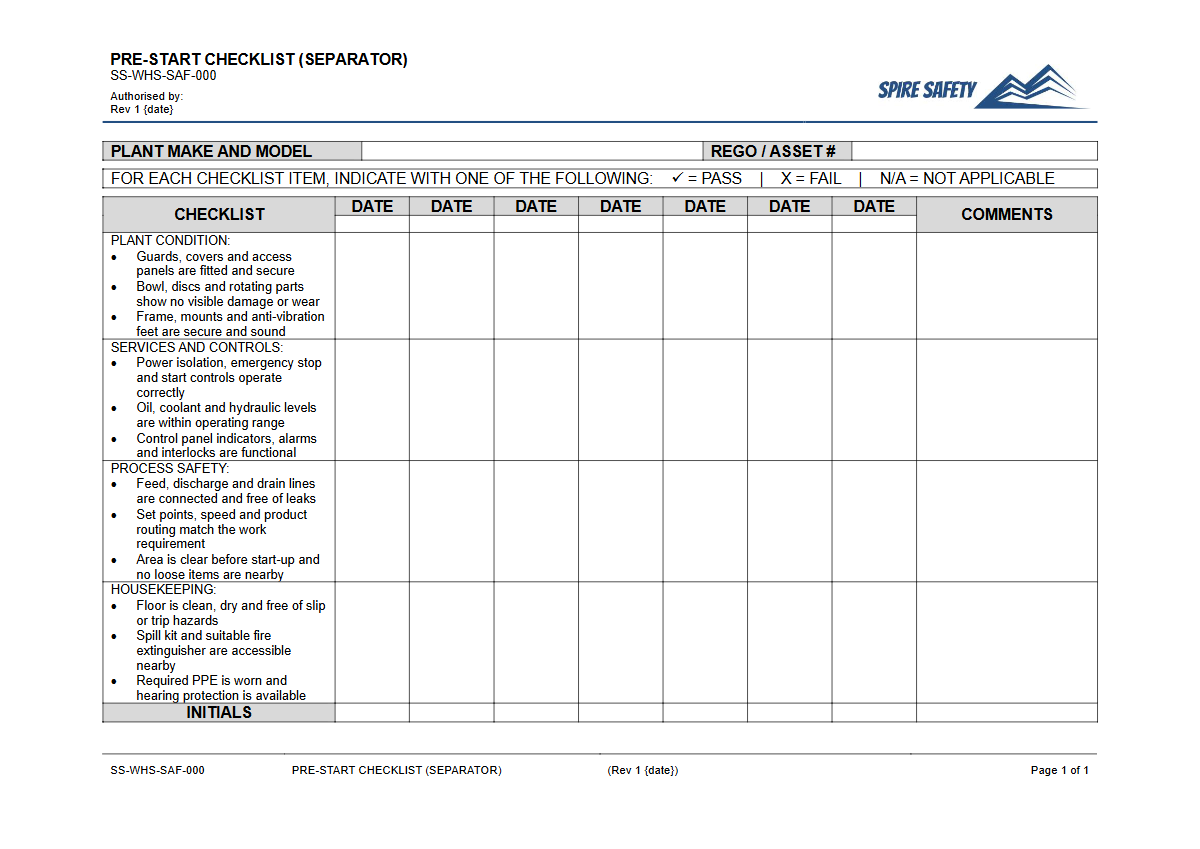
Download our free Pre-Start Checklist (Separator) Template in DOCX & PDF. A structured starting point for improving equipment safety and compliance.
Free Pre-Start Checklist (Separator) Template
DOCX • 125 KB + PDF
Updated Oct 2026
No signup required
Purpose of the Free Pre-Start Checklist (Separator) Template
Regularly inspecting industrial separators is a critical step in maintaining a safe work environment. This free Pre-Start Checklist (Separator) Template provides a structured framework for operators to conduct thorough, documented inspections before operating equipment.
Using a checklist helps formalise the process, ensuring no critical safety or operational checks are missed. It serves as a practical tool to help a Person Conducting a Business or Undertaking (PCBU) meet their primary duty of care obligations under Australian WHS laws.
Consistent pre-start checks help identify potential hazards, defects, or maintenance needs before they escalate into equipment failure, production downtime, or a serious incident. They verify that safety features like guards, emergency stops, and interlocks are functioning correctly.
This process is a fundamental part of any effective plant and equipment safety program. To help communicate these principles to your team, consider using our Pre-Start Checks and Plant Maintenance Toolbox Talk Template to reinforce safe work practices.
Video walkthrough
How to use the Free Pre-Start Checklist (Separator) Template
This resource is available as a fully editable DOCX file and a ready-to-use PDF. The DOCX version is designed to be adapted to your specific operational needs.
A generic checklist is a good start, but true effectiveness comes from customisation.
Important Note: We have provided a comprehensive starting point based on common safety principles, but it is essential that you customise this template. You must adapt it to reflect the specific make and model of your separator(s), your unique work environment, the substances being processed, and your organisation's internal safety procedures.
If you require assistance in developing site-specific documentation, our WHS consulting services can provide expert guidance.
When customising, consider adding checks relevant to:
- The type of separator (e.g., centrifugal, magnetic, vibrating screen, hydrocyclone).
- Specific guards, covers, and access panels.
- Fluid levels, lubrication points, and pressure gauges.
- Electrical components, including wiring, control panels, and isolation switches.
- The surrounding work area, such as housekeeping, spills, and clear access.
The process for using other equipment-specific checklists is similar, such as our Free Pre-Start Checklist (Agitator) Template, which also requires tailoring to the specific plant in use.
When to use it
The separator pre-start checklist should be completed by the operator before the start of every shift or before the first use of the equipment on any given day. This routine establishes a consistent baseline for equipment condition.
If multiple operators use the same machine during a day, a handover process should include a review of the checklist. These checks can be discussed as part of daily team briefings, which can be formalised using a free Pre-Start Meeting Template.
Completed checklists become valuable records. They provide evidence of due diligence, track the equipment's condition over time, and can help identify recurring issues that may signal a need for more intensive maintenance or operator retraining.
Integrating these daily checks into broader WHS management systems creates a proactive and documented approach to safety.
Who should use it
This Pre-Start Checklist should be used by workers who are trained, competent, and authorised to operate the specific separator. Competency isn't just about knowing how to turn the machine on; it involves understanding its functions, limitations, and associated hazards.
Supervisors and managers should also be familiar with the checklist to review completed forms, supports your compliance efforts with the procedure, and take prompt action on any reported defects or concerns.
During safety audits, these completed records are often reviewed to verify that safety procedures are being followed correctly. An auditor will check for consistency, completion, and evidence that identified issues were properly closed out.
If your organisation requires a formal review of its safety processes, consider engaging professional WHS compliance auditing services to assess the effectiveness of your current practices. Ultimately, this tool is for anyone responsible for the safe operation and maintenance of separator equipment.
Common mistakes
Common mistakes to avoid
- Using a generic checklist that doesn't cover model-specific safety features.
- Completing the checklist from memory without physically inspecting the equipment (a 'tick and flick' exercise).
- Failing to report identified defects or continuing to operate faulty equipment.
- Not providing adequate training to operators on how to properly conduct each check.
Legal references
Legal considerations
The following legal requirements may be relevant to this type of work.
- Work Health and Safety Act (Harmonised) — Provides the primary duties for protecting workers and other people from work health and safety risks.
- Work Health and Safety Regulations (Harmonised) — Sets out requirements supporting the management of workplace hazards and risks.
The following codes may be relevant to this type of work.
- Managing WHS Risks Code of Practice — Provides practical guidance on identifying hazards, assessing risks and applying effective controls.
- Work Health and Safety Consultation, Cooperation and Coordination Code of Practice — Provides practical guidance on consulting workers and coordinating with other duty holders.
- Managing the Work Environment and Facilities Code of Practice — Provides practical guidance on safe work environments, workplace facilities and related controls.
Did you know
A Dairy Innovation
The first continuous centrifugal separator was invented by Gustaf de Laval in 1878 to separate cream from milk. This invention revolutionised the dairy industry and laid the groundwork for separator technology now used across countless sectors, from pharmaceuticals to wastewater treatment.
Machinery Hazards
According to Safe Work Australia, machinery and fixed plant are consistently one of the leading causes of serious workplace injury claims. Entanglement, being hit by moving parts, and crushing are common mechanisms of injury that regular pre-start checks help to prevent.
FAQ
Frequently asked questions
01What is a separator pre-start checklist used for?
02Is it a legal requirement to use a pre-start checklist in Australia?
03How often should a separator pre-start check be done?
04Can this template be used for any type of separator?
Share this resource
Free Pre-Start Checklist (Separator) Template
Browse Categories
How To Use It
- 1Download and open in Word or PDF.
- 2Replace the placeholders with your business details.
- 3Get it reviewed by a WHS specialist before rollout.
Need it customised?
Our WHS consultants can adapt this template to your site, run a gap analysis, or audit what you already have in place.
Book a Free Consultation WHS consulting servicesor call 1300 156 382